
PHP Career & Tech Stack Advisor
Not sure whether to stick with PHP, switch to Node.js, or try something else? Answer a few questions about your goals and project type to get a personalized recommendation.
Awaiting Input...
Fill out the form to see which technology stack fits your needs best.
You’ve probably heard it at tech meetups or read it in a snarky Twitter thread: "PHP is dead." It’s one of the most persistent myths in software engineering. Yet, if you look at the data, a server-side scripting language designed for web development, powers nearly 75% of all websites on the internet. So, why does everyone talk about it like it’s a relic from the dial-up era?
The truth isn’t that people stopped using PHP because it broke. They stopped talking about it because they moved on to shinier toys, and because PHP spent two decades earning a reputation for being messy before it cleaned up its act. If you’re wondering whether you should learn it, stick with it, or switch to something else, this guide breaks down exactly what happened, why the narrative shifted, and where PHP actually stands today.
The Great Migration to JavaScript
Let’s be honest: the biggest reason PHP lost its cultural dominance wasn’t technical-it was social. In the mid-2010s, Node.js arrived, and suddenly, developers could use JavaScript on both the frontend and the backend. This created the concept of the "Full Stack JavaScript Developer," which sounded incredibly efficient to hiring managers.
Before Node.js, if you wanted to build a modern app, you needed two different brains: one for the browser (JavaScript) and one for the server (PHP). Node.js promised a unified ecosystem. Startups loved it. Venture capitalists loved it. Developers who were tired of context-switching loved it. Even though PHP was perfectly capable of handling high-load servers, the industry narrative shifted toward "one language to rule them all."
This didn’t mean PHP disappeared. It meant PHP became boring. And in tech, boring often gets mistaken for obsolete. While everyone was tweeting about React hooks and Next.js, PHP quietly continued running WordPress, Facebook, and Slack backends. But nobody writes viral blog posts about stable, boring infrastructure.
The Legacy Code Problem
If you’ve ever opened a PHP file written in 2009, you know the pain. Back then, PHP 5 lacked many modern conveniences we take for granted today. There were no strict types, no namespaces, and no built-in way to handle asynchronous tasks elegantly.
Developers would mix HTML directly into their logic, create global variables everywhere, and rely on inconsistent function naming conventions. One function might be called `mysql_connect`, while another was `mysqli_query`. This inconsistency made large codebases feel like archaeological digs. You’d spend more time deciphering old code than writing new features.
| Era | Dominant Version | Key Characteristics | Industry Sentiment |
|---|---|---|---|
| 2000-2014 | PHP 5.x | Inconsistent APIs, weak typing, mixed HTML/logic | "Quick and dirty," widely used but criticized |
| 2015-2019 | PHP 7.x | Significant performance boost (2x faster), scalar type hints | Respect returning, but still seen as "old school" |
| 2020-Present | PHP 8.x | JIT compiler, union types, named arguments, attributes | Modern, robust, competitive with other backends |
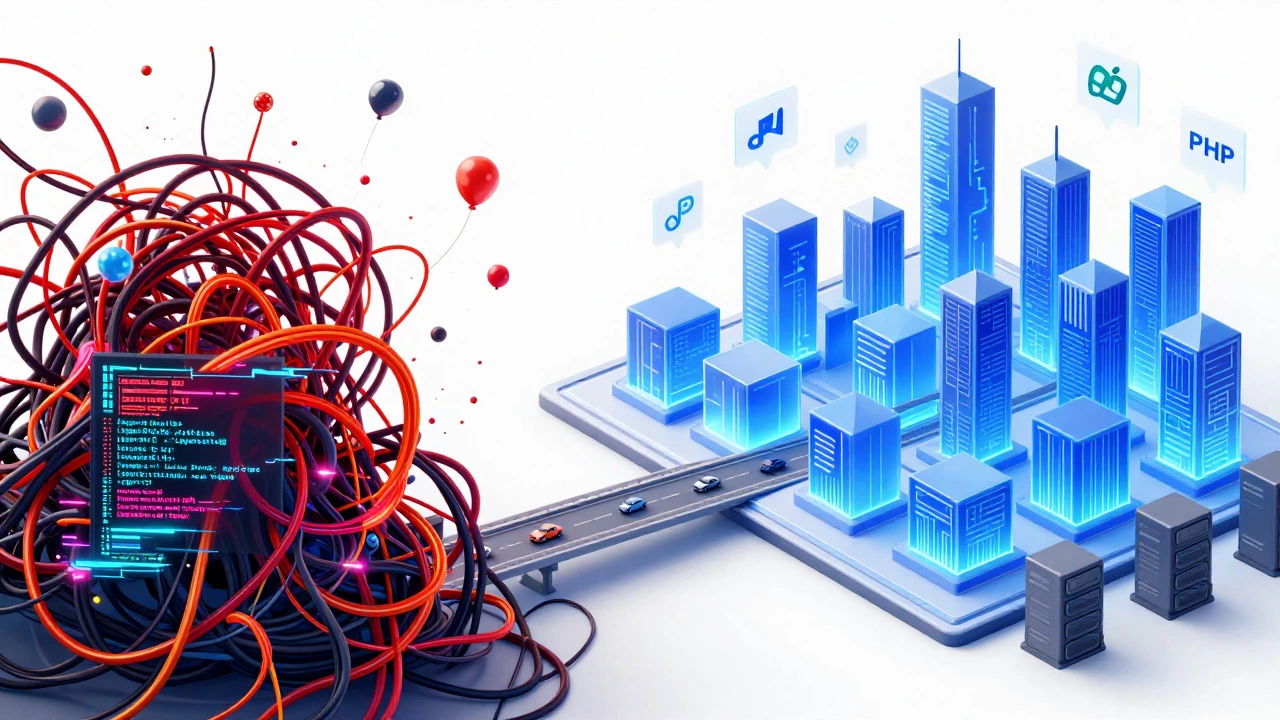
When newer frameworks like Ruby on Rails or Django emerged, they offered cleaner syntax and stricter conventions. For a junior developer choosing their first stack, Django felt structured and safe. PHP felt like the Wild West. That perception stuck, even after PHP improved dramatically.
The Rise of Specialized Backend Languages
Web development isn’t just about serving HTML pages anymore. We have real-time chat apps, machine learning pipelines, and microservices architectures. Different problems require different tools.
For example, if you’re building a system that needs heavy concurrency-like a live trading platform-Go or Elixir are often better choices than PHP. Go compiles to a single binary and handles thousands of concurrent connections with ease. Elixir runs on the Erlang VM, which was designed for telecom switches that need 99.999% uptime.
Does this mean PHP can’t do these things? No. Laravel Octane allows PHP to run persistently, improving performance significantly. But when a startup pitches investors, saying "We use Go for our microservices" sounds more cutting-edge than "We use Laravel." The shift away from PHP wasn’t always about capability; it was about signaling innovation.
WordPress Didn’t Help the Image
You can’t discuss PHP without discussing WordPress. It’s the elephant in the room. WordPress powers over 40% of the entire web, and it runs on PHP. For years, non-developers used page builders and plugins to create sites without writing a line of code.
This accessibility was a double-edged sword. On one hand, it kept PHP relevant. On the other, it associated PHP with low-quality, bloated websites. When a serious engineer saw a site running PHP, they often assumed it was a poorly maintained WordPress blog rather than a sophisticated custom application. This stigma drove many talented developers away from PHP ecosystems, fearing their work wouldn’t be taken seriously by peers.
However, this view is outdated. Modern Laravel applications are clean, testable, and scalable. Frameworks like Symfony provide enterprise-grade architecture. But breaking a decade-long stereotype takes time.

Why PHP Is Actually Making a Comeback
Here’s the twist: PHP isn’t dying. It’s evolving. Since the release of PHP 7, the language has undergone massive improvements. PHP 8 introduced features that make it genuinely pleasant to write:
- Union Types: You can now declare functions that accept multiple data types safely.
- Attributes: A native way to add metadata to classes and methods, replacing complex annotations.
- Named Arguments: Makes calling functions with many parameters much clearer.
- JIT Compiler: Improves performance for CPU-intensive tasks, closing the gap with compiled languages.
Moreover, the tooling around PHP has matured. Composer (the package manager) works flawlessly. Static analysis tools like PHPStan catch bugs before they hit production. IDEs like PhpStorm offer intelligent refactoring capabilities that rival those in Java or C#.
Developers are realizing that productivity matters more than hype. With Laravel, you can scaffold a secure, feature-rich API in minutes. The community is active, documentation is excellent, and deployment is straightforward. For small-to-medium businesses, PHP remains the fastest path from idea to launch.
Should You Learn PHP in 2026?
If you’re asking this question, you’re likely weighing your career options. Here’s a practical breakdown:
Choose PHP if:
- You want to get hired quickly. The job market for PHP developers is huge, especially for maintenance and legacy systems.
- You’re interested in freelancing. WordPress and Laravel projects dominate freelance platforms.
- You prefer simplicity. Setting up a LAMP stack (Linux, Apache, MySQL, PHP) is easier than configuring Kubernetes clusters for microservices.
Look elsewhere if:
- You’re targeting big tech companies that prioritize internal tools built in Go, Java, or Python.
- You’re deeply into machine learning or data science, where Python is king.
- You want to work exclusively on real-time, event-driven systems where Node.js or Elixir shine.
The "death" of PHP was exaggerated. What actually happened was a correction. The bubble of early-2000s PHP sprawl burst, replaced by a modern, disciplined ecosystem. Today’s PHP developer writes code that looks surprisingly similar to modern Java or C#, with strong typing and object-oriented principles.
Is PHP really dead in 2026?
No, PHP is not dead. It still powers approximately 75% of all websites with known server-side programming languages. While its popularity among new startups has decreased relative to Node.js and Python, it remains dominant in content management systems like WordPress and enterprise applications built with Laravel or Symfony.
Why did developers dislike PHP in the past?
Developers disliked older versions of PHP (particularly PHP 5) due to inconsistent function naming, lack of strict typing, and poor support for object-oriented programming. Mixing HTML with logic also led to unmaintainable "spaghetti code." These issues have largely been resolved in PHP 7 and 8.
Is PHP harder to learn than JavaScript?
Generally, no. Many beginners find PHP easier because it is simpler to set up locally and doesn't require managing complex build tools initially. However, mastering modern PHP requires understanding object-oriented principles, dependency injection, and framework-specific patterns, which adds complexity.
What are the main alternatives to PHP?
The primary alternatives include Node.js (JavaScript), Python (Django/Flask), Ruby (Rails), Java (Spring Boot), and Go. Each serves different niches: Node.js for real-time apps, Python for data-heavy tasks, and Java/Go for large-scale enterprise systems.
Will PHP disappear in the next 5 years?
It is highly unlikely. Given the massive installed base of WordPress sites and legacy enterprise applications, PHP will remain relevant for at least the next decade. Furthermore, active development continues with regular releases introducing modern features, ensuring it stays competitive.