
JavaScript Mastery Timeline Calculator
Set Your Study Plan
How many hours can you commit to JavaScript learning each week?
What This Means For You
Enter your weekly hours to see your personalized timeline.
Key Takeaways
Real mastery isn't about speed — it's about consistent, focused practice. The article emphasizes understanding core JavaScript concepts rather than just framework usage.
- 3 Months 20-25 hours/week = Realistic target for core JavaScript mastery
- 10 hours/week 6-8 months = Achievable with disciplined practice
- Less than 5 hours/week 9+ months = Requires significant adjustment to your learning strategy
Can you really master JavaScript in three months? The short answer: yes - if you know what mastery means and how to train for it. Not the kind of mastery that lets you recite every ES2025 feature, but the kind that lets you build real apps, fix bugs fast, and read documentation without panicking. This isn’t about memorizing syntax. It’s about building muscle memory in your brain.
What Does "Mastering JavaScript" Actually Mean?
Most people think mastering JavaScript means knowing every library, framework, and tool. That’s a trap. You don’t need to know React, Vue, and Angular to master JavaScript. You need to understand how JavaScript works under the hood.Real mastery means:
- Writing clean, reusable functions without copying Stack Overflow
- Debugging async code without console.log hell
- Understanding closures, prototypes, and the event loop without googling them
- Building a full project from scratch - not just following a tutorial
- Reading MDN docs like a native language
That’s the bar. Not frameworks. Not tools. Just JavaScript.
The 3-Month Roadmap: Realistic, Not Rushed
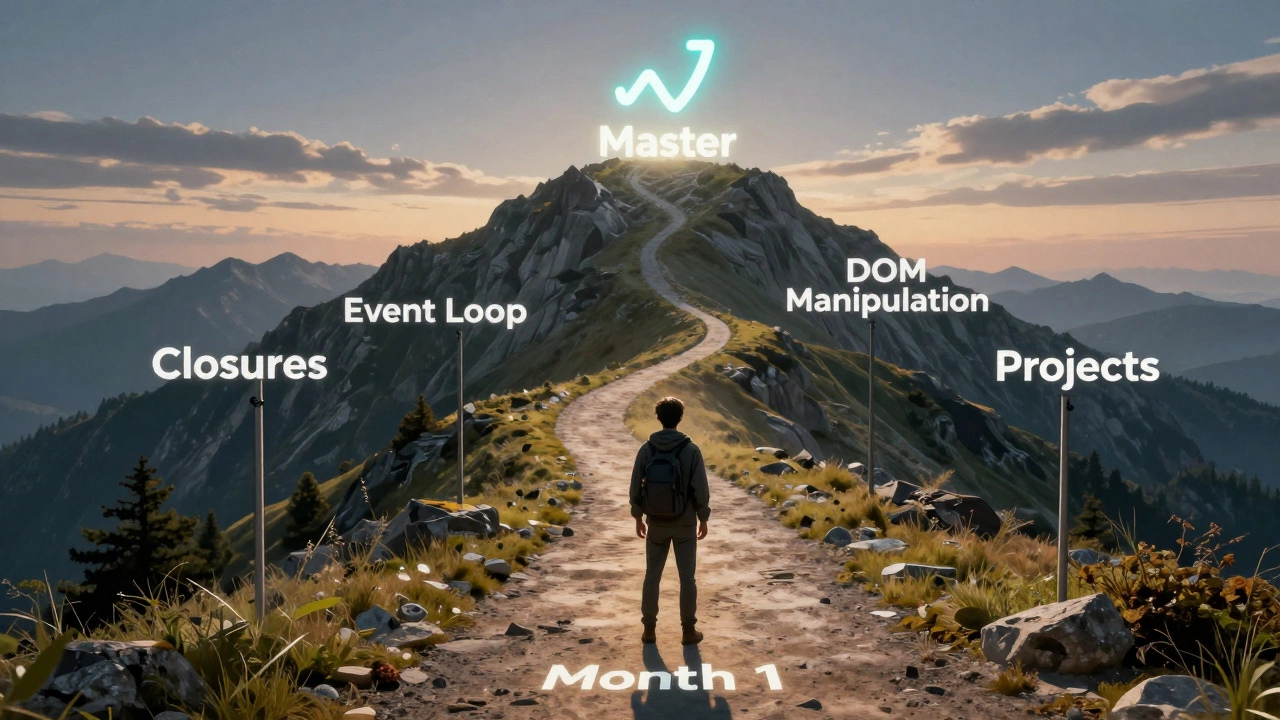
Three months is enough if you treat it like a full-time job - 20 to 25 hours a week. No shortcuts. No "learn in 7 days" nonsense. Here’s what that looks like:- Month 1: Core Language - Variables, functions, conditionals, loops, arrays, objects. Then dive into scope, closures, and hoisting. Don’t skip these. They’re the foundation. Use JavaScript a high-level, dynamic programming language primarily used for web development, with support for object-oriented, functional, and imperative styles in the browser. Write 5 small projects: a to-do list, a calculator, a quiz app, a weather widget, a simple game.
- Month 2: DOM, Events, and Async - Learn how the browser talks to JavaScript. Manipulate elements. Handle clicks, forms, and input. Then tackle promises, async/await, and fetch. Build a weather app that pulls data from a public API. Make a photo gallery that loads images on scroll. Break things. Fix them. Again.
- Month 3: Projects, Projects, Projects - No more tutorials. Build three full apps: a note-taking app with local storage, a budget tracker with charts, and a real-time chat app using WebSockets (or a mock). Deploy them. Break them. Improve them. This is where you stop being a student and start being a developer.
Every project should be built from scratch. No copy-pasting GitHub repos. Type every line. Even if it takes twice as long. That’s the point.
What You Should Avoid
Here’s what kills progress in month two:
- Jumping into React before you understand vanilla JS
- Using a framework’s boilerplate as your "learning environment"
- Watching videos instead of typing code
- Chasing shiny tools instead of deep understanding
- Comparing yourself to someone who’s been coding for five years
One person I know spent six months learning React before realizing he couldn’t write a simple function to filter an array. He didn’t know how map() worked. He just knew how to import components.
Tools and Resources That Actually Help
You don’t need 10 courses. You need a few trusted sources:
- MDN Web Docs - The official, accurate, no-fluff reference. Bookmark it.
- JavaScript.info - Clear explanations with interactive examples.
- freeCodeCamp - The JavaScript algorithms section is gold.
- Replit or CodePen - For quick testing without setup.
- Dev.to - Read real developer stories, not tutorials.
Don’t use YouTube playlists that promise "JavaScript in 2 hours." They’re designed to keep you watching, not learning.
How to Measure Progress
Don’t ask "Am I good yet?" Ask these instead:
- Can I explain how
thisworks without looking it up? - Can I write a function that sorts an array of objects by a nested property?
- Can I debug a race condition in async code without asking for help?
- Have I built something that someone else could use?
If you can answer yes to these, you’re ahead of 90% of people who say they "know JavaScript."
What Comes After Three Months?
Mastering JavaScript in three months doesn’t mean you’re done. It means you’re ready.
Now you can:
- Learn Node.js to build back-end services
- Understand REST APIs and how to consume them
- Get comfortable with npm and package management
- Start exploring React or Vue - not as a crutch, but as a tool
- Build a portfolio that shows real problem-solving, not just pretty UIs
The difference between a beginner and a developer isn’t the number of frameworks they’ve used. It’s how deeply they understand the language underneath.
Common Myths Debunked
Myth: You need a CS degree to master JavaScript.
Truth: Most self-taught developers outperform CS grads in real-world coding because they’ve built things, not just studied theory.
Myth: JavaScript is easy, so it’s not worth mastering.
Truth: JavaScript is deceptively simple. Its quirks - like type coercion, hoisting, and event bubbling - trip up even senior engineers. Mastering it means you understand why these quirks exist.
Myth: You need to learn TypeScript first.
Truth: TypeScript is great - but only if you already know JavaScript. Learn the language first. Then add types.
Final Thought: It’s Not About Speed - It’s About Depth
Three months isn’t a deadline. It’s a starting line. The people who master JavaScript in that time aren’t the fastest. They’re the most consistent. They show up every day. They build something, even if it’s small. They fail, fix it, and try again.
You don’t need to be brilliant. You just need to be stubborn.
Can I master JavaScript in 3 months if I only have 10 hours a week?
Yes - but it’ll take longer than three months. With 10 hours a week, you’re looking at 6 to 8 months to reach true mastery. Focus on depth over speed. Build one solid project every two weeks. It’s better to deeply understand five projects than to rush through twenty.
Do I need to learn HTML and CSS before JavaScript?
You need basic HTML to practice JavaScript in the browser. You don’t need to be a CSS expert, but you should know how to structure a page, link stylesheets, and use classes and IDs. Learn enough HTML to create a form, a list, and a button. Then start manipulating them with JavaScript. CSS can come later.
What’s the biggest mistake beginners make when learning JavaScript?
They skip the fundamentals and jump straight into frameworks. React doesn’t teach you how JavaScript works. It hides it. You’ll end up copying code without understanding why it works. Master closures, scope, and async first. Then frameworks will make sense.
Is JavaScript enough to get a job?
Yes - if you can demonstrate real skills. Many junior front-end roles only require strong JavaScript, basic HTML/CSS, and one framework like React. But employers care more about what you’ve built than what you’ve studied. A portfolio with three solid apps beats a certificate with ten courses.
Should I use VS Code or another editor?
Use VS Code. It’s free, fast, and has excellent JavaScript support with IntelliSense, debugging tools, and extensions like Prettier and ESLint. But don’t get distracted by themes or plugins. The editor doesn’t make you a developer - your practice does.
How do I stay motivated when I hit a wall?
Switch projects. If you’re stuck on a to-do app, build a meme generator. If you’re tired of DOM manipulation, try making a simple game with canvas. Fun beats frustration. Also, join a community - even a small Discord group. Talking to others who are struggling helps you realize you’re not alone.
Next Steps
Start today. Open your editor. Write one function. Then another. Then a third. Don’t wait for the perfect plan. Don’t wait for the perfect time. You don’t need permission to become a developer. You just need to start.
Three months from now, you’ll look back and wonder why you ever doubted it.