JavaScript Ecosystem Compatibility Checker
Check Technology Integration
Discover how different technologies work alongside JavaScript rather than replacing it. Enter a technology name to see its relationship with JavaScript.
Technology Integration Analysis
Every few months, someone asks if JavaScript is dying. Another framework rises. Another language claims to be the "next big thing." And suddenly, headlines scream: JavaScript is being replaced. But here’s the truth - it’s not. Not even close.
Why people think JavaScript is fading
It’s easy to see why the idea sticks. You’ve probably heard about:
- WebAssembly letting C++ and Rust run in browsers
- Python gaining ground in web backends with FastAPI
- Flutter and React Native pushing mobile apps away from web views
- AI tools writing code for you - sometimes without JavaScript at all
And sure, those things are real. But they’re not replacing JavaScript. They’re working alongside it.
Take WebAssembly. It’s fast. Really fast. It lets you run compiled code in the browser - great for games, video editors, CAD tools. But guess what? Over 90% of WebAssembly projects still use JavaScript to glue everything together. The WASM module doesn’t handle buttons, forms, or state. JavaScript does. WebAssembly is a turbocharger. JavaScript is still the engine.
JavaScript’s grip on the web is stronger than ever
Let’s look at the numbers. In 2025, over 98% of websites used JavaScript. That’s not a trend. That’s a standard. Even sites built with Svelte, SolidJS, or Astro? They still compile down to JavaScript. The browser doesn’t understand Svelte. It understands JavaScript.
Think about what happens when you load a page. You click a button. A modal pops up. A form validates. A video loads. All of that? JavaScript. Not Python. Not Rust. Not HTML alone. JavaScript.
And it’s not just websites. It’s everything:
- Over 70% of the top 10 million websites use React
- Node.js powers over 60% of backend services on npm
- Electron apps like Slack, VS Code, and Discord? Built with JavaScript
- Even smart TVs, car infotainment systems, and ATMs? Many run JavaScript
There’s no other language that runs on the browser, the server, the desktop, and embedded devices. JavaScript isn’t just popular - it’s universal.
What’s actually changing? Not the language. The tools.
The real shift isn’t JavaScript being replaced. It’s how we use it.
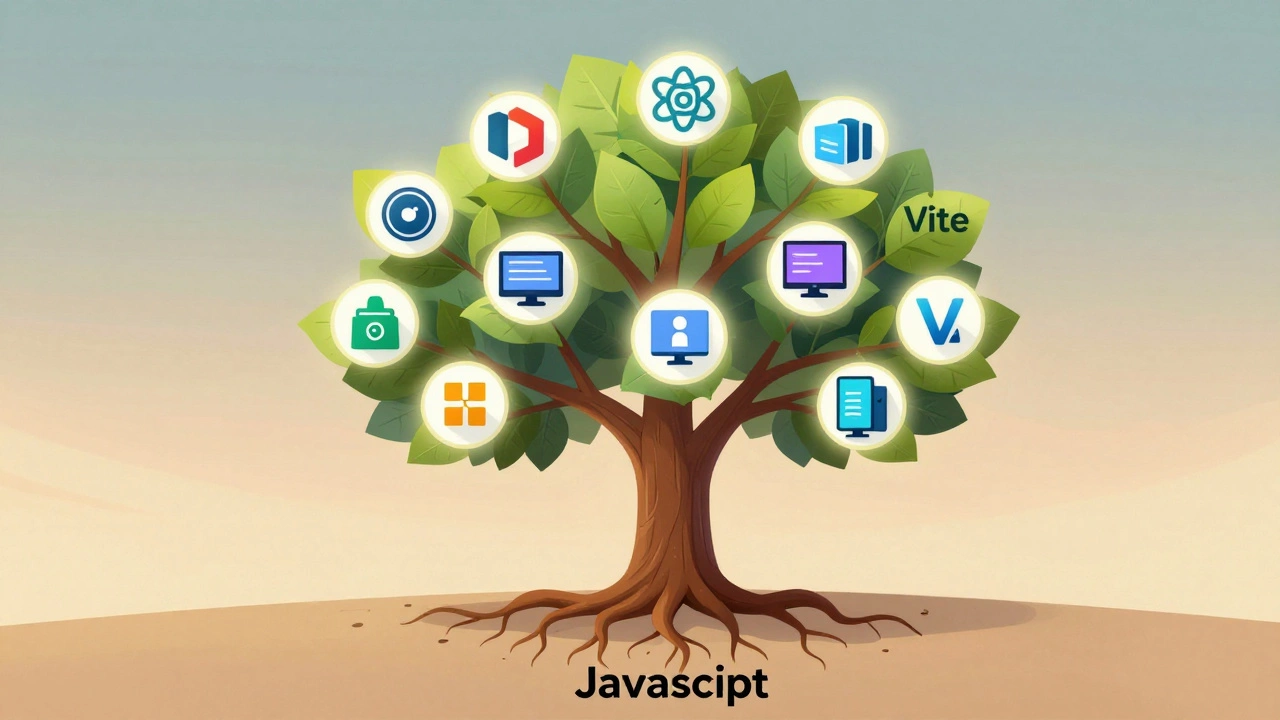
Five years ago, you needed to manually bundle files, polyfill older browsers, and debug minified code. Now? You write React components. You use Vite. You deploy with Netlify. The complexity is hidden - but JavaScript is still doing the work.
Frameworks like Svelte and SolidJS are making JavaScript development faster and simpler. But they don’t remove JavaScript. They make it more powerful. Svelte compiles your code into efficient vanilla JavaScript. SolidJS uses fine-grained reactivity to cut down on rendering overhead. Both are still JavaScript - just smarter.
And then there’s AI. Tools like GitHub Copilot or Amazon CodeWhisperer can generate JavaScript for you. You say, "Make a responsive navbar," and it writes the code. But you still need to understand what it wrote. You still need to debug it. You still need to know how events, closures, and async/await work. AI doesn’t replace JavaScript. It just makes you better at using it.
WebAssembly and Rust aren’t enemies - they’re partners
WebAssembly (WASM) is often pitched as JavaScript’s replacement. But that’s like saying diesel engines replaced cars. They didn’t. They just made them faster.
WASM excels at heavy lifting: image compression, physics engines, real-time audio processing. But it’s terrible at DOM manipulation. It can’t handle user input. It can’t fetch data from an API. It can’t change a button’s color. For that, you need JavaScript.
Companies like Figma and Adobe use WASM to run complex design tools in the browser. But the UI? The menus? The layer panel? That’s all JavaScript. WASM handles the heavy math. JavaScript handles everything else.
And Rust? Rust is great for writing WASM modules. But Rust doesn’t run in browsers natively. It compiles to WASM. And then JavaScript calls it. So again - JavaScript is the bridge.
What about Python or Go? Can they take over?
Python is great for data science, automation, and backends. But it doesn’t run in the browser. You can’t use Python to make a dropdown menu work. You can’t use it to validate a login form in real time. Tools like Pyodide let you run Python in the browser - but they’re slow, bulky, and still rely on JavaScript to connect to the DOM.
Go is fast and simple. But Go doesn’t have a browser runtime. You can’t deploy a Go app as a website without compiling it to WASM - and even then, you still need JavaScript to make it useful.
There’s no language that matches JavaScript’s reach. Not now. Not in 2026.

JavaScript isn’t dying. It’s evolving
JavaScript has changed a lot since 2009. ES5? Gone. ES2024? Standard. Arrow functions, modules, optional chaining, top-level await - all of these made JavaScript cleaner, safer, and more powerful.
And it’s still changing. The TC39 committee keeps adding features. The community keeps building better tools. The ecosystem keeps growing.
Here’s what’s happening now:
- Modern bundlers like Vite and Turbopack cut build times by 80%
- React Server Components let you render on the server without sending JavaScript to the client
- ESM (ECMAScript Modules) is now native in browsers - no more Webpack needed
- JavaScript’s performance is 5x faster than it was in 2015
These aren’t signs of decline. They’re signs of maturity.
Should you still learn JavaScript in 2026?
Yes. Absolutely.
If you want to build websites - front end, back end, or full stack - JavaScript is non-negotiable. You can’t avoid it. Not anymore. Not ever.
Start with HTML and CSS. Then learn JavaScript. Not just the basics. Learn how to:
- Handle events and DOM manipulation
- Use fetch() and async/await
- Understand closures and scope
- Work with modern frameworks like React or Svelte
- Debug with browser DevTools
Then, once you’re comfortable? Explore WebAssembly. Learn Rust for performance-critical modules. Try Python for data pipelines. But never forget - JavaScript is the glue holding it all together.
Final thought: The future isn’t replacing JavaScript. It’s building on it
JavaScript isn’t being replaced. It’s being elevated.
WebAssembly doesn’t kill JavaScript - it gives it superpowers. AI doesn’t replace developers - it makes them more productive. New frameworks don’t erase JavaScript - they make it easier to use.
The web is still built on JavaScript. And it will be for decades to come.
If you’re learning to code today, don’t waste time wondering if JavaScript is going away. Focus on mastering it. Because the future of the web isn’t a language war. It’s a JavaScript-powered world.
Is JavaScript going away anytime soon?
No. JavaScript is still the only language that runs natively in every browser. Over 98% of websites use it, and it powers everything from simple blogs to complex apps like Figma and Slack. No other language comes close to its reach across devices and platforms.
Can WebAssembly replace JavaScript?
No. WebAssembly is designed for performance-heavy tasks like video editing or 3D rendering. But it can’t directly interact with the DOM, handle user input, or manage application state. JavaScript is still required to connect WebAssembly modules to the rest of the web page.
Should I learn JavaScript or a newer language like Rust?
Learn JavaScript first. It’s the foundation. Once you understand how the web works, then explore Rust or WebAssembly for specific performance needs. Rust won’t help you build a website unless you know how to connect it to JavaScript.
Are JavaScript frameworks like React making JavaScript obsolete?
No. Frameworks like React, Svelte, and Vue are built on JavaScript. They just make development faster and more organized. Even Svelte compiles your code into plain JavaScript. You still need to understand JavaScript to use these tools effectively.
Is JavaScript still worth learning for beginners in 2026?
Yes - more than ever. JavaScript is the gateway to front-end, back-end, mobile, and desktop development. It’s the most in-demand skill in web development. Learning JavaScript opens doors to React, Node.js, WebAssembly, and even AI-powered coding tools. Skip it, and you’re skipping the entire web.