
Full Stack Developer Take-Home Pay Calculator
Compare your potential net income across top-paying countries for full stack developers. Enter your salary (USD) and select a country to see your actual disposable income after taxes and cost of living.
When you hear someone say they’re a full stack developer, you might picture someone who can build a website from scratch - frontend, backend, databases, APIs, deployment, you name it. But here’s the real question: where does that skill get you the most money? If you’re a full stack developer wondering where to work for maximum pay, or if you’re just curious about global tech salaries, the answer isn’t as simple as "Silicon Valley."
Top 5 Countries Paying the Highest Salaries to Full Stack Developers in 2026
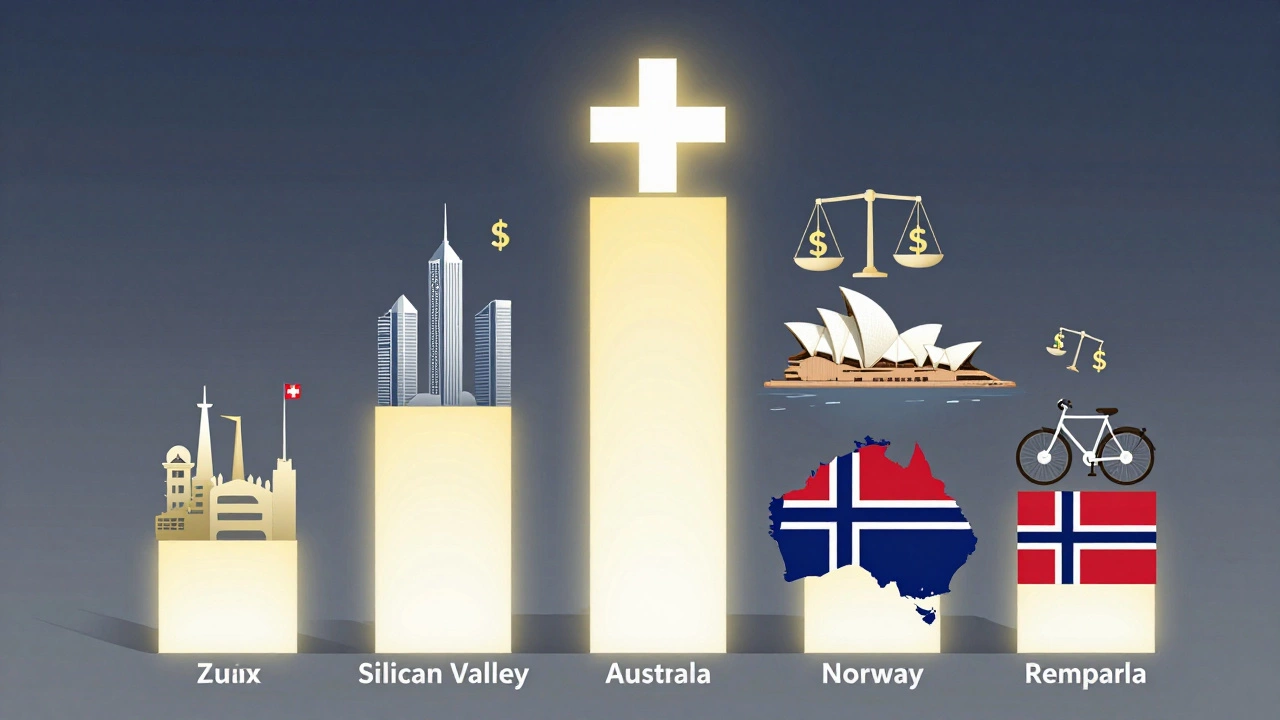
Based on data from Stack Overflow’s 2025 Developer Survey, levels.fyi, and government labor reports from OECD countries, here are the top five countries paying the highest average salaries to full stack developers in early 2026.
- Switzerland - $142,000 USD per year
- United States - $138,000 USD per year
- Australia - $127,000 USD per year
- Norway - $123,000 USD per year
- Denmark - $119,000 USD per year
Switzerland takes the top spot - not because of tech hype, but because of its stable economy, high cost of living, and demand for skilled engineers in finance and manufacturing tech. Zurich and Geneva are home to many global banks and industrial automation firms that need developers who can handle everything from React frontends to Node.js microservices and PostgreSQL databases.
The U.S. still dominates in total number of high-paying roles, especially in cities like San Francisco, Seattle, and New York. But after taxes and housing costs, the real take-home pay often doesn’t beat Switzerland or Norway. In fact, a 2025 analysis by Numbeo showed that a full stack developer earning $140,000 in Zurich ends up with more disposable income than someone making $160,000 in San Francisco.
Why Switzerland Leads the Pack
Switzerland isn’t known for startups. It’s known for precision. Companies like Novartis, ABB, and UBS don’t hire developers to chase trends. They hire them to build systems that run 24/7, handle millions of transactions, and comply with strict European data laws. That’s why full stack developers there aren’t just expected to know JavaScript and Python - they’re expected to understand CI/CD pipelines, Kubernetes clusters, and GDPR-compliant data architecture.
Many Swiss firms offer remote work options for EU-based developers, but the salary ceiling stays high even for non-residents. A 2026 survey by Hays Switzerland found that full stack developers with 3-5 years of experience in Zurich earn between CHF 140,000 and CHF 180,000 annually (roughly $155,000-$200,000 USD). Senior roles with cloud and security expertise can go beyond $220,000.
One key reason? The Swiss labor market is tight. There simply aren’t enough local engineers to fill all the roles. Companies compete by offering top salaries, generous bonuses, and flexible hours - not ping pong tables or free snacks.
How the U.S. Compares - More Jobs, But Less Take-Home
The U.S. has more full stack developer jobs than any other country - over 1.2 million positions in 2026, according to LinkedIn. But salary isn’t everything. Let’s break it down:
- Median salary: $138,000
- Median housing cost in SF/NYC: $3,500-$5,000/month
- Health insurance premiums: $400-$700/month (if not employer-subsidized)
- Tax rate (federal + state): 25-40%
In contrast, Switzerland’s tax rate is around 20-25% for middle-income earners, and healthcare is included in mandatory insurance (costs capped at $300/month). Housing is expensive, yes - but rent for a one-bedroom in Zurich averages $2,400/month, compared to $4,000+ in San Francisco.
Also, U.S. tech jobs come with more volatility. Layoffs hit big tech hard in 2022-2023, and while hiring has rebounded, job security isn’t guaranteed. Swiss firms, especially in banking and pharma, rarely downsize engineering teams.
What About Australia, Norway, and Denmark?
Australia’s tech scene is growing fast, especially in Sydney and Melbourne. Companies like Atlassian, Canva, and Afterpay pay well - but so do startups backed by Australian venture funds. The government also offers skilled migration visas for developers with proven experience, making it easier to relocate than in the U.S. or Switzerland.
Norway and Denmark combine high salaries with strong social safety nets. A full stack developer in Oslo earns about $123,000, but gets free healthcare, subsidized childcare, and 5-7 weeks of paid vacation. In Copenhagen, it’s common to work 37 hours a week, with no overtime culture. Many developers say the trade-off isn’t just money - it’s peace of mind.
What Skills Get You the Highest Pay?
It’s not enough to say "I know React and Node." The highest-paid full stack developers in 2026 have a specific combo of skills:
- Cloud architecture (AWS, Azure, or GCP) - especially Terraform and serverless
- DevOps tools - Docker, Kubernetes, GitHub Actions
- Security - OWASP standards, OAuth2, penetration testing basics
- Database optimization - PostgreSQL, Redis, query tuning
- API design - REST, GraphQL, gRPC
Developers who can bridge frontend UI/UX with backend performance and infrastructure are rare. That’s why the top 10% of earners make over $200,000 - they’re not just coders. They’re system architects.
What About Remote Work?
Many full stack developers now work remotely for companies based in Switzerland, the U.S., or Australia - while living in lower-cost countries like Portugal, Romania, or Colombia. But here’s the catch: salary often adjusts based on location. A U.S.-based company might pay you $90,000 if you’re in Mexico, even if they’d pay $140,000 in San Francisco.
Some European firms, especially in Switzerland and Germany, still pay location-independent salaries - but only if you’re hired as a full-time employee on their payroll. Freelancing or contracting usually means lower rates and no benefits.
If you’re considering remote work for a Swiss company, make sure you understand their legal structure. Some hire you through a third-party payroll provider in the EU, which affects taxes and social security.

Real-World Example: From Ireland to Zurich
Take a developer in Dublin - like someone working for a fintech startup. They earn €75,000 ($81,000 USD). After taxes, they have about €5,000 left per month. Rent for a one-bedroom? €1,800. That leaves them with €3,200 for everything else.
Now imagine the same person gets an offer from Zurich. Same role. Same experience. Salary? CHF 150,000 ($167,000 USD). After taxes (around 23%), they take home CHF 115,000. Rent? CHF 2,600/month. Healthcare? CHF 300/month. Suddenly, they’re saving €4,000+ per month. And they still get 20 days of vacation plus public holidays.
It’s not just about the number on the paycheck. It’s about what that number buys you.
Should You Move? Here’s What to Consider
Moving countries isn’t easy. Here’s what to weigh:
- Visa requirements - Switzerland requires a work permit. The U.S. has H-1B caps. Australia has skilled visas. Research before applying.
- Tax treaties - Some countries tax you on worldwide income. Others don’t. Know the rules.
- Cost of living - Use Numbeo or Expatistan to compare rent, groceries, transport.
- Language - In Switzerland, German or French is helpful. In Norway, English works, but learning Norwegian helps long-term.
- Work-life balance - Can you handle 50-hour weeks? Or do you need 35-hour weeks with 6 weeks of vacation?
There’s no single "best" country. But if your goal is maximum salary + stability + quality of life, Switzerland is currently the strongest contender.
What’s Next for Full Stack Salaries?
AI tools are changing the game. Junior developers can now build basic apps with AI assistants. That means companies are paying more for developers who can solve complex problems - not just write code.
By 2027, we’ll likely see:
- Higher pay for developers who understand AI integration (RAG, LLMs, fine-tuning)
- Bigger gaps between developers who specialize vs. those who just "know a bit of everything"
- More countries offering tax incentives to attract tech talent (think Portugal, Canada, UAE)
If you’re serious about maximizing your salary, don’t just learn React and Node. Learn how to design scalable systems. Learn how to communicate with product teams. Learn how to lead a project from idea to production. That’s what gets you to the top 5%.
Which country pays the highest salary to full stack developers in 2026?
Switzerland pays the highest average salary to full stack developers in 2026, with median annual earnings at $142,000 USD. This is due to strong demand in finance and industrial tech, low unemployment among skilled engineers, and a stable economy. While the U.S. has more job openings, Switzerland offers better take-home pay after taxes and living costs.
Why do full stack developers earn more in Switzerland than in the U.S.?
Switzerland’s high salaries reflect its tight labor market, high cost of living, and demand for engineers in regulated industries like banking and pharmaceuticals. U.S. salaries look higher on paper, but after federal and state taxes, housing, and healthcare costs, the real disposable income often falls behind. Swiss developers also benefit from shorter workweeks, more vacation days, and universal healthcare.
Do remote full stack developers get paid the same as on-site workers?
Usually not. Most U.S. and European companies adjust salaries based on your location. A developer in Manila working remotely for a Swiss firm might get 40-60% less than someone in Zurich. However, some firms - especially in Germany and Switzerland - pay location-independent salaries if you’re hired as a full-time employee on their payroll. Always ask about compensation structure before accepting a remote offer.
What skills make a full stack developer earn over $200,000 per year?
Developers earning over $200,000 typically combine deep expertise in cloud infrastructure (AWS/Azure), DevOps (Kubernetes, Terraform), system design, and security. They’re not just coders - they’re architects who can lead teams, optimize performance under load, and reduce infrastructure costs. Experience with AI integration (LLMs, RAG pipelines) and regulatory compliance (GDPR, HIPAA) also boosts earning potential.
Is it worth moving countries for a higher salary as a full stack developer?
It depends. If you’re early in your career and want to maximize savings, countries like Switzerland, Norway, or Australia offer high pay with strong social benefits. But moving means navigating visas, taxes, and cultural adjustment. For many, staying put and upskilling - especially in cloud, DevOps, and AI - can lead to a 50-100% salary bump without relocating. Evaluate your personal goals: Is it money, stability, lifestyle, or growth?