
Web Framework Selector 2026
Answer a few questions about your project goals to find the best matching framework for your specific needs.
Our Recommendation:
The Elephant in the Room
You've probably noticed a shift in the wind. For years, learning React is a JavaScript library for building user interfaces based on components was the only way to guarantee a job in front-end development. But if you look at the latest project discussions on GitHub or the chatter at 2026 developer conferences, people aren't asking how to optimize their virtual DOM anymore. They're asking if they should even be using it.
To be clear, React isn't dying overnight. It's too deeply embedded in the corporate world for that. However, the React alternatives gaining traction today solve a problem that React fundamentally struggles with: the "JavaScript tax." We've spent a decade shipping massive bundles of JS to the browser, and users are tired of waiting for the hydration process to finish before they can click a button. The industry is moving away from a "one size fits all" library toward specialized tools that prioritize speed and developer experience.
The Quick Rundown: Who's Winning?
- Svelte: The "compiler" approach that removes the runtime overhead.
- Qwik: The king of resumability, virtually eliminating hydration.
- SolidJS: Fine-grained reactivity that outperforms the virtual DOM.
- Next.js: Not a replacement, but the evolution of React into a full-stack framework.
The Death of the Virtual DOM
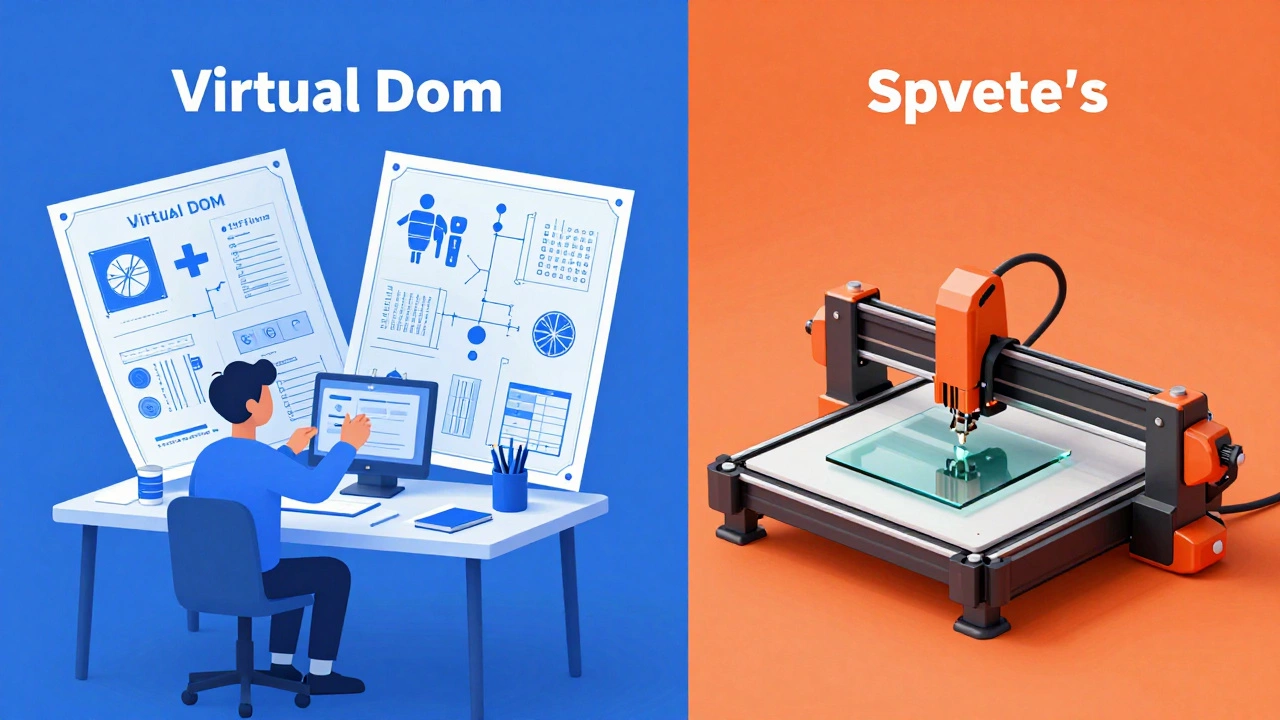
For a long time, we thought the Virtual DOM was the peak of efficiency. The idea was simple: keep a copy of the UI in memory, compare it to the real DOM, and only update what changed. But as apps got bigger, the process of "diffing" those two trees became a performance bottleneck. It's like checking every single item in your grocery bag every time you put one item on the counter.
Enter Svelte. Unlike React, Svelte is a compiler that converts your code into highly optimized vanilla JavaScript during the build step. When you change a variable in Svelte, it doesn't re-scan a tree; it knows exactly which DOM element needs to change. This results in smaller bundles and faster execution. If you're building a landing page or a content-heavy site, the difference in load times is night and day. Instead of sending a heavy runtime to the user, you're sending the same kind of lean code we wrote ten years ago, but with modern syntax.
Resumability vs. Hydration
If you've used Next.js or Nuxt, you know the pain of hydration. The server sends HTML, and then the browser has to "re-run" the JavaScript to make the page interactive. It's a redundant process that wastes CPU cycles and causes that annoying "uncanny valley" where the page looks ready but doesn't respond to clicks.
Qwik changed the game by introducing resumability. Instead of hydrating the whole app, Qwik serializes the state of the application into the HTML itself. When a user clicks a button, Qwik downloads only the tiny sliver of JavaScript needed for that specific interaction. It doesn't matter if your app is 10KB or 10MB; the initial load time remains almost constant. This is a massive leap for e-commerce sites where a 100ms delay in Time to Interactive (TTI) can lead to a measurable drop in conversion rates.
| Feature | React | Svelte | Qwik | SolidJS |
|---|---|---|---|---|
| Rendering Method | Virtual DOM | Compiled | Resumable | Fine-grained |
| Bundle Size | Large | Small | Tiny (Initial) | Small |
| Learning Curve | Moderate | Low | Moderate | Low (if you know React) |
| Ecosystem Size | Massive | Growing | Emerging | Niche |
The Case for SolidJS: Pure Speed
If your main goal is raw performance, SolidJS is the one to watch. At first glance, it looks exactly like React-it uses JSX and a similar component structure. However, under the hood, it's fundamentally different. SolidJS uses Signals to track state changes.
In React, when a state changes, the entire component function re-runs. In Solid, only the specific part of the UI tied to that signal updates. Imagine a dashboard with a ticking clock and a large data table. In React, the clock might trigger a re-render of the whole page unless you're an expert at memo and useCallback. In Solid, only the numbers in the clock update. The rest of the page remains untouched. This "surgical' approach to updates makes it one of the fastest frameworks available today, often beating Svelte in raw benchmark tests.

Why React Still Won't Disappear
Despite these innovations, you'll still see React in most job postings. Why? Because software engineering isn't just about the fastest runtime; it's about the ecosystem. When you hit a bug in React, there are ten thousand Stack Overflow threads and five hundred libraries that already solved your problem. The Meta ecosystem is simply too large to ignore.
Moreover, React has evolved. The introduction of Server Components was an attempt to tackle the JavaScript bundle problem by moving logic back to the server. While it adds complexity to the developer's mental model, it allows React to compete with the performance of newer frameworks. The trend isn't necessarily "React vs. Everything Else," but rather a move toward a hybridized approach where the server and client share the load more intelligently.
Picking the Right Tool for 2026
Choosing a framework today isn't about finding the "best" one, but the one that fits your specific constraints. If you're building a complex enterprise dashboard where the user stays on a single page for hours, a fine-grained system like SolidJS or the stability of React is a safe bet. If you're building a public-facing site where SEO and first-contentful paint are everything, Qwik is the logical choice.
For the average developer, Svelte is often the most rewarding. It strips away the boilerplate and lets you write code that feels like HTML and CSS again. You don't have to fight the framework to get a simple counter to work. The "replacement" of React isn't a single event-it's a fragmentation. We are moving from the era of the "Universal Framework" to the era of "Right Tool for the Job."
Is it a mistake to learn React in 2026?
No, it's not a mistake. While newer frameworks are faster, React still dominates the job market. Learning React also teaches you the fundamental concepts of component-based architecture, which makes picking up Svelte or SolidJS much easier. Think of it as learning the industry standard before exploring the specialized alternatives.
What is the main difference between Svelte and React?
The core difference is when the work happens. React does most of its work in the browser (runtime), using a virtual DOM to figure out what to change. Svelte does that work during the build process (compile-time), outputting direct DOM manipulations. This makes Svelte apps generally smaller and faster to load.
Does Qwik actually replace the need for Next.js?
In terms of performance and load times, yes. Qwik's resumability solves the hydration problem that Next.js still struggles with. However, Next.js is a full-featured platform with a massive ecosystem of plugins and hosting support (like Vercel) that Qwik is still building out. It's a trade-off between cutting-edge speed and ecosystem stability.
Which framework is easiest for beginners?
Svelte is widely considered the easiest for beginners. It stays closest to standard HTML, CSS, and JavaScript. You don't have to learn complex hooks like useEffect or manage manual dependency arrays, which are often the biggest hurdles for new React developers.
What are Signals and why do they matter?
Signals are a way of managing state where the framework knows exactly which piece of the UI depends on which piece of data. Instead of re-rendering a whole component, the framework only updates the specific text or attribute tied to that signal. This is the secret behind the incredible speed of SolidJS and is now being adopted by other frameworks like Angular and Vue.