For years, PHP ran the web. WordPress, Drupal, Magento - all built on it. Even today, over 77% of websites using a server-side language run on PHP, according to W3Techs. But in the last five years, Python has surged. Django, Flask, FastAPI - they’re everywhere. Startups pick Python. Tech giants use it. So the question isn’t whether Python is popular - it’s whether it’s replacing PHP. And the answer? It’s not a simple yes or no.
PHP Isn’t Dying - It’s Settling In
People say PHP is outdated. That’s not true. PHP 8.1 and 8.2 brought massive speed improvements. JIT compilation made it 2-3x faster than PHP 7.4. Type declarations, union types, and attributes made it cleaner and safer. Laravel, the most popular PHP framework, is now a full-featured ecosystem with artisan CLI, Eloquent ORM, and built-in queue systems. Companies like Slack, Etsy, and Wikipedia still run on PHP. Why? Because it works. It’s stable. It’s cheap to host. And millions of developers already know it.
PHP doesn’t need to be flashy to survive. It just needs to do its job - and it does. Most small businesses, local agencies, and WordPress sites don’t care about the latest language trend. They care about cost, speed of deployment, and support. PHP delivers that.
Why Python Is Winning New Projects
If you’re starting a project today, especially a web app with heavy data, AI, or APIs, Python is often the first choice. Why?
- It’s simpler to write. No semicolons. No curly braces. Clean syntax. A beginner can write a working API in 10 minutes with Flask.
- It’s versatile. The same developer can build a web app, analyze data with Pandas, train a machine learning model with scikit-learn, and automate tasks - all in one language.
- It’s backed by science. Python dominates data science, AI, and automation. If your app needs to process user behavior, predict trends, or integrate with AI tools, Python has the libraries. PHP doesn’t.
- It scales well for modern stacks. Django and FastAPI handle async requests, microservices, and cloud-native deployments better than most PHP frameworks.
Look at Instagram. It started on Django. YouTube used Python from day one. Reddit, Dropbox, Spotify - all Python. These aren’t small sites. They’re platforms serving hundreds of millions. Python’s ecosystem made that possible.
The Real Difference: Use Case, Not Capability
PHP and Python aren’t fighting over raw power. They’re serving different needs.
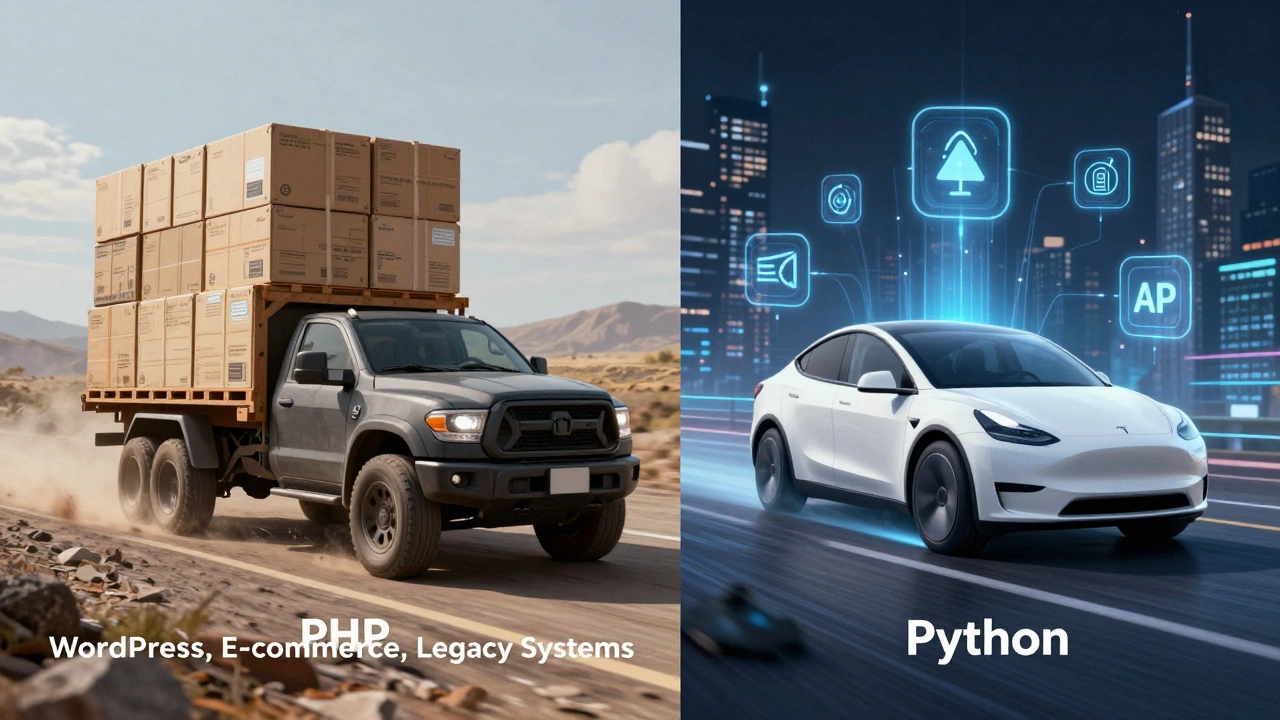
Think of it like cars. PHP is a pickup truck. Reliable. Tough. Great for hauling heavy loads - like content-heavy sites, blogs, e-commerce, or legacy systems. Python is a Tesla. Fast, smart, efficient. Perfect for building complex, evolving systems with AI, real-time analytics, or custom APIs.
Here’s where each shines:
| Use Case | PHP | Python |
|---|---|---|
| WordPress site | Best choice | Overkill |
| E-commerce (Shopify, Magento) | Strong fit | Possible, but less common |
| API-heavy app (SaaS) | Can do, but clunkier | Native strength |
| AI or data-driven features | Not practical | Only real option |
| Quick prototyping | Slow setup | Faster than PHP |
| Legacy system maintenance | Only choice | Hard to migrate |
There’s no magic switch. If you’re building a blog, a product catalog, or a WooCommerce store - PHP is still the right tool. If you’re building a SaaS platform that uses machine learning to recommend products? Python wins.
What About Developers?
There’s a quiet shift happening in hiring. Job posts for PHP developers are declining. LinkedIn data from 2025 shows PHP roles dropped 22% since 2021. Python roles grew 41% in the same period. Why? Because companies aren’t just hiring for web dev anymore. They’re hiring for full-stack engineers who can do data, automation, and AI.
PHP developers often specialize in one thing: web pages. Python developers? They’re more likely to wear multiple hats. That makes them more valuable in startups and tech firms.
But here’s the catch: PHP developers aren’t obsolete. They’re in demand for maintenance, optimization, and legacy systems. A company with a $50 million revenue Magento store isn’t going to rewrite it in Python. They’ll hire someone who knows PHP inside out.
The Migration Myth
Some say, “Just migrate everything to Python.” But that’s fantasy.
Migrating a large PHP app to Python isn’t like swapping a battery. It’s like rebuilding a plane while it’s flying. You need to rewrite the entire backend, retrain the team, retest every feature, and risk downtime. Most companies won’t do that unless they’re forced.
There are exceptions. Companies like Pinterest and Quora moved from PHP to Python years ago - and it helped them scale. But those were rare cases. They had the resources, the time, and the engineering depth. Most small and mid-sized businesses don’t.
The smarter move? Hybrid. Use PHP for the legacy parts. Use Python for new features. Many companies now run both. A PHP frontend for the website, with Python microservices handling AI recommendations or payment analytics. That’s the real future - not replacement. Coexistence.
What Should You Learn?
If you’re just starting out? Learn Python. It’s more future-proof. The skills transfer to data science, automation, and AI. You’ll have more job options.
If you’re already deep in PHP? Don’t panic. Keep using it. But start learning Python basics. Learn Flask or Django. Build one small tool in Python - maybe an automated report generator or a data scraper. You don’t need to abandon PHP. Just add Python to your toolkit.
PHP isn’t going away. But it’s no longer the only game in town. The web is changing. And the best developers aren’t loyal to one language. They’re loyal to solving problems - and using the right tool for the job.
Can Python fully replace PHP in web development?
No, not completely. Python is better for new, complex, data-heavy apps - especially those involving AI or APIs. But PHP still dominates content-driven sites, WordPress, and legacy systems. Most companies use both, not one or the other.
Is PHP slower than Python?
Not anymore. PHP 8.1+ with JIT compilation runs faster than Python in many web scenarios. Python is slower at handling high-volume HTTP requests, but it makes up for it with better libraries for complex tasks. Speed isn’t the deciding factor - use case is.
Should I switch from PHP to Python if I’m a developer?
If you’re building new apps, yes - Python gives you more flexibility and better career options. But if you’re maintaining existing PHP systems, stay focused. Learn Python on the side. You don’t need to abandon PHP to benefit from Python.
Why do startups choose Python over PHP?
Startups pick Python because it lets one engineer do more. You can build a web app, add data analysis, and integrate AI tools without switching languages. PHP is great for web pages, but it doesn’t easily extend into AI, automation, or scientific computing.
Is PHP still used by big companies?
Yes. Companies like Etsy, Wikipedia, and Slack still run major parts of their systems on PHP. Many have hybrid setups - PHP for the frontend, Python for backend services. PHP isn’t dead; it’s just not the star anymore.