
Backend Learning Path Analyzer
Select a backend skill you are learning to see why "Frontend Literacy" is still necessary for that specific area.
Quick Summary for Aspiring Developers
- You can learn backend logic, databases, and server management without mastering HTML/CSS.
- You will struggle to test your work or understand how data is actually used.
- A basic understanding of how the browser requests data is non-negotiable.
- The most efficient path is "Backend-First" but not "Frontend-Ignorant."
The Invisible Engine of the Web
To get started, we need to define what we are actually talking about. Backend Development is the process of building the server-side logic, database management, and application programming interfaces (APIs) that power a website. While the frontend is everything you see and click, the backend is the brain that handles the "how" and "why" of the data.
If you decide to jump straight into the deep end, you'll be dealing with Server-Side Programming is the use of languages like Python, Ruby, or Go to execute code on a remote server rather than in the user's browser. You'll spend your days in a terminal or a code editor, looking at logs and JSON responses instead of pixels and colors. For some people, this is a dream. You don't have to fight with a button that won't center itself on a mobile screen. Instead, you fight with a database query that takes three seconds too long to run.
What You Can Actually Learn in Isolation
If you ignore the frontend entirely, you can still become an expert in several critical areas. First, there is the Database is a structured collection of data stored electronically, such as PostgreSQL or MongoDB. You can spend months learning how to normalize data, write complex SQL queries, and optimize indexes without ever seeing a web browser. You are essentially managing a digital filing cabinet.
Then there is the world of API Development is the creation of a set of rules that allow two different software programs to communicate with each other. You can build a fully functional REST or GraphQL API that takes a request and returns a piece of data. To a backend developer, a "user interface" is often just a tool like Postman or Insomnia, which allows you to send a request to your server and see the raw text response. In this workflow, the frontend is essentially replaced by a testing tool.
You can also dive deep into DevOps is the set of practices that combines software development and IT operations to shorten the systems development life cycle. Learning how to use Docker containers, manage AWS instances, or set up CI/CD pipelines doesn't require you to know a single line of CSS. These are structural skills that focus on stability, scaling, and security.
| Backend Skill | Can you learn it in a vacuum? | What's missing without Frontend? |
|---|---|---|
| SQL & Database Design | Yes | Context of how users interact with data |
| API Logic (REST/GraphQL) | Yes | Understanding of latency and UI states |
| Authentication (JWT/OAuth) | Partial | How to store tokens in a browser (Cookies/Local Storage) |
| Server Configuration (Nginx/Apache) | Yes | How headers affect browser caching |
The Danger Zone: Where the Gap Hurts
While the technical path is open, there is a psychological and professional wall you will hit. backend development doesn't exist for the sake of the server; it exists to serve the user. If you don't understand how Frontend Development is the practice of producing HTML, CSS, and JavaScript for a website so that a user can see and interact with them, you will build APIs that are a nightmare for frontend developers to use.
For example, imagine you design an API that returns a massive, nested JSON object containing 50 fields, but the frontend only needs the user's name and profile picture. Because you don't understand how the browser handles large payloads or how a framework like React renders lists, you've created a performance bottleneck. You've built a powerful engine, but the car's wheels are square.
Another common pitfall is authentication. You might master the logic of issuing a token on the server, but if you don't know how a browser's "Same-CORS" policy works or how HTTP-only cookies protect against XSS attacks, your security is only theoretical. You are protecting the vault but leaving the front door wide open because you don't know how the door (the browser) actually operates.
A Smarter Path: The "Backend-First" Approach
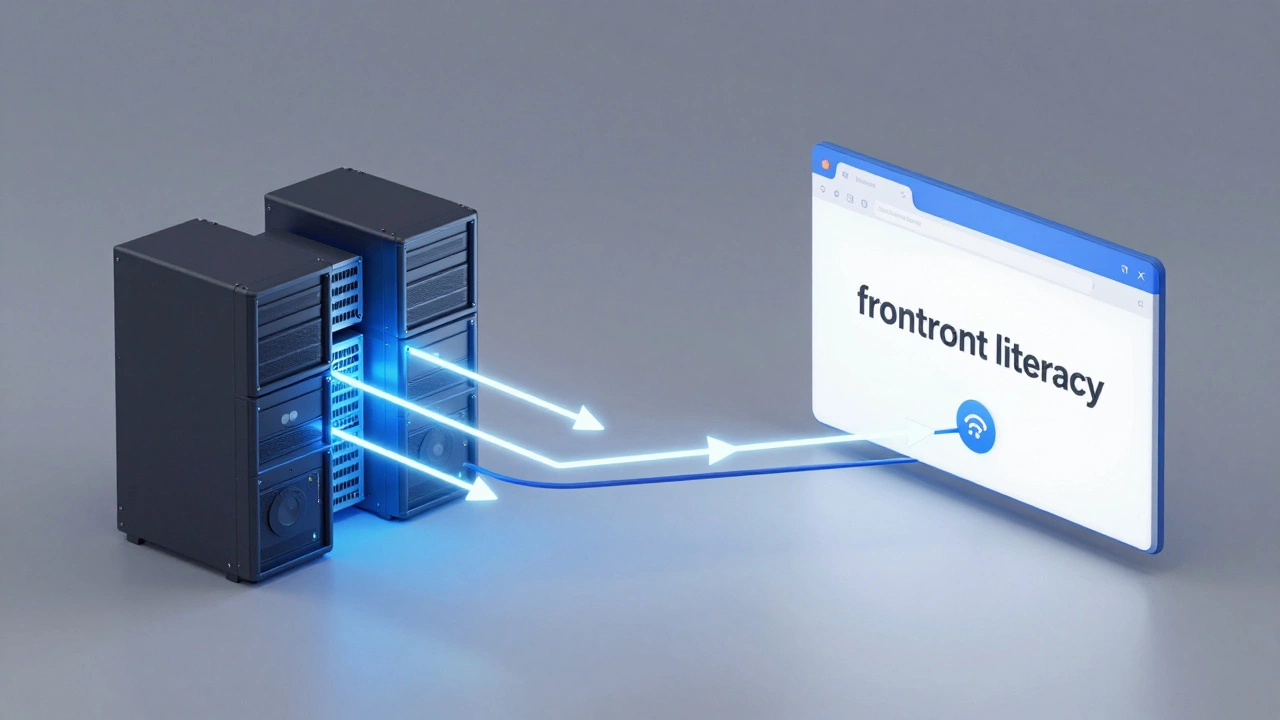
If you hate the idea of spending weeks learning about flexbox and color palettes, you don't have to. But you should still learn the "skeleton" of the web. Instead of becoming a frontend expert, aim for "frontend literacy." This means spending just two weeks learning the absolute basics: how HTML tags work, how a browser sends a GET or POST request, and how to use the Chrome DevTools Network tab.
Once you have that foundation, you can spend 90% of your time in Node.js is an open-source, cross-platform JavaScript runtime environment that executes JavaScript code outside a web browser, or Python's Django/FastAPI. This allows you to build the logic you love while still understanding why the frontend needs the data in a specific format. You aren't trying to be a designer; you're trying to be a teammate.
Try this experiment: build a simple API that returns a list of tasks. Then, instead of ignoring the frontend, use a basic HTML file with a small bit of JavaScript to fetch that data and display it. When you see the data actually appear on a screen, the logic of your backend suddenly makes sense. You start asking the right questions: "What happens if the list is empty?" or "How do I handle a 404 error so the user doesn't see a blank screen?"

The Professional Reality of the Job Market
In the real world, companies rarely hire someone who is "completely blind" to the other side of the stack. Even if your title is "Backend Engineer," you will be expected to participate in architectural meetings. If the team is discussing whether to use a Single Page Application (SPA) is a web application that interacts with the user by dynamically rewriting the current page rather than loading entire new pages from a server, and you have no idea what that means, you are a liability to the project.
Understanding the communication layer-the space between the server and the client-is where the highest-paid engineers live. This is the realm of HTTP is the Hypertext Transfer Protocol, the foundation of data exchange on the World Wide Web. If you can explain why a 304 Not Modified status is better than a 200 OK for a specific resource, you are providing value regardless of whether you can write a CSS animation.
Do I need to learn JavaScript to do backend?
Not necessarily for the logic, as you can use Python, Go, or Java. However, since JavaScript is the language of the browser, knowing it helps you understand how your API is consumed. If you use Node.js for your backend, you'll be using JavaScript for both, which is a huge efficiency gain.
Can I get a job as a backend developer without any frontend skills?
It is possible, especially in large enterprise companies with strict role separations. However, in startups or mid-sized companies, you'll be expected to have "T-shaped" skills-deep expertise in backend and a broad, basic understanding of the frontend to ensure smooth collaboration.
What is the best tool for testing backend code without a frontend?
Postman and Insomnia are the industry standards. They allow you to simulate frontend requests, send different types of data (JSON, XML), and inspect the headers and status codes your server returns.
Which should I learn first, frontend or backend?
If you enjoy visual results and user interaction, start with frontend. If you prefer logic, data structures, and systems architecture, start with backend. Just remember that regardless of where you start, you eventually need a basic understanding of the other side to be a professional developer.
Is a database the same as a backend?
No. The database is where data is stored. The backend (the server-side application) is the layer that talks to the database, applies business logic, checks permissions, and then sends that data to the frontend. The backend is the "manager" and the database is the "file cabinet."
Next Steps for Your Journey
If you've decided to go the backend route, don't just stare at a terminal. Start by picking a language (Python is great for beginners, Go is great for performance). Build a simple project, like a movie rating system. Focus on the database design first, then the API logic. Once you can return a list of movies via Postman, challenge yourself to create a single, ugly HTML page that displays those movies. That small bridge you build between the server and the browser is where the real learning happens.