
Full Stack Learning Roadmap & Time Estimator
Adjust slider to see how your pace affects the total timeline.
Your Phased Roadmap
Track your progress through the essential layers of full stack development.
Here is the honest truth: yes, full stack development is hard. But it is not impossible. The real question isn't whether you can do it-it's whether you are prepared for the mental marathon it requires. You are not just learning one language; you are learning how a digital building stands up from the foundation (database) to the roof (user interface). Many people quit because they try to climb the whole mountain in a single day. Others succeed because they break the climb into manageable camps.
In 2026, the landscape has shifted slightly. AI tools like GitHub Copilot and Cursor have changed *how* we write code, but they haven't removed the need to understand *why* the code works. If anything, they've raised the bar for conceptual understanding. You don't need to memorize syntax anymore, but you do need to know architecture better than ever before.
| Aspect | Difficulty Level | Why It Feels Hard |
|---|---|---|
| Breadth of Knowledge | High | You must understand both client-side and server-side logic. |
| Initial Learning Curve | Steep | Too many choices (React vs Vue, Node vs Python) cause paralysis. |
| Job Market Entry | Medium | Junior roles often prefer specialists, but startups hire generalists. |
| Long-Term Growth | Manageable | Once the foundation is set, adding new tech becomes easier. |
The "T-Shaped" Developer Reality
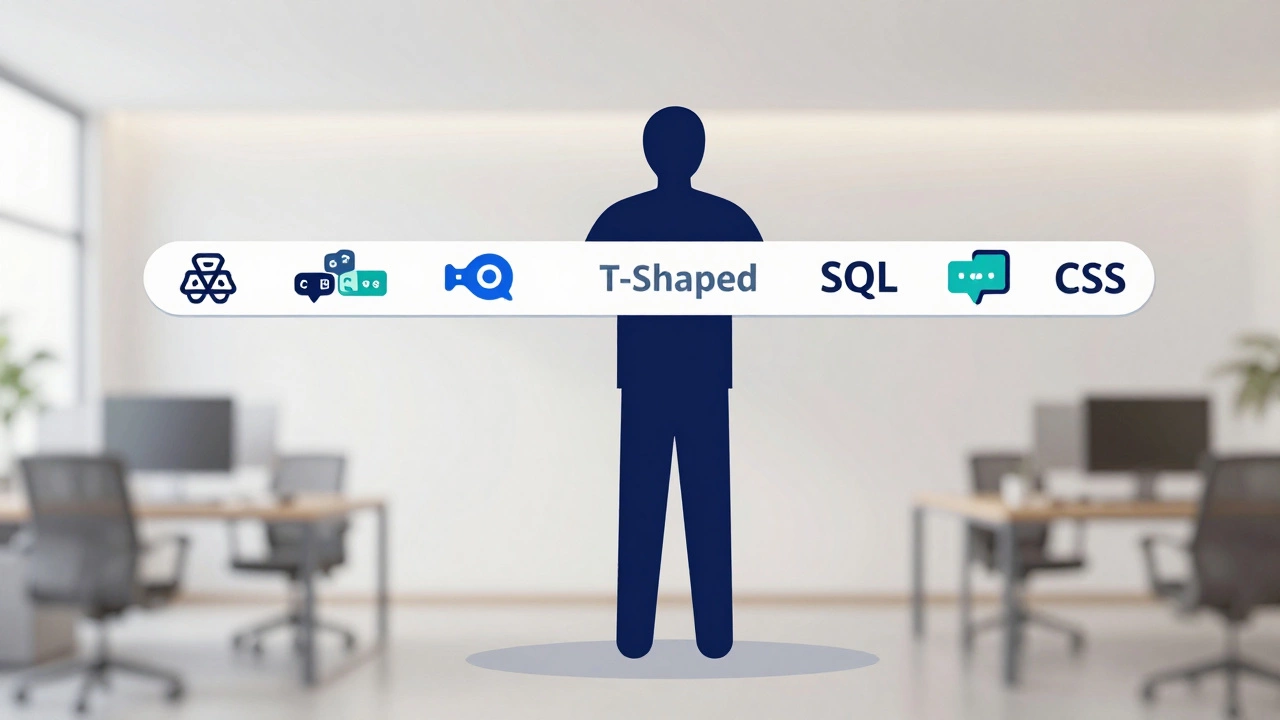
To understand why full stack feels overwhelming, you need to look at the shape of your knowledge. In the industry, we talk about "T-shaped" developers. The horizontal bar of the T represents your broad awareness of many technologies. The vertical bar represents your deep expertise in one or two areas.
When you start, you have no bars. Just a blank page. Trying to build both simultaneously is a recipe for burnout. Most beginners fail because they try to be experts in HTML, CSS, JavaScript, React, Node.js, SQL, and DevOps all within three months. That doesn't work. Your brain needs time to form neural pathways for each concept.
JavaScript is the central language that connects the front end and back end in modern web development. Unlike older stacks where PHP handled the server and jQuery handled the browser, JavaScript now runs everywhere. This actually makes learning full stack *easier* than it was ten years ago. You only need to master one core language deeply to touch every part of the application. However, the ecosystem around JavaScript is massive. Frameworks come and go. Understanding the underlying principles rather than just copying framework-specific code is what separates those who last from those who quit.
Breaking Down the Difficulty by Layer
Let's dissect the full stack into its parts. Each layer has a different type of difficulty. Recognizing this helps you manage your expectations.
1. The Front End (The Visual Layer)
This is usually the easiest place to start. You see immediate results. You change a color, and the screen changes. You move a box, and it moves. This visual feedback loop keeps motivation high.
- HTML & CSS: These are markup and styling languages, not programming languages in the traditional sense. They are declarative. You tell the browser *what* you want, not *how* to calculate it. Mastery here takes weeks, not months.
- JavaScript Basics: Here is where the first real wall appears. Logic, loops, functions, and asynchronous behavior require a shift in thinking. If you struggle with basic JS concepts like closures or promises, everything else will feel harder.
- Frameworks (React/Vue): React is a popular JavaScript library for building user interfaces, known for its component-based architecture. Learning React adds complexity because you have to think in terms of state management and component trees. It's abstract. But once you click, it becomes powerful.
2. The Back End (The Logic Layer)
The back end is invisible. You cannot see it. This makes debugging harder and progress feel slower. You might spend hours fixing a server error that returns nothing to the screen. This frustration is normal.
- Server Runtime: Since you already learned JavaScript, sticking with Node.js is a runtime environment that allows JavaScript to run on the server side. is the smartest move for beginners. It reduces context switching. You don't have to learn Python or Ruby yet.
- APIs: Understanding REST or GraphQL is crucial. You need to know how data travels from the server to the client. This is a conceptual hurdle. Think of it as designing the menu for a restaurant. What data does the front end need? How is it formatted?
- Authentication: Handling user logins securely is tricky. JWTs, sessions, cookies-these concepts can confuse newcomers. Don't worry about building perfect auth systems early on. Use established libraries until you understand the security implications.
3. The Database (The Memory Layer)
Data persistence is the backbone of any app. Without it, your app forgets everything when the server restarts.
- SQL vs NoSQL: PostgreSQL is a powerful, open-source relational database system widely used in enterprise applications. Start with SQL. It teaches you structure and relationships. NoSQL databases like MongoDB are flexible but can lead to messy data models if you don't understand relational theory first. Learning SQL queries (JOINs, indexes) is a specific skill that takes practice.
- ORMs: Tools like Prisma or Mongoose help you interact with databases using JavaScript objects. They hide some complexity but add another layer of abstraction. Learn raw SQL first, then use ORMs for speed.
The Hidden Challenges Nobody Talks About
Beyond the technical skills, there are psychological and logistical hurdles that make full stack development feel harder than it should be.
Context Switching Fatigue: One minute you are tweaking CSS margins. The next, you are debugging a race condition in your Node server. Then you are writing a complex SQL query. Your brain has to switch modes constantly. This drains energy faster than focusing on one task. To combat this, block out time. Spend mornings on front-end design and afternoons on back-end logic. Don't jump between layers randomly.
Tool Overload: In 2026, the toolchain is deeper than ever. You have bundlers (Vite, Webpack), testing frameworks (Jest, Cypress), CI/CD pipelines (GitHub Actions), and deployment platforms (Vercel, Railway). Beginners often get stuck configuring tools instead of writing code. My advice: ignore the fancy tools until you need them. Use Vite for bundling. Deploy on Vercel. Keep it simple. Complexity should solve a problem, not create one.
The "Tutorial Hell" Trap: Watching videos feels productive, but it isn't. You are passive. True learning happens when you struggle. When you hit an error that isn't in the tutorial, that is when you grow. Build projects that scare you slightly. Break things. Fix them. This active struggle is what builds intuition.
A Realistic Roadmap for 2026
If you want to become a full stack developer, follow this phased approach. Do not rush. Quality over speed.
- Month 1-2: Front End Foundations. Master HTML5, CSS3 (Flexbox/Grid), and vanilla JavaScript. Build static sites. Make them responsive. Understand the DOM.
- Month 3-4: Front End Frameworks. Learn React. Build interactive components. Learn state management (Context API or Zustand). Fetch data from public APIs.
- Month 5-6: Back End Basics. Learn Node.js and Express. Build a simple REST API. Connect it to a PostgreSQL database. Understand CRUD operations (Create, Read, Update, Delete).
- Month 7-8: Integration. Connect your React front end to your Node back end. Handle authentication. Deploy the full application. Learn Git workflow thoroughly.
- Month 9+: Specialization & Depth. Now you are full stack. Choose one area to deepen. Maybe it's performance optimization, security, or cloud infrastructure. Continue learning, but with purpose.
Does AI Make It Easier?
Yes and no. AI coding assistants can generate boilerplate code instantly. They can explain errors clearly. They can suggest best practices. This removes the friction of syntax errors and documentation hunting. You can prototype faster.
However, AI cannot replace architectural thinking. If you don't understand how data flows through your system, AI will give you code that looks right but fails under load. AI is a multiplier. It makes good developers great. It makes bad developers confused. Use AI to accelerate learning, not to bypass understanding. Always ask the AI *why* it suggested a solution. Read the code it generates line by line.

Common Mistakes That Slow You Down
- Jumping Between Stacks: Stick to one stack (e.g., MERN: MongoDB, Express, React, Node) until you are comfortable. Switching to Django or Laravel too early fragments your knowledge.
- Ignoring Fundamentals: Don't skip computer science basics. Understand how HTTP works, what DNS does, and how memory management functions. These concepts apply regardless of the framework.
- Not Building Projects: Tutorials are guides. Projects are proof. Build a todo list. Then a blog. Then an e-commerce store. Each project reveals gaps in your knowledge.
- Fearing Errors: Red text in the console is not failure. It is information. Learn to read stack traces. Google your errors. Debugging is 50% of the job.
Conclusion: It's a Marathon, Not a Sprint
Is full stack hard to learn? Yes. It requires discipline, patience, and a willingness to be confused often. But it is also incredibly rewarding. You gain the power to create complete digital experiences from scratch. You understand the entire lifecycle of data. You become versatile and valuable.
Don't let the breadth intimidate you. Focus on depth first. Build a strong foundation in JavaScript and one framework. Expand outward slowly. Celebrate small wins. Join communities. Ask questions. Keep coding. The difficulty fades as competence grows. And in 2026, with the right tools and mindset, you have never been in a better position to start.
How long does it take to become a full stack developer?
For most dedicated learners, it takes 6 to 12 months of consistent study (15-20 hours per week) to reach a junior-level competency. This assumes you focus on a single stack like MERN and build multiple projects. Part-time learners may take 12-18 months.
Do I need a computer science degree to be a full stack developer?
No. Most employers care more about your portfolio and practical skills than your degree. Bootcamps, self-study, and online courses are valid paths. However, understanding core CS concepts (algorithms, data structures) helps in technical interviews and long-term growth.
Which stack is easiest for beginners in 2026?
The MERN stack (MongoDB, Express, React, Node.js) remains the most beginner-friendly because it uses JavaScript across the entire stack. This reduces context switching. Alternatively, Next.js with a backend service like Supabase simplifies many complexities for solo developers.
Can I learn full stack development alone?
Yes, many developers are self-taught. However, isolation can lead to bad habits and stagnation. Join online communities like Discord servers, Reddit forums, or local meetups. Code reviews from others are invaluable for improving your skills.
Is full stack development still in demand?
Absolutely. While large companies may hire specialized front-end or back-end engineers, startups and small businesses heavily value full stack developers who can handle end-to-end features. The ability to bridge the gap between UI and server logic is a unique asset.
What is the hardest part of full stack development?
For most, the hardest part is state management and data flow. Understanding how data moves from the database, through the API, to the UI, and back again is complex. Debugging issues that span multiple layers (front end, network, back end) requires systematic thinking.
Should I learn Python or JavaScript first?
For full stack web development, JavaScript is the better starting point. It is the only language that runs natively in browsers, making it essential for front end. With Node.js, it also handles the back end. Python is excellent for data science and AI, but less dominant in general web UI development.