
AI-Proof Designer Career Readiness Score
Select the skills you currently possess or are actively developing. This tool calculates your "Human-in-the-Loop" readiness score based on industry trends for 2026.
Your AI-Readiness Profile
Assessing...
Loading analysis...
Recommended Next Steps:
It is May 2026, and the anxiety is palpable. You have likely seen the headlines: "AI Can Now Design Entire Websites in Seconds." You might be staring at a dashboard in Figma a collaborative interface design tool that has integrated AI plugins for auto-layout and asset generation, wondering if your next task will be handled by an algorithm instead of you. The fear is real, but the narrative that Artificial Intelligence will simply delete the role of the UI/UX Designer a professional who focuses on user experience research, interface layout, and usability testing to create digital products is fundamentally flawed.
The truth is not black and white. AI is not coming to take your job; it is coming to change what your job actually looks like. We are moving from an era of pixel-pushing to an era of strategy and empathy. If you are still defining your value solely by how fast you can draw a button, you are already behind. But if you define your value by how well you solve human problems, you are more relevant than ever.
The Quick Takeaways
- AI handles execution, humans handle empathy: Generative AI excels at creating layouts and code, but it fails at understanding complex human emotions and business contexts.
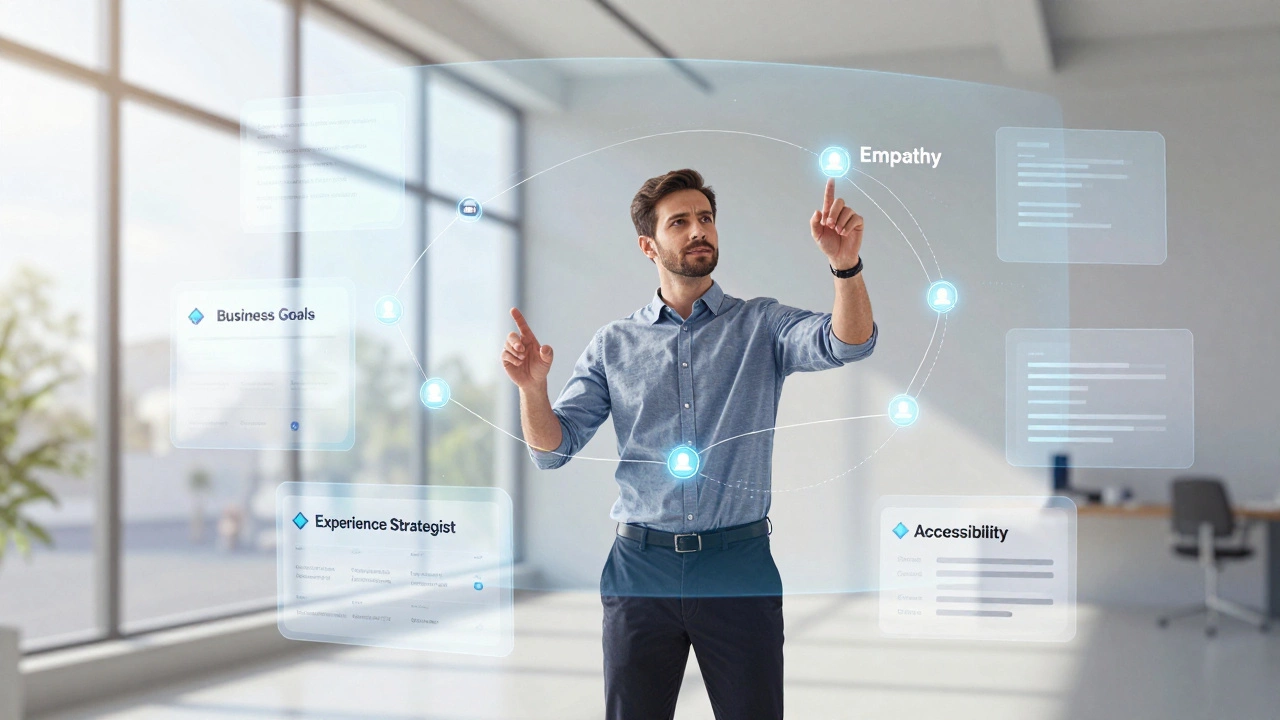
- The "Designer" title is splitting: Roles are diverging into "AI Prompt Engineers" (technical) and "Experience Strategists" (human-centric).
- Efficiency is up, but so are expectations: Clients expect faster turnaround times, meaning you must deliver higher strategic value to justify your cost.
- Tools like Midjourney and Figma AI are assistants, not replacements: They speed up the workflow but require human oversight for accessibility and logic.
What AI Actually Does Well (And Where It Fails)
To understand why you won't be replaced, we first need to respect what the technology can do. In 2026, Generative AI machine learning models capable of creating text, images, code, and designs from natural language prompts has become incredibly proficient at the "output" side of design. You can ask a tool to generate ten variations of a landing page header, and it will give you clean, modern, aesthetically pleasing options in seconds. It can write CSS code, optimize SVGs, and even suggest color palettes based on brand guidelines.
However, these tools lack context. An AI model does not know that your target audience consists of elderly users with poor eyesight who struggle with small touch targets. It doesn't understand that your client's marketing team needs a specific call-to-action to align with a Q3 sales push. AI operates on probability, not intent. It guesses what looks good based on millions of existing websites, often resulting in generic, soulless interfaces that blend into the background.
This is where the Human-in-the-Loop a design methodology where human judgment guides and corrects AI-generated outputs to ensure quality and relevance becomes critical. The AI provides the raw material; the designer provides the direction, the constraints, and the ethical guardrails. Without a human to say "no," AI tends to hallucinate features or create inaccessible designs that violate WCAG Standards Web Content Accessibility Guidelines that ensure digital content is usable by people with disabilities.
The Shift from Pixel-Pushing to Problem-Solving
For the past decade, much of the entry-level UI work was repetitive. Creating icons, adjusting padding, ensuring consistency across breakpoints. This is exactly the kind of work AI automates best. If your daily routine was 80% visual assembly, you are right to feel threatened. That part of the job is gone.
But the core of User Experience (UX) Design the process of designing products that provide meaningful and relevant experiences to users, involving research, prototyping, and testing is deeply human. It requires empathy, psychology, and negotiation. Consider this scenario: A stakeholder wants a dark mode feature because they think it looks cool. Your job isn't just to design the dark mode; it's to analyze whether it impacts readability for older users, check if it breaks the brand identity, and perhaps propose a hybrid solution that satisfies both aesthetics and usability.
An AI cannot navigate office politics. It cannot read the room during a stakeholder meeting. It cannot empathize with a frustrated user who calls support because they couldn't find the checkout button. These soft skills are now the hard currency of the industry. As the technical barrier to entry lowers (anyone can generate a website with AI), the premium on strategic thinking rises.

New Tools, New Workflows
In Dublin, as in Silicon Valley, studios are adopting new workflows. Instead of spending days wireframing, designers now use AI to rapidly prototype multiple concepts. This shifts the time budget from "creation" to "evaluation." You are no longer just building one thing; you are curating and refining several AI-generated options.
Tools like Midjourney an AI image generation tool used by designers for mood boarding and visual inspiration are standard for early-stage ideation. Figma AI features within Figma that automate layout, naming, and component creation handles the tedious cleanup. But the final handoff requires a human to ensure the interaction models make sense. For example, an AI might create a beautiful dropdown menu, but fail to account for how it behaves on a mobile device with a thumb-only navigation pattern.
The modern designer acts more like a director or an editor. You set the vision, you prompt the tools, you critique the output, and you integrate it into a cohesive system. This requires a deeper understanding of design systems and coding principles than before, because you need to speak the same language as the AI to get useful results.
The Economic Argument: Why Companies Still Hire Humans
Let's talk money. If AI can do the work, why pay a salary? The answer lies in liability and risk. If an AI-designed app crashes, violates privacy laws, or alienates customers due to poor usability, who is responsible? Not the AI. The company hires humans to assume responsibility for the product's success.
Furthermore, customization is key. Generic AI designs lead to generic brands. In a crowded market, differentiation comes from unique storytelling and nuanced interactions-things AI struggles with. Companies are finding that while AI reduces the time to build a *minimum viable product*, it takes human insight to build a *market-leading product*. The ROI of a human designer is no longer measured in hours saved, but in revenue generated through better conversion rates and user retention.
How to Future-Proof Your Career
If you want to stay employed and thrive in this new landscape, you need to adapt. Here is how:
- Master AI Tools: Don't fight them. Learn to prompt effectively. Understand the limitations of generative models so you can spot errors quickly.
- Deepen Your Research Skills: Become an expert in user interviews, data analysis, and behavioral psychology. The more you understand *why* users behave certain ways, the less replaceable you become.
- Learn Basic Coding: Understanding HTML, CSS, and JavaScript helps you communicate with developers and ensures your designs are technically feasible. AI generates code, but you need to know if it's efficient.
- Focus on Strategy: Move upstream. Involve yourself in product discovery and business goals. Show stakeholders how design impacts the bottom line.
- Cultivate Soft Skills: Improve your communication, presentation, and negotiation skills. You are selling ideas, not just pixels.
The Verdict for 2026 and Beyond
Will AI replace UI/UX designers? No. But AI-replaced designers will replace those who refuse to use AI. The role is evolving, not disappearing. The "graphic designer" who only makes things look pretty is at risk. The "experience strategist" who solves complex problems using design as a tool is indispensable.
We are entering a golden age of creativity. The friction between idea and execution has never been lower. You can test hypotheses faster, iterate quicker, and reach higher quality standards than ever before. The challenge is not survival; it is elevation. Raise your game. Focus on the human elements that machines cannot replicate: empathy, ethics, and vision.
Can AI completely design a website without any human input?
Technically, yes, AI can generate a fully functional website from a prompt. However, the result is usually generic, lacks strategic alignment with business goals, and often contains accessibility issues or logical flaws. Human oversight is required to ensure the site serves its intended audience and brand identity effectively.
Is it too late to start a career in UI/UX design in 2026?
No, it is not too late. In fact, the barrier to entry for basic tasks has lowered, allowing new designers to focus more on high-value skills like user research and strategy. Success now depends less on manual drawing skills and more on problem-solving abilities and familiarity with AI-augmented workflows.
Which AI tools should UI/UX designers learn in 2026?
Key tools include Figma AI for interface automation, Midjourney or DALL-E 3 for rapid visual ideation and mood boarding, and voice-to-code tools for prototyping. Familiarity with large language models (LLMs) for copywriting assistance is also highly valuable.
How does AI impact junior designer roles?
Junior roles focused purely on asset creation or simple layout adjustments are shrinking. Entry-level positions now require candidates to demonstrate strategic thinking and proficiency with AI tools. Juniors are expected to contribute to research and decision-making earlier in their careers rather than just executing visual tasks.
Will AI improve or worsen design quality overall?
AI improves efficiency and consistency, reducing human error in repetitive tasks. However, without skilled human guidance, it can lead to homogenized designs. High-quality design outcomes depend on the designer's ability to curate and refine AI outputs, ensuring uniqueness and user-centricity.