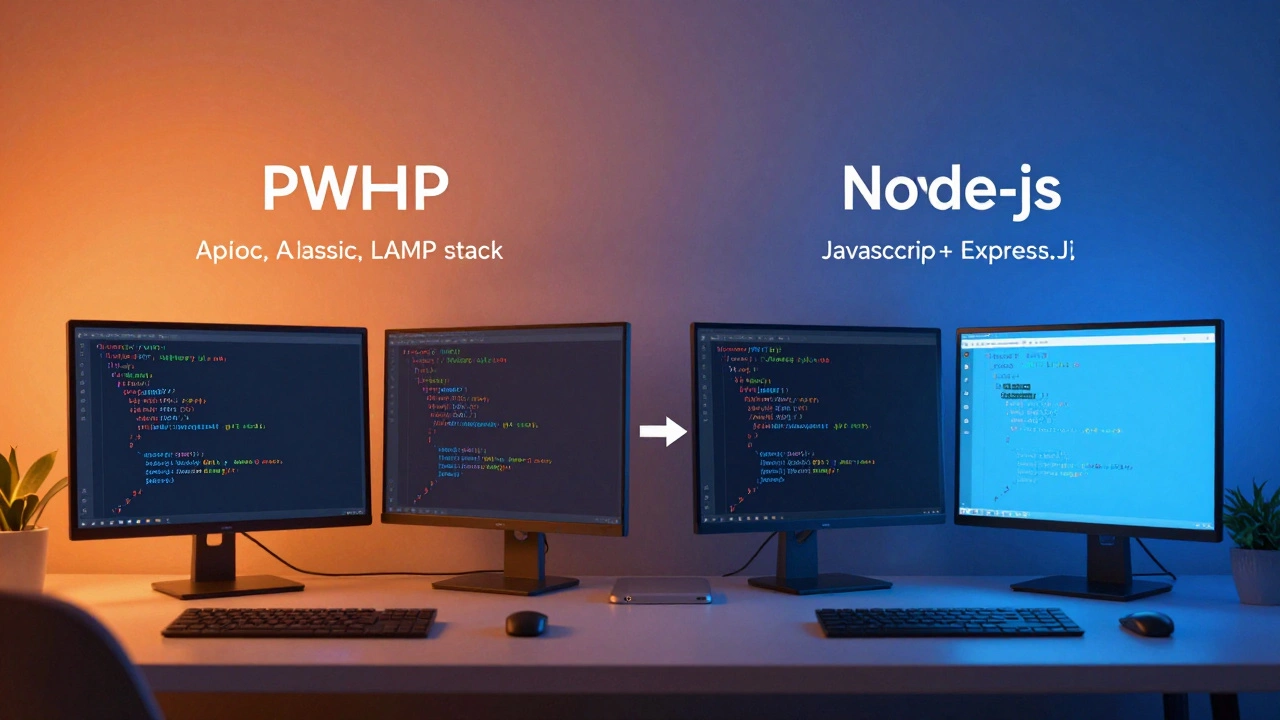
When you’ve spent years writing PHP, switching to another language feels like moving to a new house where everything’s just a little off. The lights are brighter, the doors open differently, and you keep reaching for the light switch in the wrong spot. That’s why so many PHP developers ask: Which language is closest to PHP? It’s not about which one is better-it’s about which one feels most familiar. And the answer isn’t just one language. It’s a handful of them, each with their own quirks that mirror PHP’s DNA.
JavaScript (Node.js): The Sibling You Didn’t Know You Had
If you’ve ever written PHP to handle form submissions or spit out dynamic HTML, you’ve already done half the work of a JavaScript developer. JavaScript, especially in Node.js, is the closest in spirit to PHP. Both were built to make web pages do things. PHP runs on the server. JavaScript runs on the client. But with Node.js, JavaScript runs on the server too-and suddenly, the gap vanishes.
Think about it: you write a function in PHP to fetch user data from a database. In Node.js, you write almost the same thing. The syntax is different, sure. Instead of echo $user['name'], you write console.log(user.name). But the structure? Identical. Both use curly braces, both use semicolons (though JavaScript is more strict), and both handle JSON like a second language. If you’ve ever used cURL in PHP to hit an API, you’ve basically done the same thing with fetch() in JavaScript.
And here’s the kicker: most modern PHP apps now talk to JavaScript-heavy frontends. If you’re using Laravel or Symfony with React or Vue, you’re already living in a JavaScript-PHP hybrid world. Switching to Node.js isn’t starting over-it’s just moving your logic from one side of the server to the other.
Python: The Cleaner Cousin
Python doesn’t look like PHP. It doesn’t have dollar signs. It doesn’t use semicolons. It doesn’t even use curly braces. But if you’ve ever written a PHP script to process a CSV file or generate a report, you’ll feel right at home in Python.
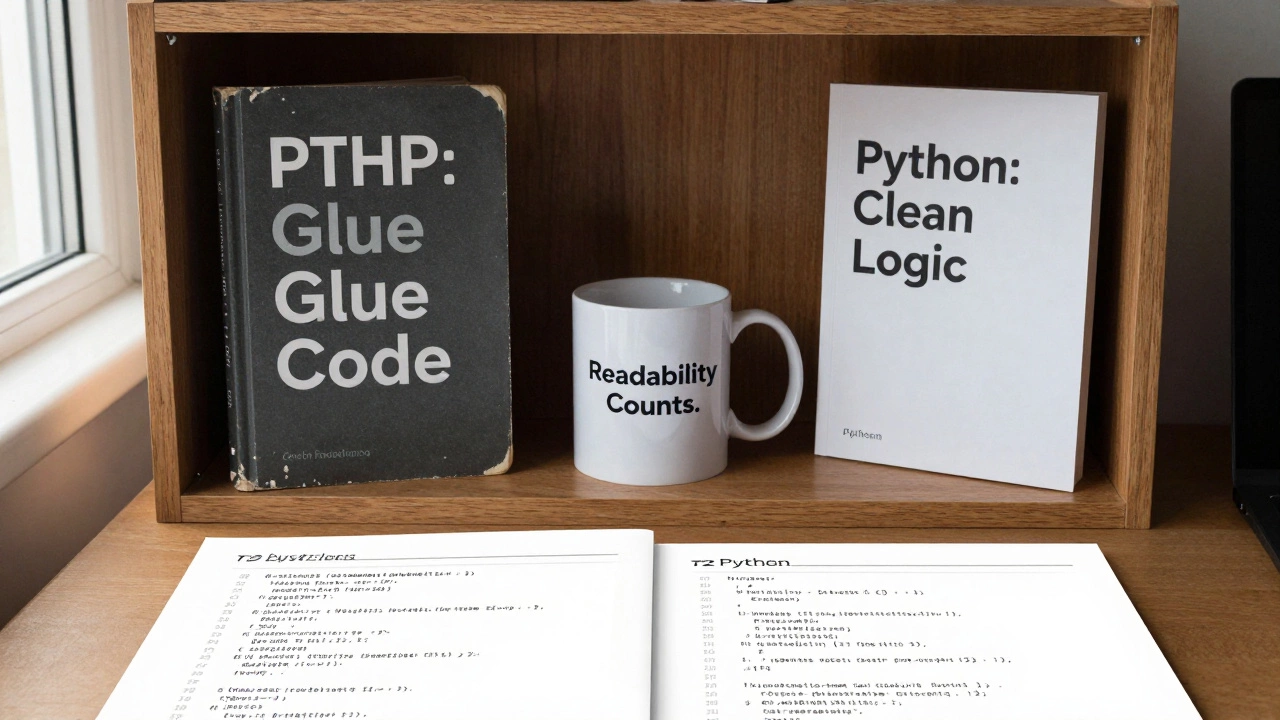
PHP’s strength has always been in glue code-connecting databases, handling forms, serving files. Python does that too, but with fewer keystrokes. Take this simple task: reading a file and printing each line. In PHP:
<?php
$file = fopen('data.txt', 'r');
while (($line = fgets($file)) !== false) {
    echo $line;
}
fclose($file);
?>
In Python:
with open('data.txt') as f:
    for line in f:
        print(line)
It’s not just shorter. It’s more readable. Python’s design philosophy-“readability counts”-makes it feel like PHP cleaned up after a long night. Django and Flask are Python’s answer to Laravel and CodeIgniter. If you’ve ever struggled with PHP’s inconsistent function names (strlen() vs strpos()), you’ll love Python’s consistency. len() works on strings, lists, dicts. Always.
Many companies that once ran on PHP have quietly migrated to Python for data-heavy tasks. Instagram started on Django. Dropbox built its core on Python. If you’re moving from PHP to something that does the same job but with less noise, Python is your quiet, efficient cousin.
Java: The Heavyweight Brother
Java doesn’t feel like PHP. It feels like PHP’s older brother who went to engineering school and came back with a suit and a spreadsheet. It’s verbose. It’s rigid. It has classes everywhere. But if you’ve ever worked with large-scale PHP applications-think enterprise CRM systems or complex e-commerce platforms-you’ll recognize Java’s purpose.
PHP was built for quick wins. Java was built for long-term stability. Both use similar patterns: MVC, dependency injection, service layers. Laravel’s service container? Java has Spring. PHP’s PDO for database connections? Java has JDBC. The concepts are the same. You just need to write more code to get there.
Java’s type system is strict. Every variable must be declared. No more guessing if a variable is a string or an integer. That’s annoying at first, but after years of debugging PHP’s “null is a string” weirdness, you’ll appreciate it. Java’s ecosystem is massive. Apache, Tomcat, Hibernate-they’re all battle-tested. If you’re moving from a small PHP site to a system that handles millions of users, Java is the bridge you didn’t know you needed.
C#: The Microsoft Twin
If you’ve ever used ASP.NET with PHP in the background, you’ve seen C# in action. C# is PHP’s twin in many ways. Both are dynamically typed (though C# can be strongly typed), both have similar syntax with curly braces and semicolons, and both were designed for web development in the early 2000s.
PHP’s $_POST['email']? C# has Request.Form["email"]. PHP’s include('header.php')? C# has @Html.Partial("Header"). Even the way they handle sessions feels familiar. The biggest difference? C# runs on .NET, which means you’re tied to Windows servers-or at least, you used to be. With .NET Core and .NET 6+, it runs anywhere. Linux. Docker. Even Raspberry Pi.
Many companies that started with PHP for quick prototypes later moved to C# for enterprise-grade apps. If you’re used to writing PHP for internal tools, C# will feel like upgrading from a pickup truck to a luxury SUV. Same purpose. Better build quality.
Ruby: The Artistic Cousin
Ruby doesn’t look like PHP. It looks like poetry. user.name.capitalize instead of ucfirst($user['name']). But Ruby on Rails, the framework built on Ruby, was created by a PHP developer who got tired of PHP’s inconsistencies. David Heinemeier Hansson, the creator of Rails, said he built it because PHP “felt like a kitchen sink.”
Still, Ruby shares PHP’s core idea: make web development easy. Rails follows convention over configuration. PHP frameworks like Laravel do the same. Both want you to write less boilerplate. Both assume you’re building a website, not a rocket ship.
Where Ruby shines is in developer happiness. Its syntax is clean. Its community values elegance. If you’ve ever spent hours debugging a PHP template with nested loops and conditional logic, you’ll appreciate Ruby’s each blocks and unless statements. It’s not a drop-in replacement, but if you’re looking for a language that does what PHP does-only with more joy-Ruby’s the one.
Why This Matters: It’s Not About Replacing PHP
Most developers don’t abandon PHP because it’s bad. They leave because they need something that scales better, tests easier, or integrates cleaner with modern tools. The languages above aren’t replacements. They’re evolution paths.
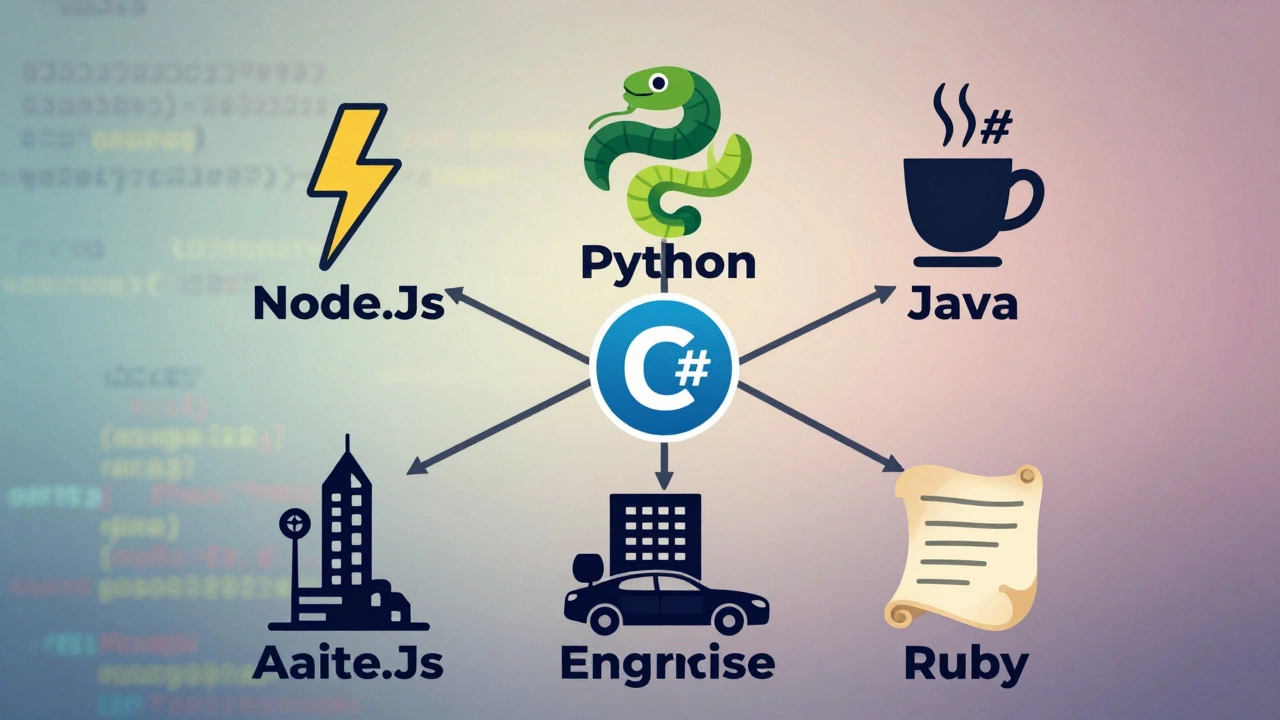
PHP still powers 77% of websites using a server-side language. WordPress, Drupal, Magento-they’re all PHP. But if you’re building a real-time chat app, you’ll reach for Node.js. If you’re doing data analysis, you’ll pick Python. If you’re in a corporate environment, you’ll likely use C#. Ruby? You’ll use it if you care about developer experience.
The truth? PHP’s closest sibling isn’t one language. It’s all of them. Each one takes a piece of what made PHP great-simple syntax, server-side execution, easy deployment-and improves it. You don’t have to choose one. You just need to know which one fits the job.
What Should You Try Next?
Here’s a quick guide based on what you’re doing right now:
- If you’re building APIs or real-time apps → Node.js
- If you’re doing data processing or machine learning → Python
- If you’re working in enterprise or banking → C#
- If you’re tired of PHP’s quirks and want clean code → Ruby
- If you’re scaling to millions of users → Java
Try this: Take one small project you’ve built in PHP-maybe a contact form, a blog, or a product catalog-and rebuild it in one of these languages. You’ll learn more in a weekend than you would in a month of tutorials.
Is PHP dying?
No. PHP still powers over 77% of websites with server-side code, including major platforms like WordPress, Facebook (historically), and Wikipedia. While its market share has slowed, it’s far from obsolete. New versions like PHP 8.3 bring modern features like typed properties, union types, and JIT compilation, making it faster and more reliable than ever.
Can I use JavaScript instead of PHP for backend tasks?
Yes. Node.js lets you run JavaScript on the server, handling database queries, file uploads, and API calls just like PHP. Many developers now use Node.js for backend logic while keeping PHP only for legacy systems. If you’re already familiar with JavaScript on the frontend, switching to Node.js for the backend feels natural and reduces context switching.
Which language is easiest to learn after PHP?
JavaScript (Node.js) is the easiest next step. The syntax is similar, the concepts (handling requests, working with files, connecting to databases) are nearly identical, and most PHP developers already use JavaScript on the frontend. You’re not learning a new paradigm-you’re just moving your logic from one environment to another.
Why do people say Python is better than PHP?
Python isn’t inherently better-it’s just more consistent. PHP has dozens of oddly named functions (str_word_count(), array_key_exists()) and inconsistent parameter orders. Python’s standard library is clean and predictable. Plus, Python excels in areas PHP struggles with, like data science, automation, and AI. If you need to go beyond web pages, Python gives you tools PHP doesn’t.
Should I learn Java if I’ve only worked with PHP?
Only if you’re aiming for enterprise roles or large-scale systems. Java is overkill for small websites, but if you’re building financial software, healthcare platforms, or systems that need 99.99% uptime, Java’s strict typing, performance, and mature ecosystem make it the safer choice. It’s a bigger leap than Node.js or Python, but it opens doors PHP can’t.