
Backend Technology Selector
Select your primary project requirement to see the recommended technology stack.
Content & CMS
Blogs, portfolios, standard e-commerceReal-time Interaction
Chat apps, live dashboards, collaborative toolsData & AI
Machine learning, heavy data analysisHigh Scale/Speed
Microservices, millions of requests/sec- Best For:
- Performance:
- Learning Curve:
- Ecosystem:
Ready to Analyze
Select a project type above to get personalized recommendations based on the 2026 landscape.
There is a persistent myth floating around developer communities: that PHP is dead. You hear it in Twitter threads, see it in clickbait headlines, and even encounter it from junior developers who were taught to fear legacy code. But if you look at the actual numbers, the story is far more nuanced. PHP powers roughly 75% of all websites with a known server-side language, including giants like Facebook (Meta), Wikipedia, and WordPress. It hasn't been "replaced" in the sense of being wiped off the map. Instead, its role has shifted dramatically.
The question isn't really "what replaced PHP?" because nothing single-handedly killed it. The real question is: "What technologies have taken over the new projects that used to default to PHP?" In 2026, the landscape for building dynamic web applications has fragmented into several powerful ecosystems. Developers are choosing tools based on performance needs, team expertise, and architectural preferences rather than following a single dominant trend.
The Rise of Server-Side JavaScript
If there is one technology that has captured the imagination of startups and modern agencies, it is Node.js, which enables server-side execution of JavaScript. For years, JavaScript was confined to the browser, handling clicks and animations. Then came Node.js, allowing developers to use the same language on the back end. This unified the stack. Front-end and back-end teams could now speak the same language, share code, and move faster.
Frameworks built on top of Node.js, such as Express.js and later NestJS, provided structure and scalability that rivaled traditional PHP frameworks like Laravel. The non-blocking I/O model of Node.js made it exceptionally good at handling many simultaneous connections, which is perfect for real-time applications like chat apps, collaborative tools, and live dashboards.
However, Node.js didn't replace PHP for every use case. It excels in high-concurrency scenarios but can struggle with CPU-intensive tasks. PHP, particularly with the introduction of PHP 8.1 and 8.2, improved significantly in performance and memory management. So while Node.js took the crown for new, high-growth tech companies, PHP remained the workhorse for content-heavy sites and small-to-medium businesses.
Python and the Data-Driven Web
Another major contender that has eaten into PHP's territory is Python, specifically through frameworks like Django and Flask. Python's rise is tied closely to the explosion of data science, artificial intelligence, and machine learning. Companies that want to integrate AI features directly into their web applications often choose Python because the ecosystem for data processing is unmatched.
Django, in particular, offers a "batteries-included" approach similar to what Laravel does for PHP. It comes with an admin panel, authentication, and ORM out of the box. For teams that need to build complex data models quickly, Django is a compelling alternative. If your project involves heavy data analysis or integration with ML models, Python becomes the logical choice, effectively replacing PHP in those specific niches.

Rust and Go: The Performance Powerhouses
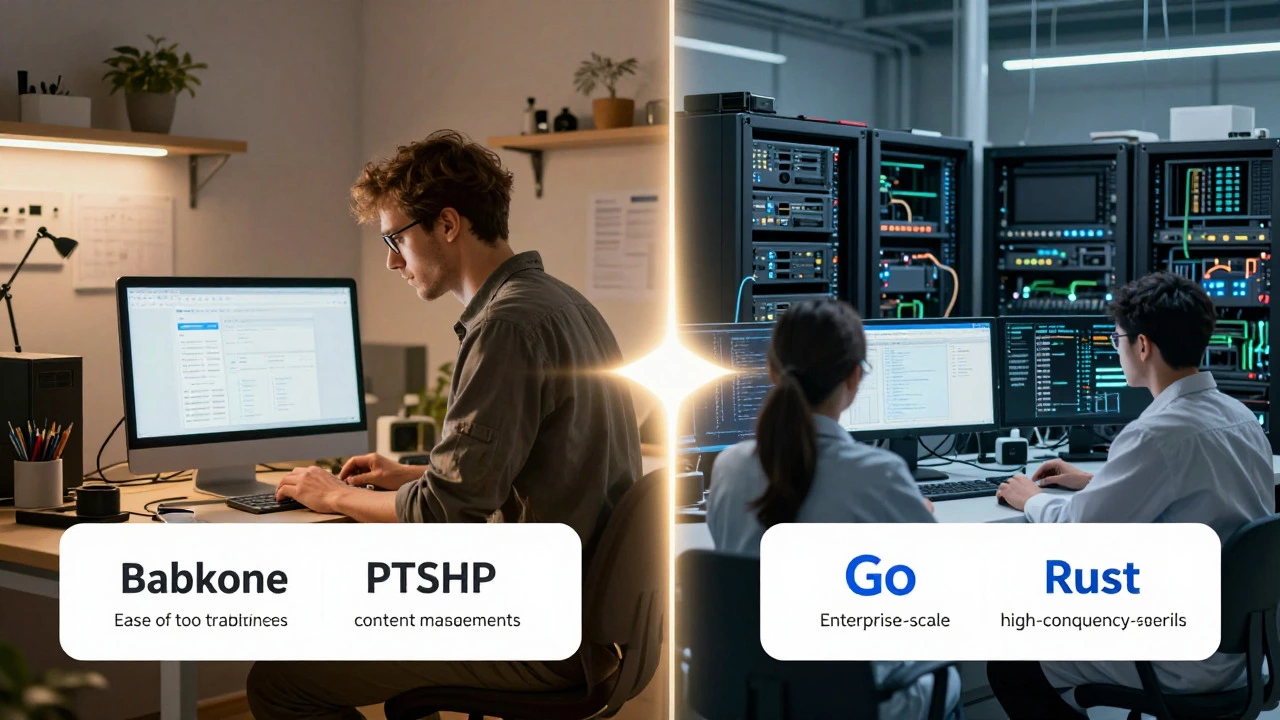
For projects where raw speed and reliability are non-negotiable, developers are turning to compiled languages like Rust and Go (Golang). These aren't direct replacements for PHP in terms of ease of use, but they are replacing PHP in infrastructure-heavy roles. Go, developed by Google, is known for its simplicity and excellent concurrency support. It handles microservices architecture beautifully, making it ideal for large-scale distributed systems.
Rust, on the other hand, focuses on memory safety without garbage collection. While the learning curve is steep, Rust is gaining traction in web development through frameworks like Actix and Axum. Companies like Cloudflare and Dropbox have adopted Rust for critical parts of their stack to improve performance and security. If you are building a system that needs to handle millions of requests per second with minimal latency, Rust or Go might be the answer, leaving PHP behind in those high-performance tiers.
Why PHP Is Still Alive and Well
Despite the hype around newer languages, PHP continues to evolve. The release of PHP 8.x introduced Just-In-Time (JIT) compilation, typed properties, and union types, making the language more robust and type-safe. Modern PHP frameworks like Laravel and Symfony offer developer experiences that rival any modern stack. They include elegant syntax, powerful testing tools, and extensive community support.
Moreover, the sheer volume of existing PHP code ensures its longevity. Rewriting a mature application in another language is expensive and risky. Many organizations prefer to maintain and gradually modernize their PHP codebases rather than start from scratch. WordPress alone accounts for over 40% of all websites on the internet, ensuring that PHP remains relevant for decades to come.
| Technology | Best Use Case | Learning Curve | Performance | Ecosystem Maturity |
|---|---|---|---|---|
| PHP | Content Management Systems, Small Business Sites | Low | Good (with optimization) | Very High |
| Node.js | Real-time Apps, Single Page Applications | Medium | High (I/O bound) | High |
| Python | Data-Driven Apps, AI Integration | Low-Medium | Medium | High |
| Go | Microservices, High-Concurrency Systems | Medium | Very High | Medium |
| Rust | Critical Infrastructure, Security-Focused Apps | High | Extremely High | Growing |
Choosing the Right Tool for Your Project
So, what should you choose? There is no one-size-fits-all answer. If you are building a blog, a portfolio, or a standard e-commerce site, PHP with WordPress or Laravel is still a fantastic choice. It gets you to market quickly with minimal overhead. If you are building a real-time collaboration tool or a highly interactive single-page application, Node.js paired with React or Vue.js is likely the better fit.
For data-heavy applications or those requiring AI capabilities, Python offers unparalleled libraries and frameworks. And if you are working on a large-scale enterprise system with strict performance requirements, consider Go or Rust. The key is to evaluate your specific needs, your team's skills, and the long-term maintenance costs before making a decision.
In short, PHP hasn't been replaced; it has been contextualized. It remains a vital part of the web development ecosystem, sharing space with a diverse array of modern technologies. Understanding the strengths and weaknesses of each allows you to make informed decisions that align with your project goals.
Is PHP really dead?
No, PHP is not dead. It powers approximately 75% of all websites with a known server-side language. While newer technologies have gained popularity for specific use cases, PHP remains widely used, especially for content management systems like WordPress.
What is the best alternative to PHP for beginners?
For beginners, Node.js is often recommended because it uses JavaScript, which is already familiar from front-end development. Python is also a great choice due to its simple syntax and extensive documentation.
Should I rewrite my PHP application in another language?
Not necessarily. Rewriting is expensive and risky. Unless your current PHP application has significant performance issues or lacks necessary features, it is usually better to maintain and gradually modernize the existing codebase.
Which language is faster: PHP or Node.js?
It depends on the workload. Node.js generally performs better for I/O-bound tasks and real-time applications due to its non-blocking architecture. PHP has improved significantly with PHP 8.x and JIT compilation, making it competitive for traditional request-response cycles.
Can I use PHP for large-scale enterprise applications?
Yes, PHP can be used for large-scale applications. Frameworks like Symfony and Laravel provide the structure and tools needed for enterprise-level development. However, for extremely high-concurrency systems, languages like Go or Rust might offer better performance.