Web Professional Hiring & Career Matcher
Answer the questions below to find out who you should hire for your website project, or which career path aligns with your skills.
You’ve probably heard the terms web designer and web developer used interchangeably. But if you’re trying to hire someone for a project-or decide which career path to take-knowing the difference is crucial. One focuses on how a site looks and feels; the other makes sure it actually works. Confusing them can lead to hiring the wrong person, wasted budget, and a website that either looks great but breaks constantly or functions perfectly but drives users away.
The Core Distinction: Visuals vs. Logic
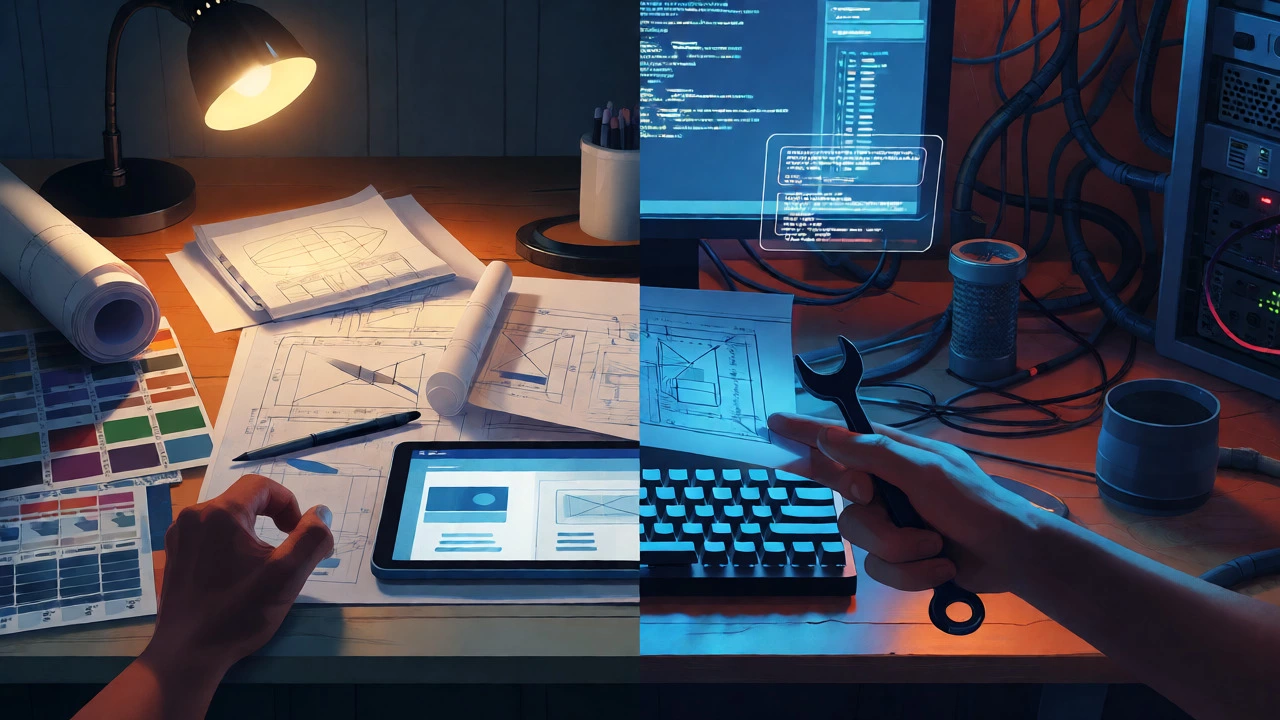
Think of building a house. The web designer is the architect and interior decorator. They decide where the windows go, what color the walls are, and how the layout flows so people feel comfortable moving through the space. Their job ends when the blueprints and mockups are ready.
Web developers, on the other hand, are the construction crew, electricians, and plumbers. They take those blueprints and build the actual structure. They wire the electricity (code), ensure the water flows (database connections), and make sure the roof doesn’t leak when it rains (bug fixing).
In digital terms:
- Designers handle aesthetics, user experience (UX), and brand identity.
- Developers handle code, functionality, performance, and security.
What Does a Web Designer Actually Do?
A web designer’s primary goal is to create an interface that users want to interact with. This isn’t just about picking pretty colors. It involves deep strategic thinking about human behavior.
Most modern designers specialize in UI/UX Design. User Interface (UI) refers to the visual elements-buttons, icons, typography, and spacing. User Experience (UX) is the invisible logic behind those visuals. Why does the "Buy Now" button turn green? Why is the navigation bar at the top instead of the side? These decisions come from data and psychology, not just artistic preference.
Common tools include:
- Figma: The industry standard for collaborative interface design.
- Adobe XD: Popular for rapid prototyping and vector-based design.
- Sketch: A long-time favorite for macOS users, though Figma has largely overtaken it.
Designers deliver assets like style guides, wireframes, and high-fidelity prototypes. They don’t usually write production-ready code, though many understand HTML and CSS well enough to communicate effectively with developers.
What Does a Web Developer Actually Do?
Developers translate design files into functioning websites. This role splits into three main categories, each requiring different skill sets.
Front-End Developers
These are the closest partners to designers. They use HTML, CSS, and JavaScript to build the parts of the website users see and interact with. If a designer draws a button, the front-end developer codes the hover effect, ensures it clicks correctly, and makes sure it looks good on both an iPhone and a desktop monitor.
Back-End Developers
These developers work "behind the scenes." They manage servers, databases, and application logic. If you submit a contact form, the back-end developer writes the code that saves your message to a database and sends an email. Common languages include Python, Ruby, Java, and PHP.
Full-Stack Developers
As the name suggests, these pros handle both front-end and back-end tasks. They can design a simple layout, code the interface, set up the server, and manage the database. While they might not be experts in every single area, their versatility makes them invaluable for startups and small projects.

Side-by-Side Comparison
To clarify the distinctions, here is a breakdown of typical responsibilities, tools, and skills.
| Feature | Web Designer | Web Developer |
|---|---|---|
| Primary Focus | Visual appeal, usability, brand consistency | Functionality, speed, security, scalability |
| Key Skills | Creativity, empathy, color theory, typography | Logic, problem-solving, syntax mastery, debugging |
| Common Tools | Figma, Adobe Creative Cloud, Sketch | VS Code, Git, Chrome DevTools, Terminal |
| Languages Known | Basic HTML/CSS (often) | HTML, CSS, JavaScript, Python, SQL, PHP |
| Deliverables | Mockups, prototypes, style guides | Live website, API endpoints, source code |
Why the Lines Are Blurring
Here’s where it gets tricky. In 2026, the distinction is less rigid than it was ten years ago. No-code platforms like Webflow and Framer allow designers to publish fully functional sites without writing traditional code. Conversely, many developers now have a sharp eye for design, creating clean, modern interfaces without needing a dedicated designer.
This hybrid role is often called a "Design Engineer." These professionals bridge the gap, understanding both the aesthetic requirements and the technical constraints. For small businesses, hiring one versatile person who can handle both design and basic development is often more cost-effective than hiring two specialists.
However, for complex applications-like a social media platform or an e-commerce site with thousands of products-you still need specialists. A designer can’t optimize database queries, and a developer can’t intuitively fix a confusing checkout flow just by looking at the code.

Which Career Path Should You Choose?
If you’re considering a career switch or choosing a course, ask yourself these questions:
- Do you enjoy solving logical puzzles? If you love breaking down big problems into smaller steps and finding bugs, coding (development) will likely satisfy you.
- Are you obsessed with aesthetics? If you spend hours tweaking font kerning or wondering why a certain shade of blue feels "off," design is your lane.
- Do you prefer immediate feedback? Developers often get instant gratification when code runs successfully. Designers deal with subjective feedback that can change based on client mood, which requires thicker skin.
For beginners, starting with front-end development is often recommended. Learning HTML and CSS gives you a tangible output immediately, and it provides a solid foundation whether you lean toward design or deeper engineering later.
Hiring Guide: Who Do You Need?
When you’re ready to hire, match the role to the project stage.
Hire a Designer When:
- You are launching a new brand and need a unique visual identity.
- Your current site looks outdated or confuses users.
- You need to improve conversion rates through better user journeys.
Hire a Developer When:
- You have approved designs and need them built.
- You need custom features that templates can’t provide.
- Your site is slow, broken, or insecure.
Hire Both When:
- You are building a complex web application.
- You have the budget for specialized expertise.
- The project timeline allows for iterative design and development cycles.
Frequently Asked Questions
Can a web designer do web development?
Yes, many web designers learn basic HTML and CSS to better control their designs. However, they typically lack the depth of knowledge required for complex back-end logic, database management, and advanced JavaScript frameworks. For simple brochure-style websites, a skilled designer using no-code tools can often handle the entire process.
Who earns more, a web designer or a web developer?
Generally, web developers earn higher salaries than web designers. According to recent industry reports, entry-level developers often start at higher pay scales due to the technical complexity of coding. Senior full-stack developers can command significantly higher wages than senior designers, though top-tier UX designers in tech hubs can also achieve very competitive compensation.
Do I need a developer if I use WordPress?
Not necessarily. WordPress is a content management system designed for non-developers. Many themes and page builders (like Elementor or Divi) allow you to design and launch a site without writing code. However, if you need custom plugins, specific integrations, or performance optimizations beyond standard settings, a developer becomes essential.
Is coding harder than design?
This is subjective. Coding requires strict logical precision-a missing semicolon can break an entire script. Design requires creative intuition and empathy, which can be harder to quantify. Many people find the initial learning curve of coding steeper because of the abstract nature of programming concepts, while others struggle with the open-ended nature of design challenges.
What is a Front-End Developer?
A front-end developer is a specialist who builds the client-side of a website. They focus on what the user sees and interacts with, using technologies like HTML, CSS, and JavaScript. They act as the bridge between the visual design created by a designer and the underlying data managed by back-end developers.