
SEO Score vs. Traffic Reality Simulator
Scenario Builder
Adjust the settings below to see how a "Perfect" technical score can hide poor user experiences.
Technical Hygiene (The Easy Points)
Performance & Experience (The Hard Work)
Audit Tool Result
Tools love clean code and tags!
Real-World Outlook
Your technical setup is perfect, and your speed is fast. You are well-positioned to rank.
You see the red progress bar. It stops at 72%. You tweak a few tags, add a meta description, compress an image, and boom-SEO score hits 100%. Does that mean you're winning at Google? Probably not. In my experience building sites in Dublin, I've seen clients obsess over hitting a perfect number while their traffic stays flat. Here is the hard truth: an SEO score of 100 is often just a vanity metric, not a guarantee of ranking.
The Truth About SEO Audit Scores
When you plug your URL into a tool, the software runs a checklist. It looks for easy fixes. Is there a title tag? Yes, +1 point. Is the site HTTPS? Yes, +1 point. Did you define an Open Graph image? Another point added. This creates a composite number out of 100. The problem is that these tools guess what Google cares about based on public best practices, not the actual algorithm.
An SEO audit score is a heuristic metric generated by third-party tools to estimate website health, often ranging from 0 to 100, but it does not directly correlate with actual search engine rankings.If you optimize solely for the tool, you might end up with a technically perfect page that has nothing useful to say. Google's algorithm is built on signals like user behavior, authority, and fresh relevance. A tool checking your robots.txt file cannot measure whether people actually like reading your content. Think of the score as a report card for compliance, not popularity. If you ignore the nuance, you're just moving digital furniture around.
Why Audit Tools Differ from Reality
Different platforms calculate this score differently. One tool might penalize you heavily for missing alt text on images, dropping your score to 60. Another might prioritize mobile responsiveness. There is no universal "Google" score available to the public. We have Google Search Console, which gives us diagnostics, but even that doesn't offer a single percentage number.
| Source Type | What It Measures | Real-World Impact |
|---|---|---|
| Aggregator Tools | META tags, broken links, SSL, sitemaps | Low - mostly technical hygiene |
| Rankings Data | Positions for target keywords | High - directly ties to visibility |
| User Engagement | Bounce rate, time on page | Very High - signals content quality |
Developers often get stuck fixing things that boost the audit score but barely move the needle on performance. For example, a tool might warn you about the character count of your meta description. Changing "Best Coffee Shop" to "Best Coffee Shop in Dublin for Amazing Brews" changes your score but likely doesn't change how Google ranks you. The search engine truncates snippets anyway. Focus on what impacts rendering and crawling instead.
Metrics That Actually Matter in 2026
If the general score is fuzzy, where should you focus your energy? You need to look at Core Web Vitals. These are concrete numbers measured in seconds and pixels. Unlike a generic 0-100 score, these metrics tell you exactly how slow or jumpy your site feels to a human being.
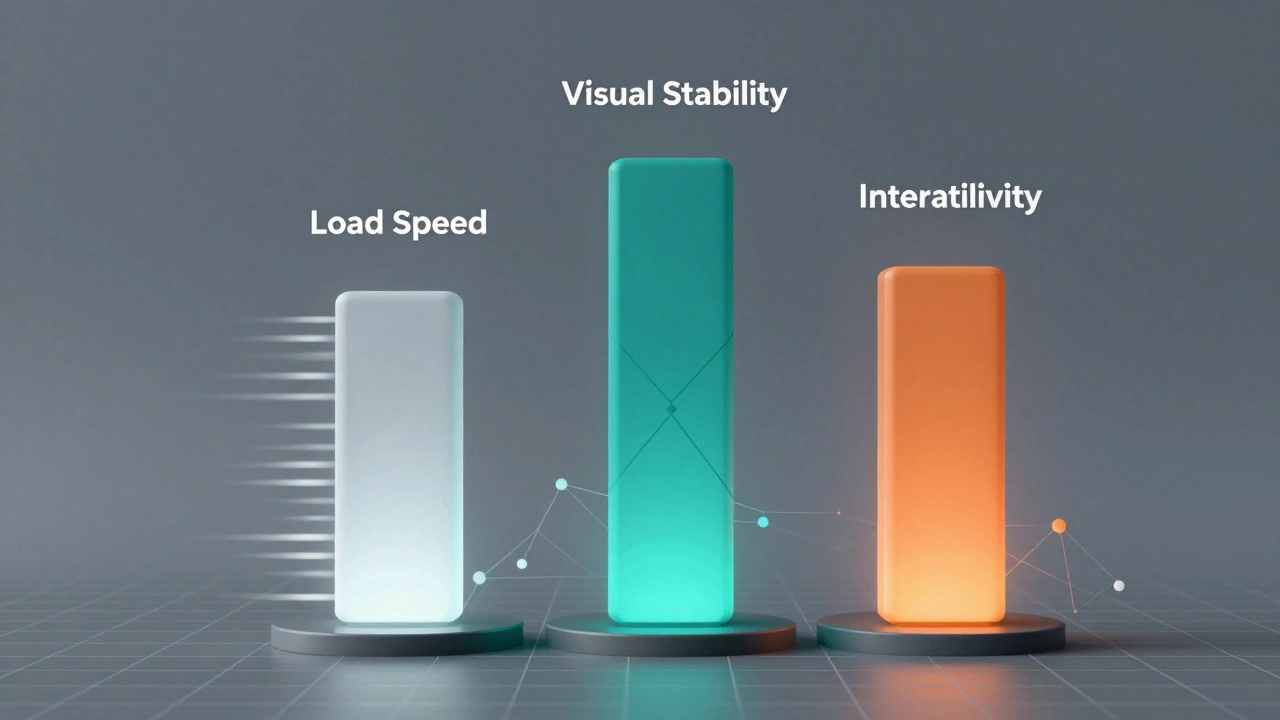
In 2026, these three metrics remain the gold standard for page experience:
- Largest Contentful Paint (LCP): This measures load speed. You want the main part of your content to appear in under 2.5 seconds. If your hero image takes 5 seconds to render, users will bounce before reading a word. Google sees this drop-off as a negative signal.
- Cumulative Layout Shift (CLS): This measures visual stability. If a user clicks a button and the layout shifts suddenly because an ad loaded underneath it, that is a bad experience. Keep CLS below 0.1. Avoid loading images without width and height attributes.
- Interaction to Next Paint (INP): This replaced First Input Delay. It measures how responsive your site is when someone interacts with it. If clicking a filter takes half a second to show results, that hurts your engagement metrics.
Audit tools often hide these specific values behind a green "Good" badge. Dig into the data. A score of 100 is useless if your LCP is 4.0 seconds. Real optimization requires analyzing your critical rendering path. As developers, we control the DOM size, script execution time, and server response. Those factors determine the raw data that feeds into the ranking algorithms.
Developer Actions Over Marketing Fluff
Many SEO guides tell developers to write better titles. While important, this is often handled by copywriters. What needs your technical skills? Fix the architecture. A site with a 100% score can still fail if the crawl budget is wasted on duplicate URLs. Check your canonical tags. Ensure your XML sitemap is accessible at `/sitemap.xml`. If search engines can't parse your directory structure, your on-page optimizations won't matter.
Consider the backend performance. If your CMS is generating heavy JSON objects for the API, that slows down the initial paint. Optimization involves reducing payload sizes. Use Brotli compression. Implement lazy loading for off-screen images. Don't preload scripts you don't need immediately. Every millisecond counts toward those Core Web Vitals mentioned earlier.
Also, look at accessibility. Accessibility features often overlap with SEO. Proper heading structures (H1, H2, H3) help screen readers understand your hierarchy, and Google uses that same hierarchy to understand your content flow. Missing H1 tags are common in WordPress themes. They tank your audit score and confuse crawlers. Writing semantic HTML is one of the fastest ways to improve both accessibility and search visibility without needing keyword stuffing tricks.
Common Pitfalls of Chasing the Number
When developers chase a 100% score, they often make mistakes. One common error is over-stuffing keywords to satisfy density checks found in older tools. In modern SEO, exact-match keywords matter far less than topic relevance. If a tool flags your content for having too many keywords, ignore it. Focus on natural language.
Another trap is ignoring external link opportunities. Many audit tools calculate an "authority" score based on the quantity and quality of backlinks pointing to your domain. You cannot fix this by changing internal code. You might have a perfect technical setup but zero inbound links. A 100% internal optimization score means nothing if your Domain Rating is zero. Building relationships and earning mentions is a separate process entirely.

When a High Score Actually Helps
Does this mean you should ignore the dashboard completely? Not entirely. A high score can flag specific technical errors that cause immediate issues. If your HTTP Status Code isn't 200 OK, the page isn't loading. If your mobile viewport isn't set, users will struggle to read. In these cases, the checklist is a diagnostic aid, not a ranking crystal ball. Use the green lights to confirm basic hygiene, but use analytics data to confirm success.
For local businesses, the correlation might be slightly tighter. If you run a bakery in Cork, optimizing your NAP (Name, Address, Phone) consistency and Local Business schema helps significantly with Map Pack rankings. A generic SEO score might miss this nuance, so ensure you have structured data implemented correctly.
Conclusion: Look at Traffic, Not Points
The bottom line is simple: Do not celebrate a 100 score until you see the traffic increase. A perfect score is just a snapshot of a technical checklist at a single moment in time. It doesn't account for competitor movement, seasonality, or brand reputation. Use the tool to find quick wins like broken links or missing descriptions, but spend the rest of your budget on building authority and ensuring your site loads fast.
Treat SEO as an iterative engineering problem, not a game to beat. Fix the bugs, ship faster pages, and let the rankings follow.
Is a 100% SEO score necessary to rank on Google?
No. Google does not provide a public SEO score, and third-party scores do not dictate rankings. You can rank well with a lower score if your content and authority are strong.
Which SEO metrics should developers prioritize?
Focus on Core Web Vitals (LCP, CLS, INP), mobile-friendliness, and HTTPS status. These have the most direct impact on user experience and ranking signals.
Does increasing keyword density improve the score?
Not necessarily. Modern tools may penalize over-optimization, but keyword density itself has minimal impact compared to content relevance and search intent.
How often should I run an SEO audit?
Run technical audits quarterly. However, monitor Core Web Vitals and organic traffic weekly using Google Search Console to catch performance dips early.
Can I fix a low SEO score without coding knowledge?
Some fixes require coding, such as adjusting schema markup or server caching headers. Simple issues like meta descriptions can be edited via CMS settings.