
Python vs C++ Front-End Comparison Tool
Compare Development Experience for Front-End Tasks
Memory Management Front-End Impact
Python: Automatic garbage collection. No manual memory management required.
Compilation Process Front-End Impact
C++: Requires compilation before execution. Must save, compile, and debug errors.
Type System Front-End Impact
Python: Dynamically typed. Handles mixed data types automatically.
Debugging Experience Front-End Impact
C++: Segmentation faults with minimal error information.
Which Language Wins for Front-End Development? Key Takeaway
Python is the clear winner for front-end development workflows. Its automatic memory management, immediate feedback cycle, dynamic typing, and rich ecosystem make it ideal for automation, scripting, and tooling.
Why This Matters for You
As a front-end developer, learning Python will save you hours of development time while C++ introduces unnecessary complexity. Focus on JavaScript, TypeScript, and Python for automation tasks—your productivity will thank you.
If you're starting out in front-end development, you've probably heard people say Python is easy and C++ is a nightmare. But why? It’s not just about syntax. It’s about what’s happening under the hood-and how much you need to manage yourself.
Python Lets You Focus on What Matters
Python was built for clarity. Want to print "Hello World"? Type print("Hello World") and hit enter. No headers, no compilers, no memory allocation. You write code that reads like plain English, and it just works.
When you’re building a front-end tool-like a script that automates form validation or pulls data from an API-Python handles the heavy lifting. You don’t need to worry about pointers, manual memory cleanup, or data types. A string is a string. A number is a number. You can loop through a list without declaring its size. That freedom lets you solve problems faster.
Front-end developers who use Python for tools like Selenium for browser automation or Flask for quick internal dashboards aren’t writing web pages with it. They’re using it to make their workflow smoother. And that’s the point: Python reduces friction.
C++ Makes You Manage Everything
C++ doesn’t hold your hand. If you want to store text in C++, you have to choose: char[], std::string, or a pointer to a character array. Each has rules. Each has traps.
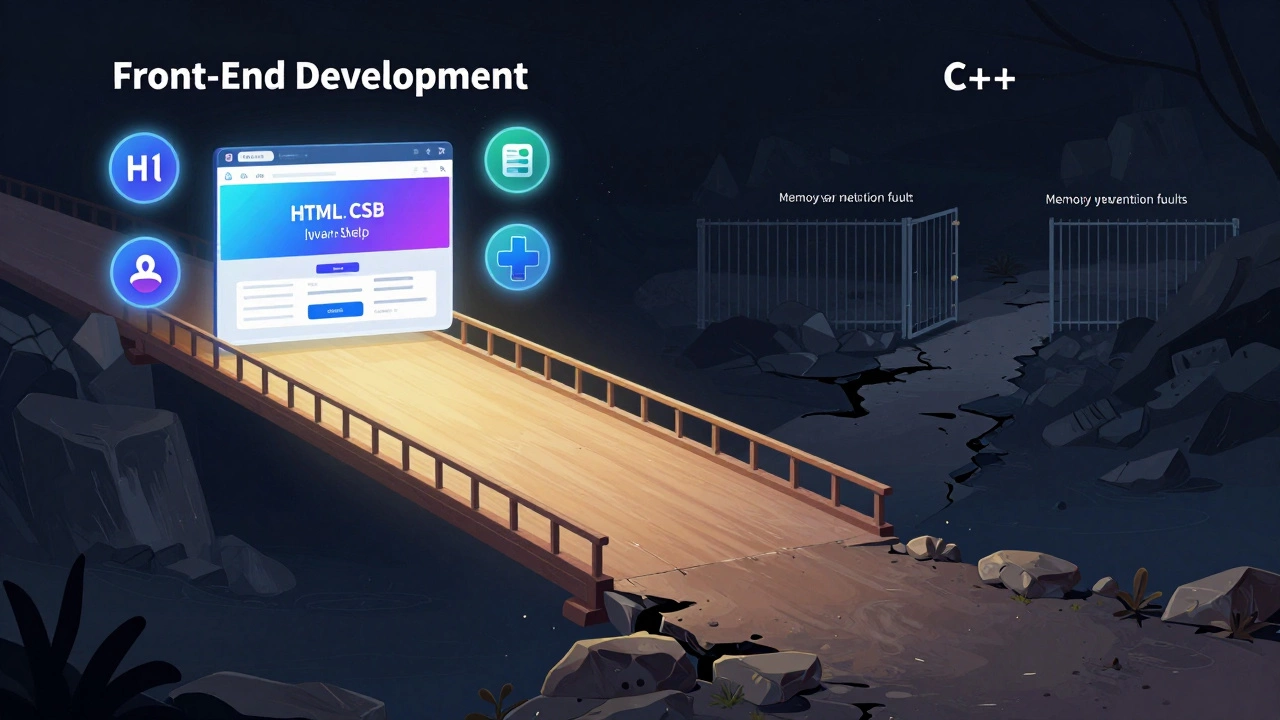
Memory management is the biggest hurdle. You can allocate memory with new, but if you forget delete, your program leaks memory. And leaks don’t crash right away-they creep in, slow things down, and make your app unstable. In front-end work, that’s unacceptable. Users don’t want browsers that lag because a script didn’t clean up after itself.
Then there’s compilation. Python runs line by line. C++ needs to be compiled into machine code first. That means writing code, saving it, running a compiler, fixing errors, and repeating. For someone used to refreshing a browser to see changes, that’s a huge slowdown.
Types Don’t Lie-But They Can Confuse
Python is dynamically typed. You write x = 5, then x = "hello". The language figures it out. C++ is statically typed. You must declare: int x = 5;. Change the type? You change the declaration. It’s strict. And that’s good for performance-but bad for beginners.
Front-end developers often work with messy, changing data: JSON from APIs, user inputs, form fields. Python handles that naturally. C++ forces you to define every type in advance. What if the API returns a number as a string? In Python, you convert it with int(). In C++, you need to parse it manually, handle exceptions, and make sure the buffer doesn’t overflow.
Even simple things like arrays become complicated. In Python: arr = [1, 2, 3]. In C++: you need to declare size, use std::vector, or risk buffer overflows with raw arrays. One wrong index, and your program crashes-or worse, it runs but corrupts data.
Tooling and Ecosystems Are Worlds Apart
Front-end development thrives on tools. npm, Webpack, Babel, React, Vue-they all run on JavaScript, but developers use Python to support them. Think of linters, test runners, build scripts. Most are written in Python because it’s fast to write and easy to maintain.
C++ has libraries, sure. But they’re not designed for web tooling. You won’t find a C++ package manager that works like pip or npm. You won’t find a C++ library that lets you scrape a webpage with three lines of code. The ecosystem is built for systems programming: operating systems, game engines, embedded devices-not web automation.
Try installing a C++ library on Windows, macOS, and Linux. You’ll need to compile it from source, link dependencies, handle different compiler versions. Python? pip install requests. Done.
Debugging Is a Different Beast
When your Python script crashes, you get a clean error: ValueError: invalid literal for int() with base 10: 'abc'. You know exactly what went wrong and where.
In C++, you might get a segmentation fault. That means your program tried to access memory it didn’t own. But why? Was it a null pointer? An out-of-bounds array? A dangling reference? The error message gives you almost nothing. You need a debugger, memory analyzers, and hours of tracing through code.
For front-end developers who need to iterate quickly-testing a UI change, fixing a bug, deploying a fix-time is money. C++ eats time. Python gives it back.
Why Do People Still Use C++?
It’s not that C++ is "better." It’s that it’s necessary in places Python can’t go. Game engines like Unreal use C++ because they need every drop of performance. Real-time systems, high-frequency trading, embedded hardware-those need C++. But none of those are front-end development.
If you’re building a website, a web app, or a browser extension, you don’t need C++. You need speed of development, readability, and reliability. That’s Python’s sweet spot.
Even if you’re working with WebAssembly now-where C++ can compile to run in browsers-it’s still the exception. Most front-end devs use JavaScript, TypeScript, or Python tools behind the scenes. C++ is a specialist’s tool, not a generalist’s.
What Should You Learn First?
If you’re learning front-end development, start with HTML, CSS, JavaScript. Then add Python if you want to automate tasks, build scripts, or understand how tools work under the hood.
Don’t waste time on C++ unless you’re targeting performance-critical systems, like a browser engine or a plugin for a game. Even then, you’ll likely be working with teams that already know C++. You don’t need to learn it to be a great front-end developer.
Python teaches you how to solve problems. C++ teaches you how computers work. Both are valuable. But if your goal is to build websites quickly, reliably, and without headaches-Python wins. Every time.
Is C++ used in front-end development at all?
C++ isn’t used directly in most front-end development. Websites are built with HTML, CSS, and JavaScript. But C++ can be compiled to WebAssembly to run high-performance code in browsers-like image editors or 3D renderers. Even then, it’s rare and usually handled by specialists. Most front-end tools (build scripts, linters, automation) are written in Python or JavaScript.
Can I use Python for front-end tasks?
Yes, but not in the browser. Python runs on the server or locally on your machine. Front-end devs use Python to automate testing with Selenium, generate reports, scrape data, or build internal tools with Flask or FastAPI. You can’t write a React component in Python, but you can use Python to make your workflow faster.
Why do some developers say C++ is more powerful?
C++ gives you direct control over memory, hardware, and performance. That makes it powerful for systems programming-like building operating systems or game engines. But power doesn’t mean usefulness. For building websites, that control is overkill. It adds complexity without benefit. Python’s simplicity lets you solve real problems faster.
Is it worth learning C++ if I’m a front-end developer?
Only if you plan to work on browser engines, WebAssembly projects, or performance-critical plugins. For 95% of front-end roles, no. Learning C++ will take months-and you’ll rarely use it. Focus on JavaScript, TypeScript, React, and Python for automation instead. Those skills pay off daily.
Does Python’s simplicity mean it’s less capable?
No. Python can do almost everything C++ can-just slower in some cases. For web automation, data processing, API calls, and scripting, Python is faster to write and just as reliable. Speed matters in development. Python lets you ship code quicker. C++ might run faster at runtime, but if it takes you 10 hours to fix a memory leak, you lost more time than you gained.