
Tech Stack Selector for 2026
Select your primary goal to see which technology fits best according to 2026 industry standards.
PHP
Laravel / SymfonyNode.js
Express / NestJSPython
Django / FlaskGo
MicroservicesWhat is your project's main requirement?
Walk into any tech conference in Dublin or San Francisco today, and you’ll hear the same question whispered in corners: "Why are we still talking about PHP?" It’s easy to assume that languages like JavaScript (specifically Node.js) and Python have completely pushed the old guard out of the door. After all, it’s 2026. The hype cycles move fast.
But here is the reality check that most bootcamps won’t tell you: PHP isn’t just surviving; it’s thriving in specific, high-value sectors. While it may not be the shiny new toy for every startup founder obsessed with full-stack JavaScript, it remains the backbone of a massive portion of the internet. If you are wondering whether to invest your time learning it or if your company should use it for a new build, the answer isn't a simple yes or no. It depends entirely on what you are building.
The Numbers Don't Lie: PHP's Market Share in 2026
Let’s look at the hard data before we get into opinions. According to W3Techs usage statistics from early 2026, PHP powers approximately 75% of all websites with a known server-side programming language. That number has been remarkably stable for years. Why? Because inertia is a powerful force in business.
When a large enterprise runs its e-commerce platform or content management system (CMS) on PHP, they don’t rewrite it in Go or Rust just because those languages are faster in benchmark tests. They optimize the existing PHP codebase. This creates a steady demand for maintenance, but does it create demand for new projects?
Yes, but with caveats. Most new PHP projects aren't greenfield startups trying to disrupt the social media landscape. They are:
- Custom CMS solutions: Businesses that need more control than WordPress offers but less complexity than a headless Java stack.
- E-commerce platforms: Magento (now Adobe Commerce) and WooCommerce remain dominant forces, both built on PHP.
- Internal tools: Rapidly deployed admin panels and dashboards where development speed matters more than raw computational power.
If your goal is to build the next viral mobile app backend, PHP might not be the first choice. But if you need to launch a robust, secure, and scalable web application quickly, PHP is still a heavyweight contender.
Modern PHP Is Not What You Remember
A lot of developers who say "I hate PHP" are actually hating PHP 5.4. That version is ancient history. Since the release of PHP 8.0 in 2020, and subsequent updates like PHP 8.3 and 8.4, the language has undergone a radical transformation. It is cleaner, faster, and significantly more type-safe.
Here are three major shifts that make modern PHP attractive for new projects:
- JIT Compilation: Introduced in PHP 8.0, Just-In-Time compilation allows PHP to execute certain operations much faster, narrowing the performance gap with compiled languages like C++ in specific scenarios.
- Strict Typing: Modern PHP encourages strict types. You can define exactly what kind of data a function accepts and returns. This reduces bugs and makes code easier to read and maintain, similar to TypeScript in the frontend world.
- Attributes: Instead of relying on messy docblock comments for metadata, PHP now uses native attributes (similar to annotations in Java). This streamlines frameworks like Symfony and Laravel.
For example, consider how clean a modern PHP class definition looks compared to five years ago. The syntax is concise, the error messages are helpful, and the developer experience (DX) has improved dramatically. Tools like Composer for dependency management and PHPUnit for testing have matured into industry standards, making PHP development feel professional and structured rather than hacky.
The Framework Factor: Laravel and Symfony
You rarely write "raw" PHP anymore. You work within a framework. In the PHP ecosystem, two giants dominate: Laravel and a PHP web framework following the MVC pattern, and Symfony.
Laravel has become incredibly popular among startups and agencies because of its elegance. It provides a "batteries-included" approach, meaning authentication, routing, caching, and queue management are built-in. For a new project, this means you can go from zero to a deployable MVP in days, not weeks. Its ecosystem, including packages like Livewire (which allows reactive UI components without writing complex JavaScript), has made it possible to build single-page-application-like experiences using mostly PHP.
Symfony, on the other hand, is the engine behind many enterprise-level applications. It is modular, meaning you only use the components you need. Companies like Spotify and Drupal rely on Symfony components. If you are building a long-term, high-security project for a bank or government agency, Symfony’s rigorous architecture and stability often win out over Laravel’s convenience.
| Feature | Laravel | Symfony |
|---|---|---|
| Learning Curve | Low to Medium | Medium to High |
| Best For | Startups, Agencies, Rapid Prototyping | Enterprise, Long-term Maintenance, Microservices |
| Flexibility | Opinionated (Magic methods) | Modular (Choose your components) |
| Community Size | Very Large | Large |
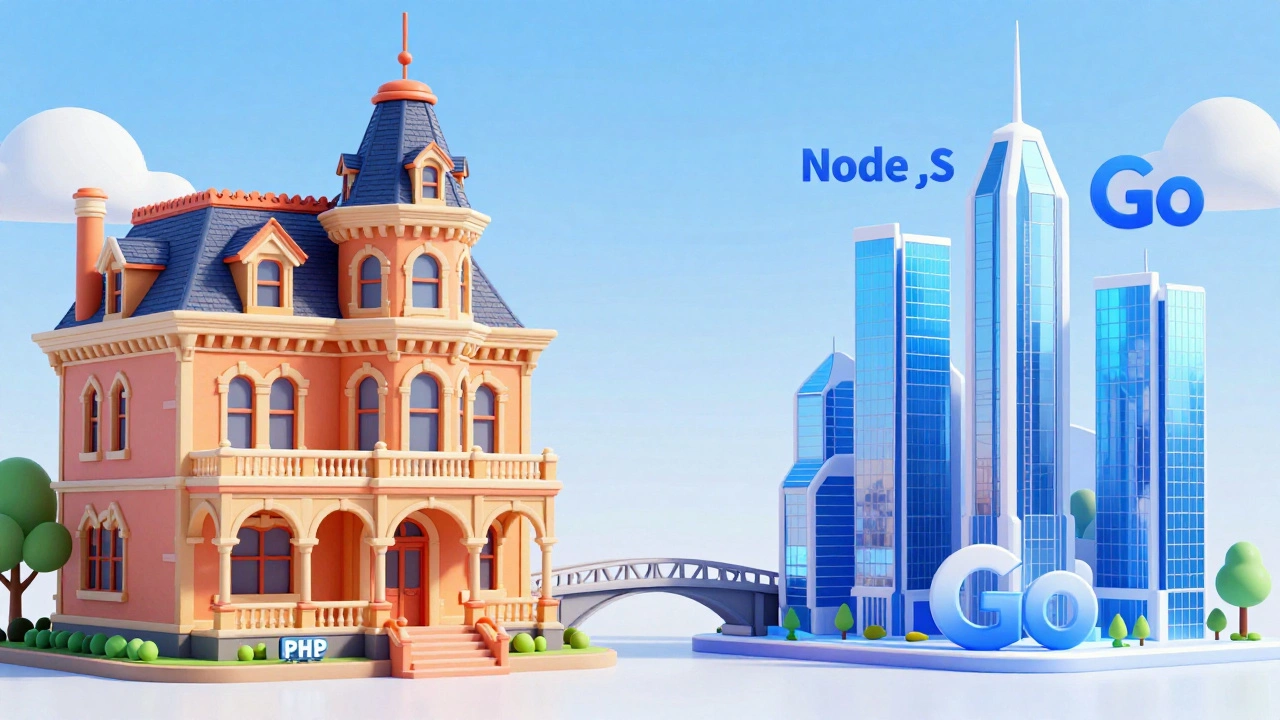
PHP vs. The Challengers: Node.js, Python, and Go
To decide if PHP is right for your new project, you have to compare it to the alternatives. Let’s break down the competition based on real-world use cases.
Node.js (JavaScript): Node is the king of real-time applications. If you are building a chat app, a collaborative document editor, or a live streaming service, Node’s non-blocking I/O model is superior. However, for traditional CRUD (Create, Read, Update, Delete) applications-like blogs, news sites, or standard e-commerce stores-PHP’s synchronous execution model is often simpler to debug and reason about. Plus, hosting PHP is generally cheaper and easier to scale horizontally on shared infrastructure.
Python (Django/Flask): Python is the undisputed leader in data science, AI, and machine learning. If your new project involves heavy data processing, recommendation engines, or AI integration, Python is the logical choice. Django is a fantastic framework, but Python’s Global Interpreter Lock (GIL) can sometimes bottleneck pure CPU-intensive tasks compared to optimized PHP-FPM setups.
Go (Golang): Go is blazing fast and efficient with resources. It’s perfect for microservices, cloud-native infrastructure, and high-concurrency systems. However, Go requires more boilerplate code and lacks the rich ecosystem of pre-built libraries that PHP frameworks offer out of the box. Building a basic blog in Go takes significantly longer than in Laravel.
So, when do you choose PHP? When you need a balance of speed-to-market, ease of deployment, and a vast library of existing solutions. PHP is the "middle ground" champion.
Hosting and Deployment: The Hidden Advantage
One aspect often overlooked is infrastructure cost and complexity. PHP was designed for the web, and the web hosting industry is built around it. Almost every hosting provider, from cheap shared hosting to premium managed VPS services, supports PHP out of the box.
In 2026, deploying a PHP application is straightforward. You can use traditional LAMP stacks (Linux, Apache, MySQL, PHP) or modern stacks like LEMP (Nginx instead of Apache). Platforms like Heroku, DigitalOcean App Platform, and AWS Elastic Beanstalk have seamless support for PHP.
Compare this to setting up a complex Node.js environment with Webpack, Babel, and various runtime dependencies, or managing a Python virtual environment with specific binary requirements. PHP’s simplicity in deployment translates to lower DevOps overhead, which is a huge plus for small teams and freelancers.
Job Market and Freelance Opportunities
If you are asking this question as a career decision, the job market tells a clear story. There is a consistent demand for PHP developers, particularly those skilled in Laravel and Symfony. Many established businesses run on legacy PHP systems that need modernization, while new agencies continue to choose PHP for client projects due to its reliability and cost-effectiveness.
Freelance platforms are flooded with requests for WordPress customization, WooCommerce store setup, and custom Laravel applications. While salaries for pure PHP roles might not always match the top-tier rates for specialized Go or Rust engineers, the volume of available work is significantly higher. It’s easier to find a $50/hour PHP gig than a $150/hour niche systems programming role.
When Should You Avoid PHP?
Being fair means admitting where PHP struggles. You should probably avoid PHP for new projects if:
- You need real-time bidirectional communication: WebSockets are supported in PHP (via Ratchet or Swoole), but they are not as native or performant as they are in Node.js or Elixir.
- You are building a heavy API gateway for millions of concurrent connections: Languages like Go or Rust handle concurrency better at the OS level.
- Your team consists entirely of frontend developers: If everyone knows React and Vue, sticking with Node.js for the backend keeps the tech stack unified (full-stack JavaScript).
However, for the vast majority of web applications-business websites, portals, marketplaces, and SaaS platforms-PHP is more than capable.
Conclusion: A Mature Tool for Serious Work
Is PHP still used for new projects? Absolutely. But it’s no longer the default "easy" choice for beginners; it’s a deliberate choice for professionals who value stability, ecosystem maturity, and rapid development. The narrative that PHP is dead is a myth perpetuated by hype cycles. In 2026, PHP is a mature, modern language that powers some of the most critical parts of the internet.
If you are starting a new project, ask yourself: Do I need cutting-edge experimental features, or do I need a reliable tool that gets the job done efficiently? If the latter, PHP deserves a serious look.
Is PHP faster than Node.js?
It depends on the metric. For raw request-per-second throughput in simple scripts, modern PHP (with OPcache) can be very fast. However, Node.js handles concurrent connections and I/O-bound tasks (like reading from databases or APIs) more efficiently due to its non-blocking event loop. For CPU-intensive tasks, neither is ideal compared to Go or C++, but PHP’s synchronous nature makes it easier to debug for typical web workflows.
Should I learn PHP in 2026?
Yes, especially if you want to work with WordPress, Laravel, or Symfony. There is a huge amount of legacy code that needs maintenance and modernization, ensuring steady jobs. Additionally, new projects still choose PHP for its ease of deployment and rich ecosystem. It is a valuable skill that complements frontend development.
What is the best PHP framework for beginners?
Laravel is widely considered the best framework for beginners due to its intuitive syntax, extensive documentation, and large community. It abstracts away much of the complexity of web development, allowing new developers to build functional applications quickly while learning best practices.
Can PHP handle high-traffic websites?
Yes. Major platforms like Facebook (historically), Wikipedia, and Slack (parts of their infrastructure) have used or use PHP. With proper optimization, caching strategies (like Redis or Memcached), and load balancing, PHP can handle millions of daily visitors efficiently.
Is PHP secure for new projects?
Modern PHP is very secure when used correctly. Frameworks like Laravel and Symfony include built-in protections against common vulnerabilities such as SQL injection, Cross-Site Scripting (XSS), and Cross-Site Request Forgery (CSRF). Security largely depends on the developer’s knowledge and adherence to best practices, not the language itself.