
Backend Language Suitability Calculator
Select all factors that apply to your current project:
Recommendation Analysis
Select options on the left to see which backend language fits your project best.
You’ve probably seen the memes. You’ve likely heard the senior developers at conferences sigh when someone mentions PHP is a server-side scripting language designed for web development that can be embedded into HTML. The narrative has been loud and persistent for a decade: PHP is dying. It’s legacy code. It’s the dinosaur of the web.
But if you look past the noise, the data tells a completely different story. As of mid-2026, PHP still powers roughly 75% of all websites with a known server-side programming language. That number hasn’t dropped significantly since 2018. So why does it *feel* like PHP isn’t popular anymore? The answer isn’t that the language is dead; it’s that the conversation has shifted.
The Visibility Trap: Why PHP Feels Invisible
The primary reason PHP seems less popular is simple: it doesn’t talk back to you on the screen. When you visit a modern website built with React or Vue.js, you see JavaScript running everywhere. You see component libraries, state management tools, and frontend frameworks dominating the developer discourse.
JavaScript has become the lingua franca of the web. It runs in the browser, on the server (via Node.js), on mobile devices (via React Native), and even on microcontrollers. Because JavaScript is omnipresent, it generates more content, more tutorials, and more hype. PHP, by contrast, stays behind the curtain. It processes your form submission, queries the database, and sends back HTML or JSON. It works so reliably and quietly that nobody notices it until it breaks.
This creates a perception gap. A junior developer learning to code in 2026 will spend 80% of their time on frontend technologies. They might never touch a PHP file unless they inherit an old WordPress site. This lack of exposure makes PHP feel obscure, even though it is arguably the most widely deployed backend language in history.
The Rise of Alternatives: Go, Rust, and Python
While PHP holds its ground in market share, it has lost its monopoly on new projects. Ten years ago, if you wanted to build a web API, PHP was the default choice alongside Ruby on Rails. Today, the landscape is fragmented.
Python has surged in popularity, driven largely by the AI and machine learning boom. If a startup wants to integrate AI features, they often choose Python for the entire stack to avoid context switching. Go (Golang) has become the darling of cloud-native infrastructure. Companies building high-concurrency microservices prefer Go for its performance and simplicity. Even Rust is making inroads into web development, offering memory safety without a garbage collector.
| Language | Primary Strength | Typical Use Case | Learning Curve |
|---|---|---|---|
| PHP | Rapid Web Deployment | Content Management Systems, Small Business Sites | Low |
| JavaScript (Node.js) | Full-Stack Consistency | Real-time Apps, SPAs, Startups | Medium |
| Python | Data Science & AI Integration | AI-driven Services, Scripting | Low-Medium |
| Go | Concurrency & Performance | Microservices, Cloud Infrastructure | Medium |
These alternatives don’t necessarily replace PHP for every job. They compete for the *new* jobs. The billion-dollar SaaS platform starting today might choose Go. The AI-powered analytics tool will choose Python. But the local bakery’s online order system? That’s still likely PHP.
The "Legacy" Misconception
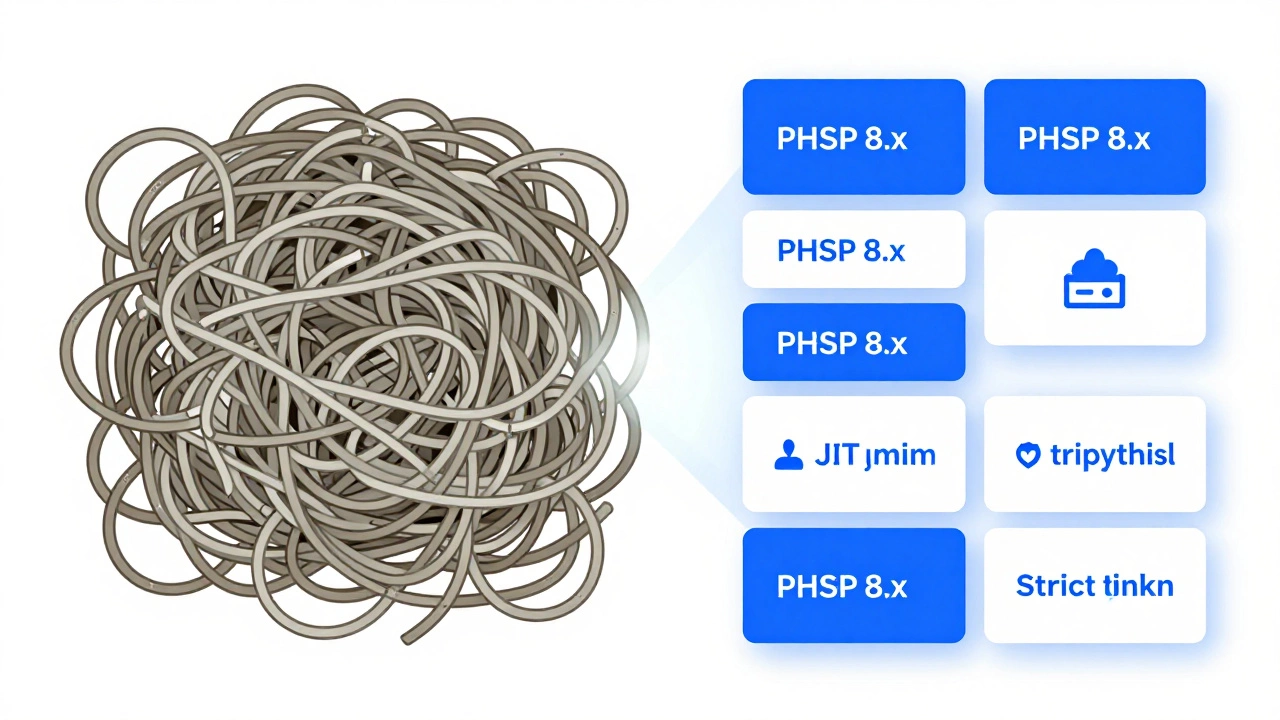
There is a dangerous conflation between "old code" and "old language." Much of the criticism aimed at PHP stems from poorly written codebases created in the early 2000s. Back then, PHP lacked strict typing, had inconsistent function naming, and offered no standard library structure. Developers could write spaghetti code with impunity.
Modern PHP (versions 8.0 through 8.4) is unrecognizable compared to its predecessor. It features:
- JIT Compilation: Just-In-Time compilation capabilities that boost performance for compute-heavy tasks.
- Strict Typing: Optional but enforceable type declarations for variables, parameters, and return types.
- Modern Syntax: Named arguments, match expressions, and constructor property promotion that make code cleaner and shorter.
- Error Handling: Exceptions instead of fatal errors, making debugging far more manageable.
When people say PHP is unpopular, they are often reacting to the reputation of PHP 5.3, which is long dead. Judging modern PHP by the standards of 2012 is like judging a 2026 electric car by the reliability of a 1998 combustion engine.
The Framework Factor: Laravel’s Dominance
If raw PHP feels boring, its ecosystem is anything but. The Laravel is a free, open-source PHP web framework following the model-view-controller architectural pattern has revitalized the community. In 2026, Laravel remains one of the most loved frameworks among professional developers, consistently ranking top-tier in surveys like Stack Overflow’s Developer Survey.
Laravel provides out-of-the-box solutions for authentication, caching, queueing, and database migrations. It allows a single developer to build complex applications quickly. This efficiency keeps PHP relevant in freelance work, agencies, and small-to-medium businesses where speed-to-market matters more than theoretical purity.
Other frameworks like Symfony provide robust components used under the hood by many other systems, including Drupal and Magento. This underlying presence means PHP is powering enterprise-level commerce platforms even if the marketing materials highlight other technologies.
Why the Hype Cycle Matters
Technology follows hype cycles. New languages get attention because they solve specific pain points or introduce novel concepts. Rust solves memory safety. Go solves concurrency. PHP solved the problem of embedding logic into HTML pages easily in the 1990s.
Because PHP’s problem is solved, it doesn’t generate excitement. It’s the utility player. It’s the spreadsheet in the office software suite. Nobody tweets about how much they love Excel, but billions of people use it daily to run their businesses. PHP is the Excel of the web backend.
The lack of hype is actually a sign of maturity. Stable, mature technologies rarely trend on social media. They just work. For hiring managers, this stability is a feature, not a bug. There is a massive pool of experienced PHP developers available, unlike niche languages where talent is scarce and expensive.
The Future of PHP in 2026 and Beyond
Will PHP ever regain the cultural cachet of JavaScript? Probably not. And that’s okay. Its role has evolved from being the shiny new toy to being the reliable workhorse.
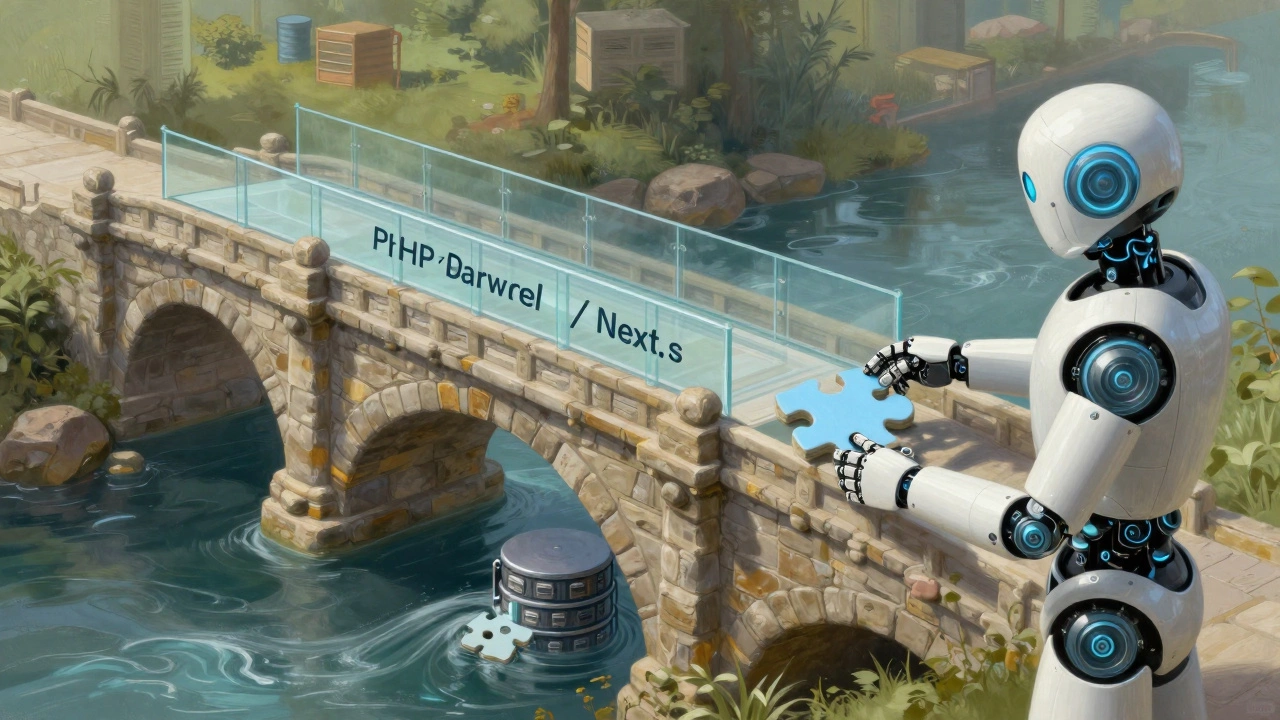
We are seeing a shift towards hybrid architectures. Many modern sites use PHP (via Laravel or headless WordPress) as a Content Management System (CMS) to manage data, while using a JavaScript frontend (Next.js or Nuxt) to render the user interface. This decoupling leverages PHP’s strength in content management and JavaScript’s strength in interactivity.
Furthermore, the rise of AI-assisted coding tools levels the playing field. Tools like GitHub Copilot understand PHP syntax perfectly well. This reduces the barrier to entry for writing clean, modern PHP, allowing new developers to produce high-quality code without memorizing decades of quirks.
So, is PHP unpopular? In terms of viral tweets and conference keynotes, yes. In terms of actual usage, revenue generation, and employment opportunities, it remains a titan. The silence around PHP is not a funeral dirge; it’s the quiet hum of servers keeping the internet running.
Is PHP still worth learning in 2026?
Yes, absolutely. If you want to work in freelancing, digital agencies, or maintain existing large-scale web applications, PHP is highly valuable. The demand for skilled PHP developers who know modern frameworks like Laravel remains strong due to the vast amount of existing codebases that need maintenance and updates.
What is replacing PHP in new startups?
Many new startups are choosing JavaScript (Node.js) for full-stack consistency, Python for AI integration, or Go for high-performance microservices. However, PHP is still chosen for content-heavy sites and rapid prototyping where development speed is prioritized over raw computational power.
Is WordPress killing PHP's reputation?
WordPress contributes to the perception that PHP is only for simple blogs. While WordPress uses PHP, modern PHP development involves complex architectures, APIs, and enterprise applications. The association with WordPress hides the depth and capability of the language itself.
How does PHP performance compare to Node.js?
For traditional request-response web applications, modern PHP (with OPcache) performs exceptionally well and often matches or exceeds Node.js in throughput per core. Node.js excels in I/O-bound, real-time applications like chat servers, whereas PHP is optimized for handling individual HTTP requests efficiently.
Will AI make PHP obsolete?
No. AI coding assistants improve productivity across all languages, including PHP. Since there is so much existing PHP code, AI tools are particularly good at helping developers refactor, secure, and modernize these legacy systems, ensuring PHP's relevance for years to come.