Backend Technology Selector
Select your primary project focus to see which technology aligns best with your needs in 2026.
PHP
Laravel/Symfony ecosystem. Best for CMS & E-commerce.
Node.js
Express/NestJS. Best for Real-time & Microservices.
Python
Django/FastAPI. Best for Data-heavy apps & AI.
Technology Name
Recommended ChoiceReasoning goes here.
You’ve heard the rumors. For years, tech Twitter and junior developer forums have been chanting the same mantra: "PHP is dead." It sounds dramatic, doesn’t it? Like a eulogy for a language that powers nearly 75% of all websites on the internet. But if you look past the hype cycles and check the actual server logs, the story is completely different. PHP is a server-side scripting language designed specifically for web development. Far from being extinct, it has evolved into a robust, high-performance tool that underpins giants like Facebook, Wikipedia, and Slack.
The question isn't whether PHP is used-it is. The real question is why so many developers *think* it’s gone. This perception gap comes from a mix of historical baggage, the rise of flashy new JavaScript frameworks, and a fundamental misunderstanding of what modern PHP actually looks like. Let’s strip away the noise and look at the facts.
The "Dead" Narrative: Where Did It Come From?
To understand why people say PHP is no longer used, we have to look back at the early 2010s. Back then, PHP was messy. You had inconsistent function naming conventions, weak typing, and security vulnerabilities that were common knowledge among hackers. If you built a site in PHP in 2012 without strict best practices, your codebase likely looked like spaghetti.
Then came the "Node.js Revolution." Suddenly, everyone wanted to use JavaScript on both the front end and the back end. It felt revolutionary. Startups flocked to Node.js is a runtime environment that executes JavaScript code outside a web browser because it allowed full-stack teams to work with one language. PHP got left behind in the cool kids' club. Tech blogs started writing clickbait headlines like "Why We Ditched PHP for Node," reinforcing the idea that sticking with PHP meant you were stuck in the past.
But here’s the thing: while the hype train moved on, PHP didn’t stop moving. It just stopped shouting about itself.
Modern PHP: A Complete Reinvention
If you learned PHP five or ten years ago, you might be shocked by what it looks like today. The language underwent a massive transformation starting with PHP 7 in 2015 and continuing through PHP 8.3 and 8.4 in 2026. This wasn’t a minor update; it was a complete architectural overhaul.
First, let’s talk speed. PHP 7 introduced the Zend Engine 3.0, which doubled performance compared to PHP 5.6. Modern PHP 8.x versions are significantly faster than their predecessors, often outperforming older versions of other languages in raw request processing. When you combine this with OPcache is a bytecode cache that stores precompiled script bytecode in shared memory, the overhead of interpreting PHP scripts becomes negligible for most web applications.
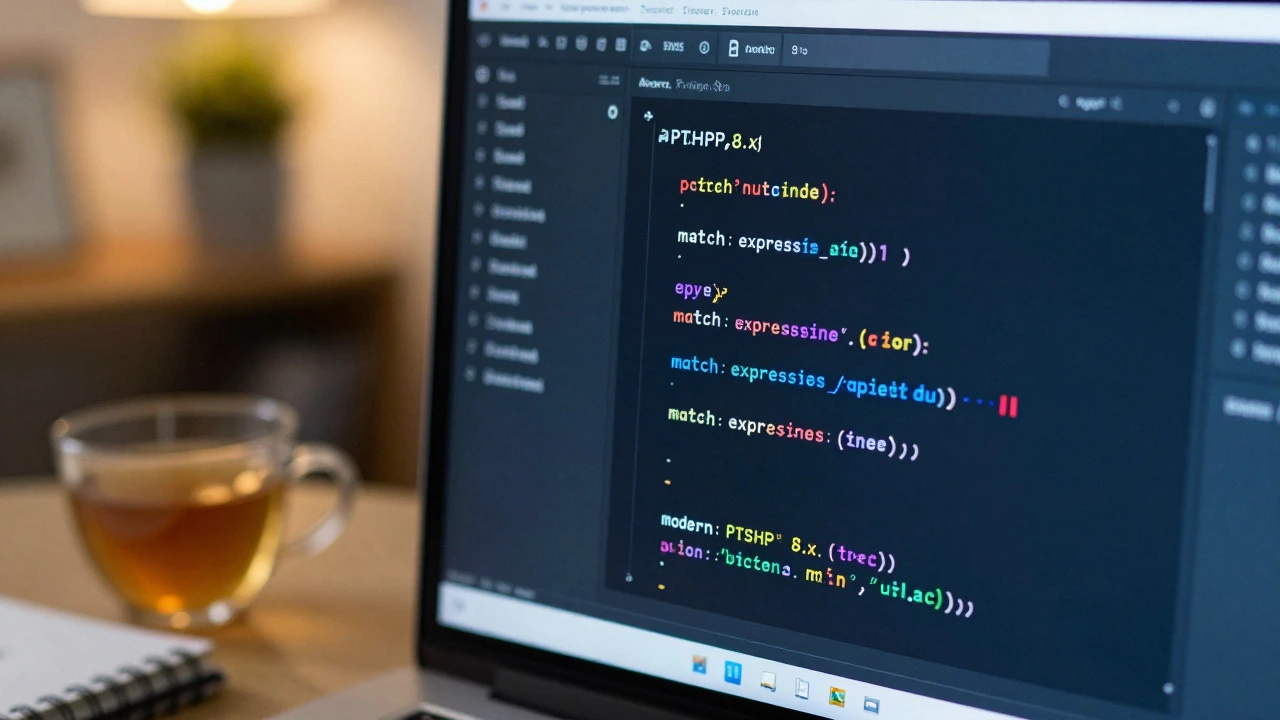
Second, the syntax is cleaner. PHP now supports typed properties, union types, match expressions, and named arguments. It feels more like Java or C# than the loose scripting language of the past. For example, instead of writing complex conditional statements, you can use the `match` expression:
return match ($status) {
    'active' => 1,
    'pending' => 0,
    default => -1,
};
This kind of modernization makes PHP readable, maintainable, and safe. It removes the "wild west" feeling that gave the language a bad reputation.
The Silent Giant: Powering the Web
Let’s look at the numbers. According to W3Techs, as of mid-2026, PHP still powers approximately 74-75% of all websites whose server-side programming language is known. That number hasn’t dropped drastically; it has stabilized. Why? Because the biggest player in the PHP ecosystem is WordPress is an open-source content management system (CMS) written in PHP.
WordPress runs over 40% of the entire internet. Small businesses, news outlets, blogs, and even large enterprise sites rely on it. Since WordPress is built on PHP, there is a massive, ongoing demand for PHP developers to maintain, customize, and secure these platforms. Even if you don’t build custom PHP apps, understanding PHP is essential if you want to work with the dominant CMS in the world.
Beyond WordPress, major companies continue to rely on PHP for core infrastructure:
- Facebook: Originally built entirely on PHP, Facebook created HHVM (HipHop Virtual Machine) to compile PHP into native machine code. While they have moved some services to Hack and other languages, the legacy and core logic remain deeply tied to the PHP lineage.
- Slack: Uses PHP for its initial MVP and continues to leverage it for specific internal tools and legacy systems due to its rapid development capabilities.
- Wikipedia: Runs on MediaWiki, a PHP-based wiki software package. Handling millions of daily views requires a stable, efficient backend, which PHP provides.
Why Developers Think It’s Obsolete
If PHP is everywhere, why does it feel invisible? There are three main reasons for this perception gap.
1. The Framework Hiding Layer Most modern PHP applications aren’t written in raw PHP. They are built using frameworks like Laravel is a popular PHP web application framework with expressive, elegant syntax or Symfony is a set of reusable PHP components and a web application framework. These frameworks abstract away much of the underlying PHP code. When a junior developer joins a team, they spend most of their time interacting with Laravel’s Eloquent ORM or Symfony’s Dependency Injection container. They rarely write raw `` code. This makes them feel like they’re not really using PHP, even though they are.
2. The Rise of Serverless and Edge Computing In 2026, the trend is moving toward serverless functions and edge computing. Languages like Go, Rust, and JavaScript (via Deno or Bun) are heavily marketed for these environments because they start up quickly. PHP, traditionally a process-per-request model, was seen as slow to boot. However, tools like RoadRunner is a high-performance PHP application server have solved this. RoadRunner keeps PHP workers alive in memory, allowing PHP to compete in serverless environments with near-instant cold starts. But since this is a niche optimization, the general public doesn’t see it.
3. Bootcamp Bias Coding bootcamps prioritize employability in startups. Startups love full-stack JavaScript (React + Node.js) because it simplifies hiring and context switching. Consequently, thousands of new graduates enter the workforce knowing JS but not PHP. They create an echo chamber where PHP seems irrelevant because it’s not part of their immediate learning path.
PHP vs. The Competition: A Realistic Comparison
To decide if PHP is right for your next project, you need to compare it fairly against its main competitors. Here is how PHP stacks up against Node.js and Python in 2026.
| Feature | PHP (with Laravel/Symfony) | Node.js (Express/NestJS) | Python (Django/FastAPI) |
|---|---|---|---|
| Learning Curve | Low to Medium | Medium (Async complexity) | Low (Readable syntax) |
| Hosting Cost | Very Low (Shared hosting works) | Medium (Requires VPS/Docker) | Medium (Requires VPS/Docker) |
| Performance (Raw I/O) | High (with OPcache) | Very High (Non-blocking) | Medium (GIL limitations) |
| Ecosystem Maturity | Extremely Mature (25+ years) | Mature (Rapidly changing) | Mature (Data Science focus) |
| Best Use Case | CMS, E-commerce, Traditional Web Apps | Real-time apps, Microservices, Chat | Data-heavy apps, AI integration, Scripting |
Notice the "Hosting Cost" row. This is a huge advantage for PHP. You can deploy a PHP app on cheap shared hosting for $5/month. Deploying Node.js or Python usually requires a VPS, Docker containers, and more DevOps overhead. For small businesses and agencies, PHP remains the most cost-effective choice.
When Should You Still Choose PHP?
Despite the noise, PHP is the superior choice in several specific scenarios. Knowing when to pick PHP saves you time and money.
- Content Management Systems (CMS): If you are building a blog, news site, or corporate brochure site, WordPress (PHP) is unbeatable. The plugin ecosystem is vast, and finding developers to maintain it is easy.
- E-commerce Platforms: Magento (now Adobe Commerce), WooCommerce, and PrestaShop are all PHP-based. If you are building an online store, leveraging these existing PHP frameworks is smarter than reinventing the wheel with React or Node.
- Rapid Prototyping: Laravel allows you to build authentication, database migrations, queues, and APIs in hours. The "batteries-included" philosophy means less configuration and more coding.
- Legacy System Maintenance: Millions of lines of PHP code exist. Companies need people to maintain, refactor, and modernize these systems. This is a steady, well-paid job market that will last for decades.
The Future of PHP: What’s Next?
PHP is not standing still. The PHP-FIG (Framework Interoperability Group) continues to standardize interfaces, ensuring that libraries work together seamlessly. The introduction of Fibers in PHP 8.1 enables cooperative multitasking, bringing async-like capabilities to the language without breaking synchronous code.
Furthermore, the community is focusing on static analysis tools like PHPStan is a static analysis tool for PHP that detects bugs and Psalm is a static analysis tool for PHP focused on type safety. These tools catch errors before the code even runs, raising the quality bar for PHP applications to rival statically-typed languages like TypeScript or Go.
In 2026, PHP is not the "cool" new toy. It is the reliable workhorse. It doesn’t need viral marketing because it simply works. It handles traffic spikes, it’s cheap to host, and it has a massive library of packages via Composer.
So, is PHP no longer used? No. It’s used more than almost any other language. The only thing that’s dead is the outdated version of PHP you might remember from 2010. Modern PHP is fast, type-safe, and incredibly powerful. If you dismiss it based on old stereotypes, you’re ignoring the engine that drives the majority of the web.
Is PHP harder to learn than JavaScript?
Not necessarily. PHP has a very straightforward syntax for beginners. However, mastering modern PHP frameworks like Laravel requires understanding concepts like dependency injection and service providers, which can be complex. JavaScript, especially with asynchronous patterns in Node.js, often presents a steeper initial learning curve due to callback hell and promise chains, though modern async/await has improved this.
Can PHP handle real-time applications like chat apps?
Yes, but it requires specific tools. Traditional PHP is request-response based, which isn't ideal for real-time data. However, using tools like Swoole, ReactPHP, or integrating with WebSockets via Laravel Echo allows PHP to handle real-time events effectively. For pure real-time needs, Node.js is still often preferred, but PHP is catching up.
Why do big companies like Facebook still use PHP?
Facebook uses a compiled version of PHP called Hack, running on HHVM. The primary reason is velocity. PHP allows developers to write code quickly and iterate fast. Rewriting their entire stack in another language would take years and introduce massive risks. The ROI of staying with the PHP ecosystem outweighs the benefits of switching.
Is it worth learning PHP in 2026 if I already know JavaScript?
Absolutely. Knowing both makes you a versatile full-stack developer. Many agencies and enterprises still run on PHP. By knowing PHP, you open yourself up to jobs involving WordPress customization, Laravel development, and maintaining legacy systems, which are plentiful and often less competitive than the Node.js job market.
What is the difference between PHP and Node.js in terms of performance?
Node.js is non-blocking and excels at handling many concurrent connections with low memory usage, making it great for I/O-bound tasks. PHP, with OPcache, is extremely fast at processing individual requests. For typical web pages (blogs, e-commerce), PHP's performance is often indistinguishable from Node.js to the end user, but PHP is easier to scale horizontally on cheaper hardware.
Does PHP support Object-Oriented Programming (OOP)?
Yes, modern PHP is fully object-oriented. It supports classes, interfaces, traits, enums, and inheritance. Frameworks like Symfony and Laravel are built entirely around OOP principles, encouraging clean, modular, and testable code structures.
How does PHP compare to Python for web development?
Python (via Django or Flask) is excellent for data-heavy applications and those integrating with AI/ML libraries. PHP is generally better suited for traditional content-driven websites, e-commerce, and CMS platforms. PHP also tends to have lower hosting costs and a simpler deployment process for standard web apps.