
Consistency Progress Tracker
Your Learning Journey
Based on Harvard CS50 study: 20 minutes daily for 90 days = 7x more likely to succeed
People ask if becoming a web developer is hard. The truth? It’s not about being a genius. It’s about showing up every day and doing the work. You don’t need a computer science degree. You don’t need to memorize every line of code. You just need to build things - over and over - until it clicks.
You don’t start by learning everything
Most beginners think they have to master HTML, CSS, JavaScript, React, Node.js, databases, APIs, and deployment all at once. That’s why they quit before they even start. No one learns all of that in a week. Or a month. Or even six months.
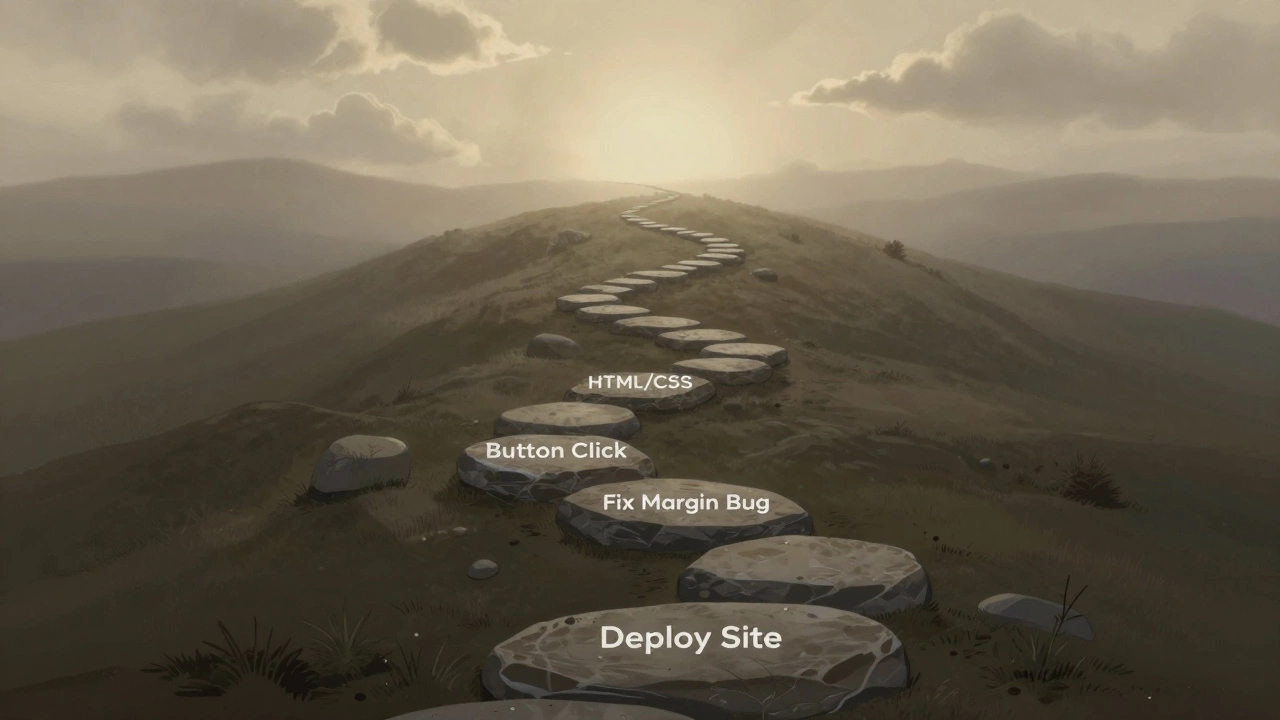
Start with one thing: HTML and CSS. Build a simple portfolio page. Then add a button that changes color when you click it. That’s JavaScript. Now you’ve built something real. Not a tutorial. Not a video you watched. Something you made.
Web development isn’t a mountain you climb all at once. It’s a series of small hills. Each one gets easier once you’ve climbed the one before it.
The real challenge isn’t coding - it’s staying consistent
Learning to code is easy. Staying consistent is hard. You’ll hit walls. You’ll copy-paste code you don’t understand. You’ll spend three hours fixing a single margin that’s off by 2 pixels. That’s normal.
Here’s what separates people who become developers from those who don’t: they keep going even when they’re frustrated. They don’t wait for motivation. They build a habit. Even if it’s just 30 minutes a day. Even if they only fix one bug. Even if they don’t feel like it.
A study from Harvard’s CS50 course found that students who coded for 20 minutes daily for 90 days were 7 times more likely to complete their projects than those who crammed for 5 hours once a week. Consistency beats intensity every time.
You don’t need expensive courses
There are thousands of web development courses out there - some cost $1,000. Others are free. The expensive ones don’t make you better. The free ones don’t make you worse.
Free resources like freeCodeCamp, MDN Web Docs, and The Odin Project have trained more working developers than any paid bootcamp. Why? Because they focus on building, not watching. You don’t learn to swim by watching videos. You learn by jumping in.
Here’s what actually works: pick one free course. Stick with it. Build 3 projects from start to finish. Don’t switch halfway through. Don’t chase the next shiny course. Finish what you start.
It’s not about the tools - it’s about problem-solving
People think being a web developer means knowing React, Vue, or Angular. But those tools change every year. What doesn’t change? Your ability to break down problems.
Can you look at a broken website and figure out why the button doesn’t work? Can you read an error message and trace it back to your code? Can you Google the right question when you’re stuck?
Those are the real skills. Tools are just the language you use to say it. Once you learn how to think like a developer - how to debug, how to test, how to ask for help - you can pick up any framework in a few days.
You’ll get stuck. That’s not failure - it’s part of the job
Every developer, no matter how experienced, spends 60% of their time stuck. That’s not a sign you’re doing it wrong. That’s the job.
When you’re stuck, you don’t need more tutorials. You need:
- A clear error message to copy-paste into Google
- A 10-minute walk to clear your head
- Asking one specific question on Stack Overflow or Reddit
- Commenting out code line by line until you find the problem
There’s no magic trick. Just patience and process.
Real jobs don’t care about your certificates
Companies don’t hire you because you finished a Udemy course. They hire you because you have something to show them.
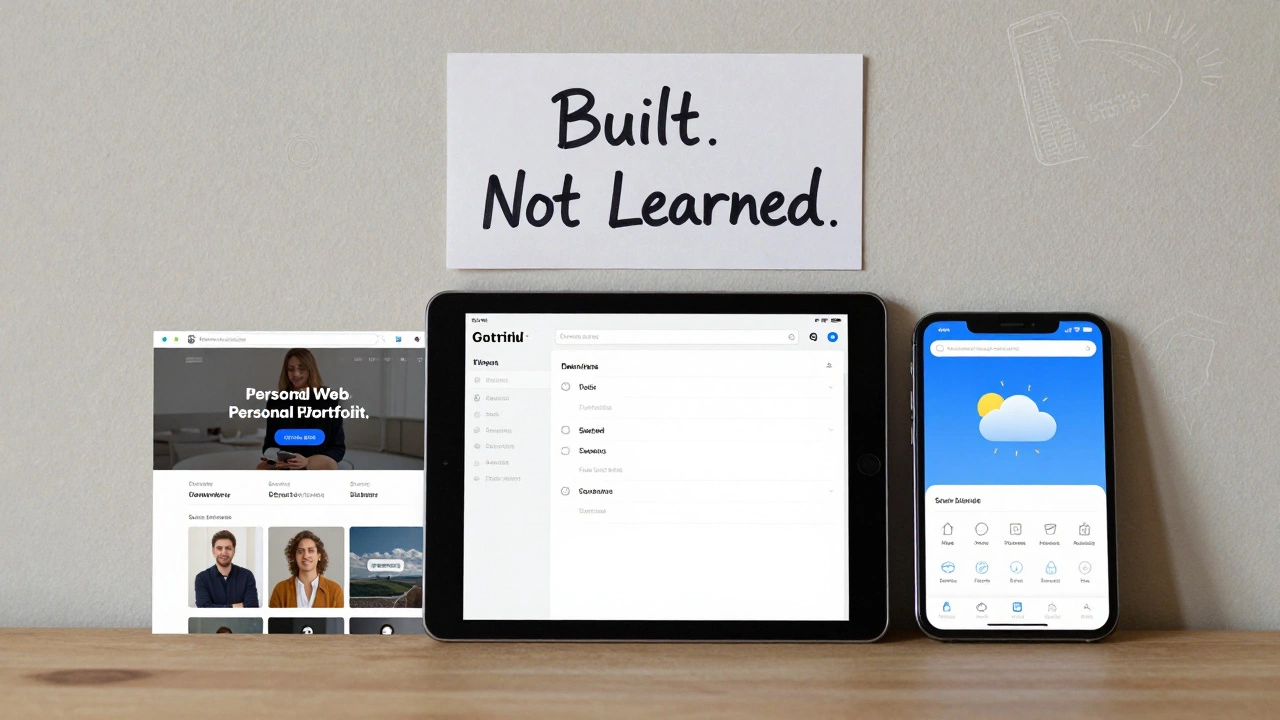
A portfolio with 3 live projects - even simple ones - beats a 200-hour certificate every time. Build a personal website. Build a to-do app that saves data. Build a weather app that pulls from a real API. Put them on GitHub. Write a short note about what you learned in each one.
That’s your resume. That’s your proof. That’s what gets you interviews.
It’s not about being the best coder - it’s about being the most reliable
The best developer isn’t the one who writes the fastest code. It’s the one who shows up on time, asks good questions, admits when they don’t know something, and fixes bugs without making excuses.
Web development is a team sport. You’ll work with designers, product managers, clients. You’ll need to explain technical stuff in plain language. You’ll need to handle feedback without getting defensive.
Those soft skills matter more than knowing every JavaScript method. You can learn syntax. You can’t fake reliability.
How long does it really take?
If you spend 15-20 hours a week learning and building, you can land your first junior job in 6-9 months. Not because you’re brilliant. Because you didn’t quit.
Some people take longer. Some take less. It doesn’t matter. What matters is that you keep moving forward. Even if it’s slow. Even if it’s messy.
The web doesn’t need more perfect developers. It needs more people who just keep going.
What if you’re not good at math or science?
You don’t need to be. Web development is not engineering. It’s not physics. It’s not calculus.
Most of what you’ll do is arranging text on a screen. Making things look right. Making buttons work. Fixing layout bugs. Writing clear messages for users. That’s it.
Logic matters. Pattern recognition matters. But you don’t need a STEM background to learn it. You just need curiosity and persistence.
Is it hard? Yes. But it’s worth it
Becoming a web developer is hard because it demands consistency, patience, and resilience. It’s not hard because you’re not smart enough. It’s hard because you’re human.
But here’s the thing: once you get past the first few months, it stops feeling like work. You start seeing the web as something you can shape. You fix a broken site and feel proud. You build something from nothing and realize - I made that.
That’s the reward. Not the salary. Not the title. The quiet satisfaction of knowing you created something useful - and you did it yourself.