JavaScript vs C++: Which Should You Learn?
Loading...
Why this fits you:
You’ve probably heard the joke: "JavaScript is easy to learn but hard to master." Meanwhile, C++ gets labeled as the language that breaks beginners. But which one is actually harder? The answer isn’t a simple yes or no. It depends entirely on what kind of pain you’re willing to endure and what you want to build.
If you are looking for immediate visual results with minimal setup, JavaScript feels easier at first. If you prefer strict rules, explicit memory management, and deep understanding of how computers work, C++ might feel more logical, even if it’s stricter. Let’s break down the real differences in complexity, learning curve, and daily usage so you can decide which mountain you want to climb.
The Barrier to Entry: Setup and First Steps
The biggest difference between these two languages often happens before you write a single line of code. This is where many people decide which language is "harder" based purely on friction.
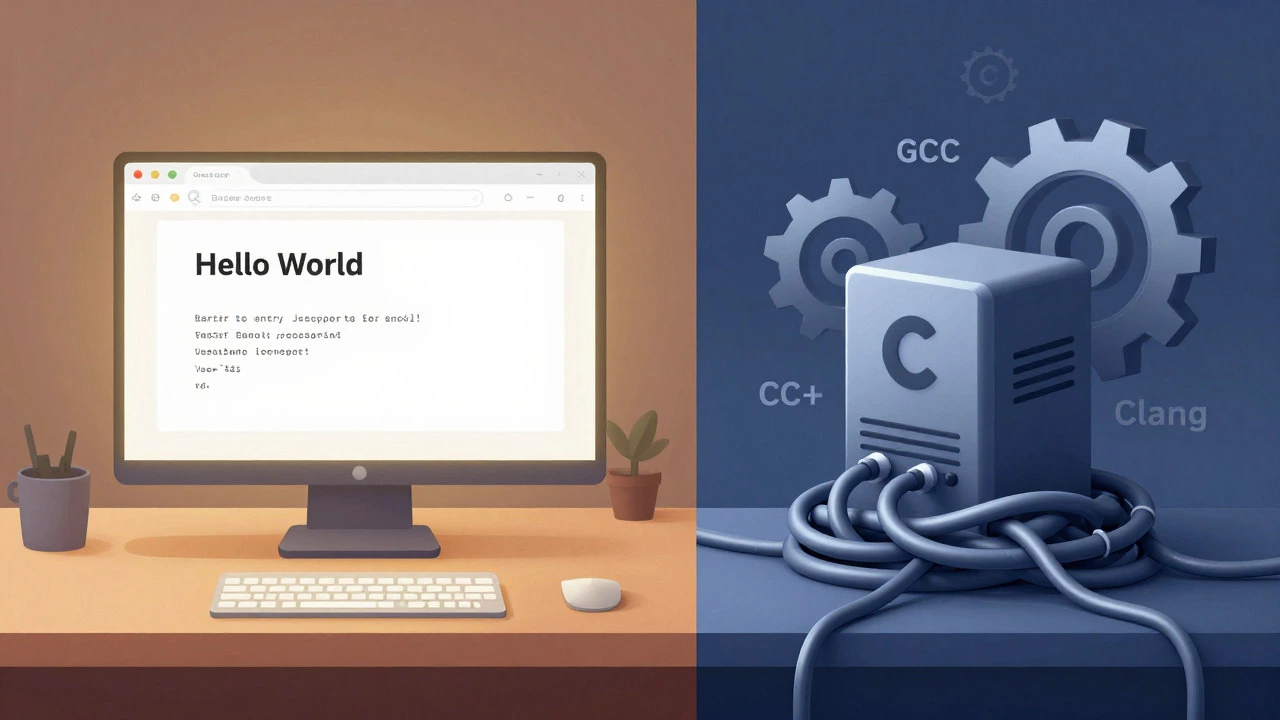
JavaScript runs natively in every modern web browser. You don’t need to install compilers, linkers, or complex development environments. You open your browser’s developer console, type `console.log("Hello World")`, and see the result instantly. This low barrier to entry makes it incredibly accessible for beginners who want to see their code do something immediately.
C++, on the other hand, requires a compiler. You need to set up a toolchain like GCC, Clang, or MSVC. You have to understand concepts like compiling, linking, and building executables before you can run your program. For a complete novice, this setup process can be intimidating and time-consuming. One missing semicolon or incorrect library path can stop you from running anything at all.
So, strictly speaking about getting started, JavaScript is significantly easier. But does that make it easier to learn long-term? Not necessarily.
Syntax and Type Systems: Freedom vs. Structure
Once you get past the setup, the way you write code differs drastically. These differences shape how difficult the language feels day-to-day.
JavaScript uses dynamic typing. This means you don’t declare variable types explicitly. You just write `let name = "Landon";` and the engine figures out it’s a string. This flexibility allows for rapid prototyping. However, it also introduces subtle bugs. In JavaScript, `[] + []` equals an empty string `""`, while `[] + {}` equals `[object Object]`. These quirks stem from JavaScript’s loose type coercion rules, which can confuse beginners and lead to unexpected behavior in larger applications.
C++ is statically typed. You must declare types: `std::string name = "Landon";`. The compiler checks your types at compile-time, catching errors before you even run the program. This strictness forces you to think carefully about data structures. While this adds verbosity, it reduces runtime surprises. Once you understand the type system, C++ code tends to be more predictable than JavaScript.
For some learners, the freedom of JavaScript feels easier because there are fewer rules to memorize initially. For others, the structure of C++ feels easier because the compiler acts as a strict teacher, pointing out mistakes immediately rather than letting them fail silently at runtime.
Memory Management: Garbage Collection vs. Manual Control
This is arguably the most significant technical difference between the two languages and a major factor in perceived difficulty.
JavaScript uses automatic garbage collection. When you create an object, the JavaScript engine tracks its references. When no part of your code points to that object anymore, the garbage collector frees the memory automatically. This saves you from worrying about memory leaks (mostly) and segmentation faults. You can focus on logic rather than resource management.
C++ traditionally requires manual memory management. You allocate memory with `new` and free it with `delete`. If you forget to delete, you leak memory. If you delete too early or twice, you crash the program. Modern C++ (C++11 and later) has introduced smart pointers like `std::unique_ptr` and `std::shared_ptr` to automate much of this, reducing the burden. However, understanding *why* these tools exist still requires grasping underlying concepts like stack vs. heap memory, pointers, and references.
Learning pointers in C++ is often cited as the hardest part for beginners. A pointer is essentially a variable that stores a memory address. Dereferencing it incorrectly leads to segmentation faults-crashes that can be cryptic and difficult to debug. JavaScript hides this complexity entirely, making it conceptually simpler for those who just want to build features without managing hardware resources.

Ecosystem and Tooling: Fragmentation vs. Standardization
The environment around the language matters as much as the language itself. Both ecosystems are massive, but they present different challenges.
JavaScript has the largest ecosystem of any language, thanks to Node.js and npm (Node Package Manager). There are over two million packages available. This is both a blessing and a curse. You can find a library for almost anything, but choosing the right one is overwhelming. The landscape changes rapidly. Frameworks like React, Vue, and Angular come and go, or evolve significantly. Keeping up with bundlers like Webpack, Vite, or esbuild adds another layer of complexity. Debugging issues in third-party libraries can be frustrating when documentation is outdated or inconsistent.
C++ has a more stable, albeit smaller, ecosystem. Package managers like Conan or vcpkg exist, but they are less ubiquitous than npm. The standard library (STL) is powerful and comprehensive, providing containers, algorithms, and utilities out of the box. Because C++ is used in performance-critical systems like game engines, operating systems, and high-frequency trading, stability is prioritized over rapid change. This makes the learning path more linear. You spend more time mastering the core language and standard library rather than chasing new frameworks.
Use Cases: What Are You Building?
Difficulty is subjective and heavily influenced by context. Is JavaScript harder if you want to build a video game? Is C++ harder if you want to build a website?
JavaScript dominates web development. If your goal is to build interactive websites, web applications, or server-side APIs, JavaScript is the natural choice. With frameworks like React or Node.js, you can build full-stack applications using one language. The feedback loop is fast: change code, refresh browser, see result. This immediacy makes learning feel rewarding and less abstract.
C++ excels in performance-intensive domains. Game development (Unreal Engine), desktop applications, embedded systems, and real-time simulations rely on C++. If you want to build a 3D game or optimize a physics engine, JavaScript will struggle. Learning C++ opens doors to industries where raw performance and hardware control matter. However, the projects tend to be larger and more complex, requiring deeper architectural thinking from the start.
| Factor | JavaScript | C++ |
|---|---|---|
| Setup Complexity | Low (Browser-based) | High (Compiler/Toolchain) |
| Type System | Dynamic (Flexible but error-prone) | Static (Strict but safe) |
| Memory Management | Automatic (Garbage Collected) | Manual/Semi-Automatic (Pointers/Smart Pointers) |
| Learning Curve | Easy start, steep mastery | Steep start, gradual mastery |
| Primary Use Case | Web Development, Full Stack | Systems Programming, Games, High Performance |
| Debugging Experience | Runtime errors, console logs | Compile-time errors, memory crashes |
Which One Should You Learn First?
Your background and goals should dictate your choice. Here’s a practical guide:
- Choose JavaScript if: You want to build websites, web apps, or mobile apps (via React Native). You prefer seeing visual results quickly. You enjoy working with a vast community and endless libraries. You want to enter the job market quickly, as web development roles are abundant.
- Choose C++ if: You are interested in computer science fundamentals, such as how memory works. You want to build games, simulations, or high-performance software. You enjoy solving complex logical puzzles and appreciate strict, deterministic behavior. You don’t mind spending more time debugging setup and compilation issues.
Many developers eventually learn both. Understanding C++ makes you a better JavaScript developer because you’ll understand performance implications and memory constraints. Conversely, knowing JavaScript helps you appreciate the convenience of higher-level abstractions.
Common Misconceptions About Difficulty
It’s important to debunk a few myths. First, "JavaScript is easy" is misleading. While syntax is simple, mastering asynchronous programming, closures, the event loop, and modern framework patterns is challenging. Second, "C++ is obsolete" is false. C++ remains critical in infrastructure, gaming, and finance. Its complexity is a feature, not a bug, for specific use cases.
Another misconception is that one language is objectively superior. They solve different problems. Using C++ to build a simple landing page is overkill and inefficient. Using JavaScript to power a real-time flight simulator is impractical due to performance overhead.
The "hardest" language is the one that doesn’t align with your goals. If you force yourself to learn C++ just because it’s "prestigious," you’ll likely quit out of frustration. If you stick with JavaScript only because it’s "easy," you may hit a ceiling when trying to build complex, performance-sensitive applications.
Is JavaScript easier to learn than C++ for absolute beginners?
Yes, generally. JavaScript requires no installation and runs in the browser, allowing immediate feedback. C++ requires setting up a compiler and understanding build processes, which can be daunting for newcomers. However, JavaScript's lack of strict typing can lead to confusing bugs later on.
Do I need to know C++ to become a good JavaScript developer?
No. Most professional JavaScript developers never touch C++. However, understanding basic concepts from C++ like memory management and pointers can deepen your understanding of how JavaScript engines work under the hood, potentially making you a more efficient coder.
Which language has better job prospects in 2026?
JavaScript has a significantly higher volume of job openings, particularly in web development, startups, and digital agencies. C++ jobs are fewer but often pay well and are concentrated in specialized fields like gaming, finance, automotive, and systems engineering. Your choice should depend on the industry you want to enter.
Can I use JavaScript for backend development?
Yes, thanks to Node.js. JavaScript is now a full-stack language, meaning you can use it for both frontend (browser) and backend (server) development. This unified approach simplifies development workflows and allows teams to share code and skills across the entire application stack.
Why is C++ considered dangerous for beginners?
C++ gives programmers direct access to memory through pointers. Beginners can easily cause segmentation faults (crashes) by accessing invalid memory addresses, or memory leaks by forgetting to free allocated memory. These errors can be difficult to trace and debug compared to the safer, managed environments of languages like JavaScript.
Is modern C++ easier than older versions?
Yes. Modern C++ (C++11, C++14, C++17, C++20, and C++23) has introduced many features to simplify code and improve safety. Smart pointers reduce manual memory management needs, and features like `auto` type deduction reduce verbosity. However, the core complexity of the language remains, and legacy codebases still pose challenges.