
Freelance Web Developer Income Calculator
Input Parameters
Projected Annual Income
Insight:
Adjust the sliders to see how billing more hours or increasing your rate impacts your bottom line. Remember, higher rates often mean fewer billable hours due to specialized work.
Picture this: It’s 10 AM on a Tuesday. You’re sitting at a coffee shop in Dublin, laptop open, coding a new feature for a client in New York. No boss breathing down your neck, no mandatory Zoom meetings that could have been emails. Just you, your code, and the freedom to log off when the job is done. This is the dream that sells freelance web development. But is it actually worth it?
The short answer is yes, but only if you treat it like a business, not just a coding gig. The landscape has shifted dramatically since the pandemic boom. In 2026, the market is saturated with entry-level developers, but there is still a massive hunger for skilled professionals who can deliver results. The difference between struggling and thriving isn’t just your ability to write JavaScript or PHP; it’s your ability to manage clients, handle taxes, and sell your value.
The Financial Reality: High Ceiling, Unstable Floor
Let’s talk money first, because that’s usually why people ask this question. When you are an employee, your income is predictable. You get a paycheck every two weeks, regardless of whether you had a great month or a terrible one. As a freelance web developer, your income is directly tied to your output and your sales pipeline.
In Ireland, the average salary for a mid-level web developer might hover around €50,000 to €70,000 annually. As a freelancer, you can potentially earn significantly more. If you charge €50 per hour and bill 30 hours a week, that’s €64,500 before expenses. But here is the catch: you will rarely bill 30 hours a week consistently. Some weeks you’ll bill 40, others you’ll bill zero while you hunt for new clients.
You also lose the safety net. There is no paid sick leave, no holiday pay, and no employer pension contributions. You need to set aside roughly 25-30% of your gross income for taxes (PAYE, USC, PRSI) and save aggressively for retirement. Many beginners forget this and find themselves broke by tax season. The financial upside is real, but it requires strict discipline.
Freedom vs. Isolation: The Lifestyle Trade-off
People often romanticize the "digital nomad" lifestyle. They imagine working from beaches in Bali or cafes in Paris. While possible, it comes with significant drawbacks. The biggest one is isolation. Coding is a solitary act. When you remove the office environment, you lose the casual chats, the lunch breaks with colleagues, and the immediate feedback loop of asking a senior dev a quick question.
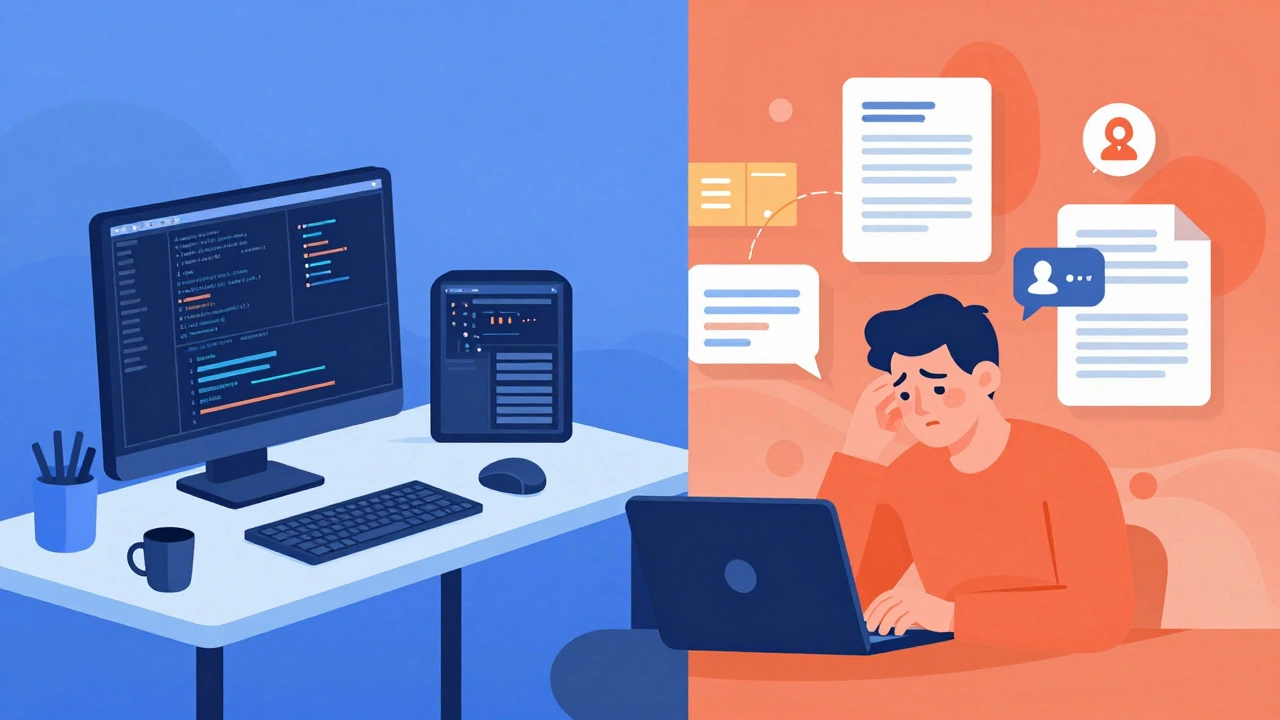
For many, this silence becomes deafening. You become your own manager, HR department, IT support, and sales team. One day you are debugging a complex React component; the next, you are arguing with a hosting provider about server downtime, and then you are drafting invoices. This context switching is mentally exhausting. If you thrive in social environments, freelancing might feel lonely very quickly.
However, the autonomy is unmatched. You choose your projects. Hate building e-commerce sites on Shopify? Don’t take those clients. Prefer working on sustainability startups? Focus your marketing there. You control your schedule, allowing you to attend your kid’s school plays or go to the gym during peak office hours. For introverts or those seeking work-life balance, this freedom is worth the trade-offs.
Skills Beyond Code: The Business of Freelancing
This is where most aspiring freelancers fail. They think their technical skills are enough. They can build a website in WordPress or code a custom API in Node.js, but they don’t know how to price their services or negotiate contracts. To succeed, you need to develop a hybrid skill set.
- Sales and Marketing: You need to constantly feed your pipeline. This means networking, content creation, and cold outreach. If you stop selling, you stop eating.
- Client Management: Clients don’t speak "code." They speak "business." You need to translate technical problems into business solutions. Managing expectations is crucial. Scope creep-the gradual expansion of project requirements-is the profit killer.
- Financial Literacy: Understanding cash flow, invoicing, and basic accounting is non-negotiable. Tools like QuickBooks or Xero are your friends.
- Legal Awareness: You need solid contracts. Without them, you risk non-payment or being liable for bugs you didn’t cause. Always define scope, payment terms, and intellectual property rights clearly.
Learning these soft skills takes time. It’s not something you pick up overnight. Treat your freelance career as a startup. You are the CEO, and your product is your development service.
The Market in 2026: AI and Competition
We cannot ignore the elephant in the room: Artificial Intelligence. By 2026, AI tools like GitHub Copilot, Cursor, and various no-code platforms have changed the game. Can AI replace a web developer? Not entirely, but it has replaced the bottom tier of the market.
If your only skill is writing basic HTML/CSS or setting up a standard WordPress theme, you are vulnerable. AI can do that faster and cheaper. However, AI struggles with complex architecture, nuanced user experience design, and integrating disparate systems. The value of a human developer has shifted from "writing code" to "solving problems."
Clients now expect faster turnaround times and lower costs because AI makes it seem like everything should be easy. This puts pressure on freelancers to justify their rates. You must position yourself as a strategic partner, not just a pair of hands. Show clients how your work increases their revenue, reduces churn, or improves efficiency. That is hard to automate.
| Factor | Employee | Freelancer |
|---|---|---|
| Income Stability | High (Fixed Salary) | Low (Variable) |
| Earning Potential | Moderate (Capped by Role) | High (Uncapped) |
| Benefits | Pension, Sick Pay, Holidays | None (Self-funded) |
| Work-Life Balance | Structured (9-5) | Flexible (But blurry boundaries) |
| Learning Curve | Technical Skills Only | Technical + Business + Sales |

How to Start: A Practical Roadmap
If you’ve read this far and still want to jump in, good. Here is how to do it without burning out in the first three months.
- Build a Niche: Don’t be a generalist. Specializing in high-demand areas like Headless CMS, E-commerce optimization, or specific frameworks like Next.js or Laravel allows you to charge premium rates. Generalists compete on price; specialists compete on value.
- Create a Portfolio: Your portfolio is your resume. Showcase 3-5 strong case studies. Explain the problem, your solution, and the result. Metrics matter. Did your redesign increase conversion rates by 20%? Say so.
- Set Your Rates: Don’t underprice yourself. Calculate your minimum viable income, add overheads, and multiply by 1.5 to account for non-billable hours. Hourly rates are easier for beginners, but value-based pricing is better for long-term growth.
- Find Your First Clients: Leverage your existing network. Tell everyone you know you are available. Use platforms like Upwork or Toptal initially, but aim to move clients to direct relationships quickly to avoid platform fees.
- Stay Employed Initially: If possible, keep your day job while building your freelance side hustle. This reduces financial pressure and allows you to take your time finding the right clients.
Conclusion: Is It Right for You?
Becoming a freelance web developer is worth it if you are self-motivated, resilient, and willing to wear many hats. It offers financial freedom and creative control that traditional employment rarely matches. However, it demands a level of professionalism and business acumen that goes far beyond coding.
If you love the stability of a steady paycheck and dislike sales, stick to employment. But if you crave autonomy and are ready to build a business around your skills, freelancing is one of the most rewarding paths in tech today. Start small, stay consistent, and never stop learning.
How much does a freelance web developer make in Ireland?
In Ireland, freelance web developers typically charge between €40 and €100+ per hour depending on experience and specialization. A mid-level freelancer might earn €50,000 to €80,000 annually after expenses, but this varies greatly based on client consistency and niche.
Do I need a degree to become a freelance web developer?
No, a degree is not required. Clients care about your portfolio and ability to solve their problems. Bootcamps, self-study, and practical experience are often valued more than academic credentials in the freelance market.
What are the biggest risks of freelancing?
The biggest risks are irregular income, lack of benefits (health insurance, pension), client non-payment, and burnout from wearing too many hats. Mitigate these by maintaining an emergency fund, using contracts, and diversifying your client base.
How do I find my first freelance clients?
Start with your personal network. Then, use freelance platforms like Upwork or Toptal to build reviews. Networking events, LinkedIn outreach, and creating valuable content (blogs, tutorials) also help attract inbound leads over time.
Is freelancing better than working for an agency?
It depends on your goals. Agencies offer stability, mentorship, and team collaboration but lower individual earnings. Freelancing offers higher earning potential and autonomy but requires more administrative work and carries higher financial risk.