
Full Stack Reality Check Quiz
Think you're ready to dive into full stack development? Take this quick quiz to see if you understand the realistic challenges ahead.
Quiz Complete!
You scored 0/5
You see the job titles on LinkedIn: Full Stack Developer. It sounds powerful. You get to build everything from scratch, touch every part of the application, and command a decent salary. But then you open a tutorial, and suddenly you are drowning in acronyms like React, Node.js, Docker, and Kubernetes. The question keeps popping up in forums and Discord servers: Is being a full stack developer easy?
The short answer is no. The long answer is that it depends entirely on how you define "easy." If you think it means writing code without ever hitting a wall, you are in for a rude awakening. But if you mean "is it manageable with the right approach," then yes, absolutely. Most people who quit don't fail because they aren't smart enough; they fail because they try to eat the whole ocean at once. They jump into complex frameworks before understanding basic HTTP requests. Let's break down why this role feels so hard, what actually makes it tough, and how you can make the journey less painful.
Why Everyone Thinks It’s Hard (And Why They’re Right)
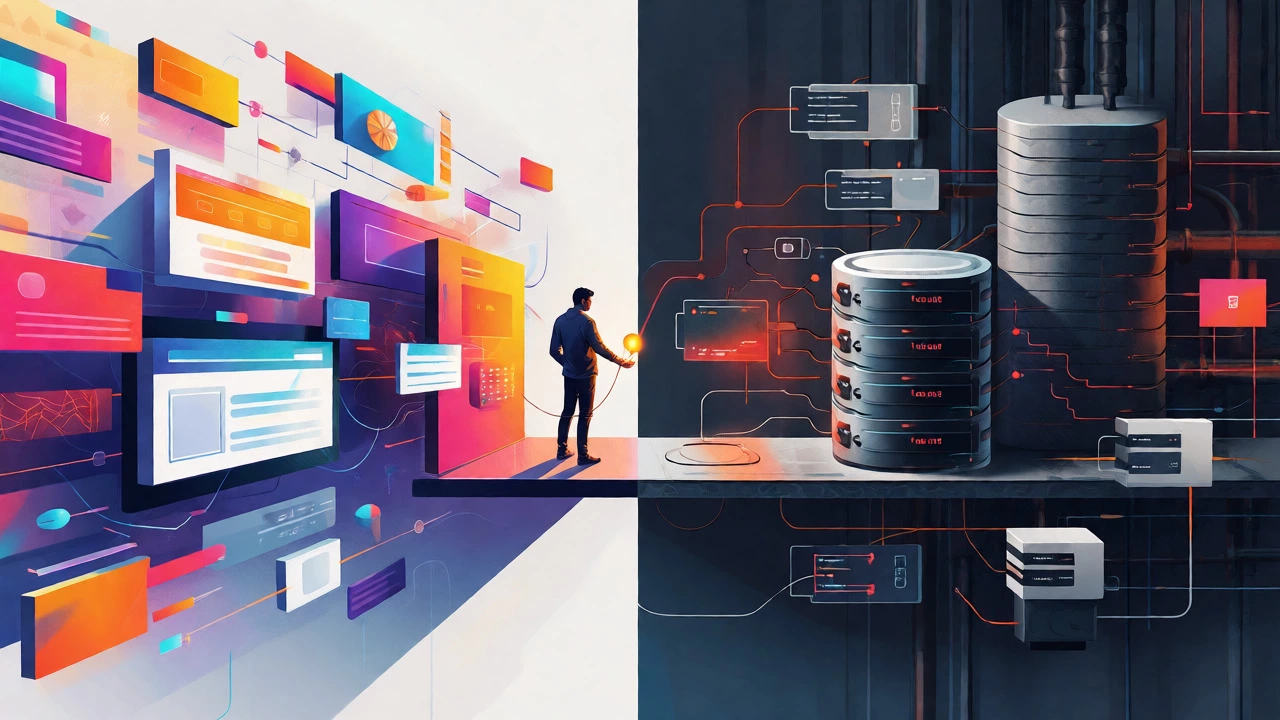
Here is the brutal truth about full stack development: it combines two distinct career paths into one person. On one side, you have Front End Development, which deals with what users see and interact with. On the other, you have Back End Development, which handles logic, databases, and server configuration. Historically, these were separate jobs. Now, companies want one person to do both.
This creates a massive cognitive load. In front end work, you worry about pixel perfection, browser compatibility, and user experience. One wrong CSS property can ruin your layout. In back end work, you worry about security, data integrity, and server performance. A small mistake here can leak user passwords or crash your database. Switching between these mindsets requires mental flexibility that takes time to build. It is not just about knowing syntax; it is about understanding context.
Think of it like being a chef who also has to be the electrician fixing the stove while serving customers. You need culinary skills, but you also need to know how electricity works. If you ignore the electrical side, the stove breaks mid-service. If you ignore the cooking side, the food tastes bad. Balancing both is where the difficulty lies.
The Learning Curve Is Steep, Not Vertical
Many beginners confuse a steep learning curve with an impossible one. A steep curve means you improve quickly when you put in the effort. An impossible curve means no amount of effort helps. Full stack development falls into the first category. However, the initial phase feels overwhelming because of the sheer volume of tools.
Consider the typical tech stack. You might start with HTML and CSS, which are relatively forgiving. Then you add JavaScript, which introduces programming logic. Next comes a framework like React or Vue. Suddenly, you need to understand state management, component lifecycle, and API calls. Then you move to the server side, picking up Node.js or Python. Finally, you deal with databases like PostgreSQL or MongoDB.
| Component | Initial Difficulty | Mastery Timeframe | Common Pitfall |
|---|---|---|---|
| HTML/CSS | Low | 1-3 Months | Over-relying on frameworks too early |
| JavaScript | Medium | 6-12 Months | Ignoring asynchronous behavior |
| Backend Logic | High | 1-2 Years | Poor database schema design |
| DevOps/Deployment | Very High | Ongoing | Assuming local equals production |
The table above shows that difficulty isn't uniform. Some parts click quickly; others take years. The key is accepting that you won't master everything at once. Senior developers still struggle with new frameworks. The difference is they know how to read documentation and debug efficiently.
What Makes It Actually Difficult?
Beyond the list of technologies, three specific factors make full stack development challenging for most people. These are not technical barriers but structural ones.
First, there is the issue of context switching. When you write front end code, you are thinking visually. When you write back end code, you are thinking logically. Flipping between these modes drains mental energy. Studies on productivity show that task-switching costs significant focus time. As a solo full stack developer, you switch contexts multiple times a day. This leads to burnout faster than specializing in one area.
Second, debugging becomes harder. If a feature doesn't work, the problem could be in the UI, the API, the database query, or the server configuration. Isolating the bug requires knowledge of all layers. A front-end specialist can assume the API is correct and check their code. A back-end specialist can assume the request is formatted correctly. You have to check everything. This expands the surface area for errors significantly.
Third, the ecosystem changes rapidly. What was best practice in 2024 might be outdated in 2026. Keeping up with updates for ten different tools is exhausting. Many developers feel "imposter syndrome" because they feel they are always behind. Remember, you don't need to know every tool. You need to know how to learn new tools quickly.

How to Make It Easier: Strategic Simplification
If you want to reduce the pain, stop trying to learn everything. Instead, pick a cohesive stack and stick with it for six months. For example, the MERN stack (MongoDB, Express, React, Node.js) uses JavaScript everywhere. This reduces cognitive load because you only need to master one language's syntax, even if the environments differ.
Another strategy is to delay complexity. Do not use microservices when a monolith will do. Do not use Kubernetes when a simple VPS is sufficient. Build a project that works locally first. Deploy it simply. Only add complexity when you hit real limits. Premature optimization is the root of much frustration.
- Start Small: Build a To-Do app. Then a blog. Then an e-commerce site. Don't start with a social network clone.
- Master Fundamentals: Understand HTTP methods, status codes, and JSON structure before touching frameworks.
- Use Tools Wisely: Leverage boilerplates and generators to skip repetitive setup tasks.
Is It Worth the Struggle?
Despite the challenges, many developers love this path. Why? Because it gives you autonomy. You can build a product idea from concept to launch without waiting for a team. You understand the entire system, which makes you better at estimating timelines and spotting bottlenecks. Employers value this versatility, especially in startups where resources are tight.
Also, the problem-solving aspect is addictive. There is a unique satisfaction in seeing a button click trigger a database update that reflects instantly on the screen. That end-to-end visibility is rewarding. Once you push through the initial confusion, the pieces start fitting together. You begin to see patterns rather than isolated facts.
So, is full stack development easy? No. It demands patience, resilience, and continuous learning. But it is not reserved for geniuses. It is reserved for those willing to embrace the discomfort of not knowing. If you enjoy building things and solving puzzles, the difficulty becomes part of the fun, not a barrier to entry.
Can I become a full stack developer in 6 months?
It is possible to reach a junior level in 6 months if you study full-time (40+ hours per week). Part-time learners usually need 12-18 months. Focus on one stack deeply rather than skimming many. Building portfolio projects is more important than completing courses.
Which stack is easiest for beginners?
The MERN stack (MongoDB, Express, React, Node) is often recommended because it uses JavaScript throughout. Alternatively, Python-based stacks like Django or Flask are great for beginners due to Python's readable syntax and robust built-in features.
Do I need to know DevOps to be full stack?
You don't need to be a DevOps engineer, but you should understand basics. Learn how to deploy an app, set up environment variables, and manage dependencies. Platforms like Heroku, Vercel, or AWS Elastic Beanstalk simplify this process significantly.
Is math required for full stack development?
Basic arithmetic and logic are essential. Advanced calculus or linear algebra is rarely needed unless you work in data science, graphics, or game development. Most web applications rely on logical reasoning rather than heavy mathematics.
Why do so many people quit learning full stack?
Tutorial hell is the main culprit. People watch endless videos without building anything themselves. Without practical application, concepts remain abstract and frustrating. Quitting often happens when learners try to build complex apps before mastering fundamentals.