
Full Stack Learning Timeline Calculator
Your Learning Profile
Your Personalized Roadmap
Configure Your Profile
Adjust the settings on the left and click calculate to see your personalized full stack developer learning timeline.
You’ve probably seen the ads. "Become a Full Stack Developer in 12 Weeks." "Land Your First Tech Job in 60 Days." It sounds like a dream come true if you’re stuck in a dead-end job or looking for a high-income pivot. But here is the hard truth that most marketing brochures hide: two months is enough to build a few projects, but it is rarely enough to become job-ready in the competitive market of 2026.
That doesn’t mean you should give up. It means you need to redefine what "enough" actually looks like. If your goal is to understand how the web works and build simple applications, yes, you can do that in eight weeks with intense focus. If your goal is to walk into an interview at a mid-sized tech company and negotiate a salary, you likely need more time-or a very specific strategy.
The Myth of the "Instant" Full Stack Developer
To understand why two months feels tight, we first need to define what Full Stack Development is the practice of building both the client-side (front end) and server-side (back end) of web applications. This isn't just learning one language; it's mastering a ecosystem. You are dealing with HTML, CSS, JavaScript, databases like SQL or MongoDB, and frameworks like React or Node.js.
In a traditional four-year computer science degree, students spend years on data structures and algorithms alone. In a two-month sprint, you are skipping the theory to focus purely on syntax and application. This creates a "tutorial hell" trap. You can follow along with a video tutorial and build a todo list app, but when the tutorial ends, you freeze because you don’t understand *why* the code works. That gap between following instructions and solving problems is what takes time to close.
What You Can Actually Achieve in 8 Weeks
If you treat these two months like a full-time job-meaning 40 to 60 hours a week of focused study-you can achieve surprising results. Here is a realistic breakdown of what a disciplined learner can cover:
- Weeks 1-2: The Foundations. You master HTML5 semantic tags, CSS3 flexbox/grid layouts, and vanilla JavaScript. You understand the Document Object Model (DOM) and how to manipulate elements without libraries.
- Weeks 3-4: Frontend Frameworks. You dive into React is a JavaScript library for building user interfaces maintained by Meta. You learn components, state management with hooks, and how to fetch data from APIs.
- Weeks 5-6: Backend Basics. You set up a Node.js environment. You create RESTful APIs using Express.js. You connect your app to a database, likely MongoDB via Mongoose, handling CRUD (Create, Read, Update, Delete) operations.
- Weeks 7-8: Integration & Deployment. You combine the front end and back end. You handle authentication (login/signup flows). You deploy your project to platforms like Vercel or Render. You learn basic Git commands for version control.
By day 60, you will have a portfolio with 2-3 functional apps. Maybe a weather dashboard, a task manager, or a simple e-commerce store. These are real products. They prove you can code. But they also highlight your limitations. Your code might be messy. Your error handling might be non-existent. Your security knowledge will be shallow. This is where the "job-ready" label becomes tricky.
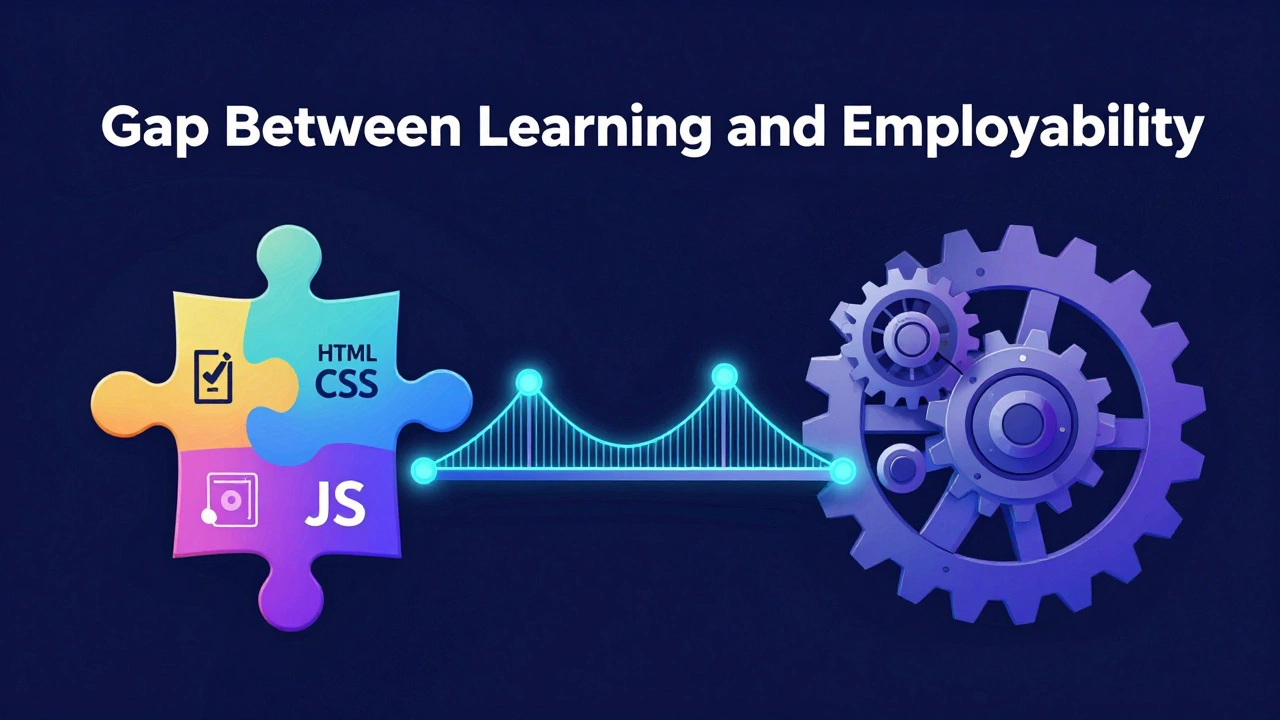
The Gap Between Learning and Employability
Employers in 2026 aren't just looking for people who can make things look pretty. They want developers who understand system architecture, debugging, and collaboration. A two-month learner often struggles with three critical areas:
- Debugging Complex Issues. When your code breaks in a way that isn't covered in a tutorial, do you know how to use browser dev tools effectively? Do you know how to read stack traces? Experienced developers spend 50% of their time fixing bugs. Newcomers often panic when errors appear.
- Code Quality and Best Practices. Writing code that works is easy. Writing code that is maintainable, readable, and scalable is hard. Concepts like separation of concerns, modular design, and clean code principles take time to internalize.
- Soft Skills and Team Dynamics. Development is a team sport. You need to understand Agile methodologies, pull requests, code reviews, and how to communicate technical issues to non-technical stakeholders. Two months rarely provides enough context for this professional maturity.
This doesn't mean you can't get hired. It means you need to compensate for your lack of experience with exceptional communication, a strong portfolio, and a willingness to start in junior or internship roles.
Bootcamps vs. Self-Study: Which Path Fits 2 Months?
Your success in this short timeframe depends heavily on your learning method. Let’s compare the two most common approaches.
| Feature | Intensive Bootcamp | Self-Study (Online Courses) |
|---|---|---|
| Cost | High ($10k - $20k USD) | Low ($50 - $500 USD) |
| Structure | Rigid, pre-defined curriculum | Flexible, self-directed |
| Support | Mentors, peers, career coaching | Community forums, AI assistants |
| Pace | Fast-paced, no choice | Variable, risk of burnout |
| Job Guarantee | Sometimes offered (with conditions) | None |
Bootcamps are designed specifically for this "career switch in months" model. They provide structure, accountability, and networking. If you have the budget and can commit full-time, a bootcamp increases your odds of landing a role within six months of graduation. However, many bootcamps suffer from outdated curricula or poor instruction quality. Do your research.
Self-study is cheaper but requires immense discipline. Without external pressure, it is easy to procrastinate or get stuck on minor details for days. If you choose this path, you must treat it like a job. Set strict hours. Build projects independently. Join online communities like Discord servers or Reddit groups to ask questions and stay motivated.

Strategies to Maximize Your 60-Day Sprint
If you are committed to the two-month timeline, here is how to optimize your chances of success. Stop trying to learn everything. Focus on depth over breadth.
1. Pick One Stack and Stick to It. Don't try to learn Python, Ruby, PHP, and JavaScript simultaneously. Choose one popular stack. The MERN stack (MongoDB, Express, React, Node.js) remains a top choice for beginners due to its unified JavaScript environment. Alternatively, consider the T3 Stack (Next.js, TypeScript, Tailwind CSS, Prisma) which is gaining massive traction in 2026 for its modern tooling and type safety.
2. Build Projects, Not Just Tutorials. After watching a tutorial, delete the code and rebuild it from scratch. Then, add features that weren't in the tutorial. Change the color scheme. Add a search function. Connect it to a different API. This forces your brain to retrieve information rather than just recognize it.
3. Learn Git Early. Version control is non-negotiable. From day one, push your code to GitHub. Commit daily. Write clear commit messages. This builds a history of work that employers can see. It also teaches you how to manage changes and collaborate.
4. Network Aggressively. Coding alone won't get you hired. Attend local meetups in Dublin or virtual events. Connect with developers on LinkedIn. Share your progress publicly. When you post about a bug you fixed, tag relevant technologies. Visibility matters. Many junior roles are filled through referrals, not job boards.
What Comes After the Two Months?
Let’s be clear: finishing your two-month sprint is not the finish line. It is the starting line. Most successful career switchers spend 3-6 months actively job hunting after completing their initial training. During this time, you continue to learn. You fix bugs in your portfolio projects. You contribute to open-source repositories. You prepare for technical interviews.
Expect rejection. It is part of the process. Each interview is a learning opportunity. Ask for feedback. Improve your resume. Refine your GitHub profile. The goal is not to be perfect on day 60. The goal is to be employable within six months of starting your journey.
Two months is enough to change your trajectory. It is enough to gain the skills to build real software. But it is not enough to become an expert. Embrace the beginner mindset. Stay curious. Keep building. The tech industry rewards persistence far more than perfection.
Can I really get a job as a full stack developer in 2 months?
It is highly unlikely to land a full-time senior or mid-level role in just two months. However, you can secure internships, junior positions, or freelance gigs if you have a strong portfolio and excellent soft skills. Most successful transitions take 4-6 months of active job searching after the initial learning period.
Is it better to learn frontend or backend first?
For a two-month sprint, starting with frontend (HTML, CSS, JavaScript) is generally recommended because you get visual feedback quickly, which boosts motivation. Once you are comfortable with JavaScript, transitioning to backend (Node.js) is smoother since you are already familiar with the core language.
Do I need a computer science degree to be a full stack developer?
No. The tech industry values practical skills and portfolios over degrees. Many successful developers are self-taught or graduated from coding bootcamps. However, some large enterprise companies may still prefer degrees, so focus on smaller startups or mid-sized tech firms initially.
How many hours a day should I study?
To achieve significant progress in two months, aim for 6-8 hours of focused study per day, 5-6 days a week. Consistency is key. Studying 2 hours every day is better than studying 14 hours once a week. Take breaks to avoid burnout and ensure retention.
Which programming language is best for beginners in 2026?
JavaScript remains the best choice for full stack development because it runs on both the client (browser) and server (Node.js). TypeScript is also highly recommended as it adds static typing to JavaScript, improving code quality and employability. Python is a good alternative for backend-focused roles but less versatile for full stack web development.