
E-commerce Website Valuation Calculator
Estimate Your Site's Value
Estimated Sale Price
You built it. You launched it. Maybe you even made your first sale. Now you’re looking at the code, the domain name, and the bank account balance, wondering: "Is this thing worth anything to someone else?" It’s a valid question. Selling your first e-commerce website is a digital retail store that sells products or services directly to consumers over the internet is different from selling a SaaS app or a content blog. Buyers look for different signals, and if you price it wrong, you’ll either leave money on the table or sit with an unsold asset for months.
The short answer? Most first-time e-commerce sites sell for between 1x and 3x their annual net profit. If you have no profit yet, you might only get a fraction of your development costs back, unless you have massive traffic or a highly sought-after niche brand. Let’s break down exactly how to calculate that number so you don’t guess.
Understanding the Core Valuation Metrics
To know what to ask for, you need to speak the language of buyers. In 2026, the market for small online businesses has matured. Buyers are sophisticated; they aren't buying dreams, they are buying cash flow. The two most important numbers in your spreadsheet are Revenue and Net Profit (also called SDE - Seller's Discretionary Earnings).
Seller's Discretionary Earnings is the total financial benefit of owning a small business to one person, including salary, perks, and non-recurring expenses added back to net income. This is not just your bottom line after taxes. It includes your salary, health insurance, car payments, and one-time startup costs like logo design or initial inventory buys. Buyers want to know: "If I step into the owner's shoes, how much cash do I take home?"
For e-commerce specifically, there is another critical metric: Gross Margin. If you sell a product for $50 but it costs $45 to make and ship, your margin is 10%. That is dangerous. Healthy e-commerce margins usually sit between 40% and 60%. Low margins mean low valuations because the risk of supply chain disruption is higher.
The Multiples Method: Doing the Math
The industry standard for valuing small e-commerce sites is applying a multiple to your trailing twelve-month (TTM) net profit. Here is the general breakdown for 2026:
- 1x - 1.5x Multiple: High risk, low growth, or heavy reliance on paid ads (Facebook/Google). If you stop spending on ads tomorrow, does revenue drop to zero? Then you are at the lower end.
- 2x - 2.5x Multiple: Stable traffic, mixed traffic sources (some organic, some social), decent retention rates, and clean books.
- 3x+ Multiple: Strong brand recognition, high organic search traffic, recurring revenue elements (subscriptions), and year-over-year growth of 20% or more.
Let’s say your site made $50,000 in net profit last year. If it relies entirely on Instagram ads, you might list it for $50,000 ($1x). If half that traffic comes from Google Search and you have an email list of 5,000 active subscribers, you could reasonably ask for $100,000 to $125,000.
| Traffic Source Mix | Gross Margin | Valuation Multiple (of Net Profit) |
|---|---|---|
| 90% Paid Ads | < 30% | 0.5x - 1.0x |
| 50% Organic / 50% Paid | 40% - 50% | 1.5x - 2.5x |
| 80%+ Organic & Email | > 50% | 3.0x - 4.0x+ |
Factors That Boost Your Price Tag
Why would anyone pay more than the baseline multiple? Because certain assets reduce the buyer's risk. When you are preparing to sell, highlight these specific elements:
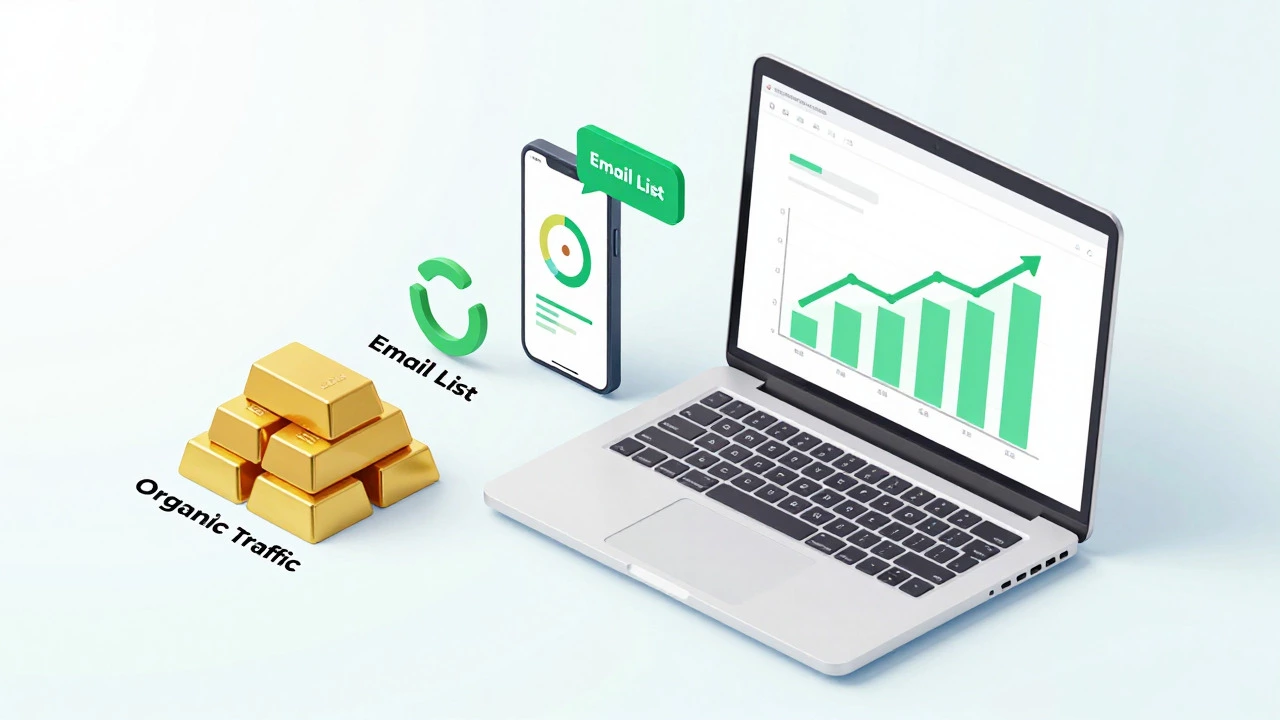
Organic Traffic Dominance: Traffic from Search Engine Optimization is the process of improving website visibility in unpaid search engine results is gold. Unlike Facebook ads, which can be turned off by the platform or become too expensive, organic traffic is an asset you own. If 70% of your visitors come from Google, your site is worth significantly more than a competitor with the same revenue who pays for every click.
Email List Quality: Don't just give the count. Give the engagement rate. An email list of 1,000 people who open 40% of your emails is worth more than 10,000 people who ignore you. Buyers see this as immediate, free marketing channels. Show them your last three campaign open rates and conversion rates.
Recurring Revenue: Do you sell consumables? Supplements, pet food, coffee? If you have a subscription model, even if it’s only 10% of your revenue, it boosts the valuation. Predictable income is easier to value than one-off purchases.
Clean Code and Platform Stability: If you built your site on Shopify is a leading cloud-based e-commerce platform that allows users to create online stores and manage sales, you have an advantage. Shopify stores are easy to transfer. Custom-coded solutions on WordPress/WooCommerce can be risky for non-technical buyers. Document your tech stack clearly. If it’s custom PHP or Python, ensure the documentation is flawless, or expect a discount for the "maintenance risk."
Common Mistakes That Kill Deals
I’ve seen many first-time sellers fail to close because they didn’t prepare properly. Here is what to avoid:
Hiding Expenses: Buyers will audit your books. If you used a personal credit card for server hosting and didn’t record it, or if you took extra cash out for "personal use," it looks messy. Normalize your expenses. Show a clear picture of what the business actually costs to run versus what the owner personally spends.
Overvaluing Development Costs: You spent $5,000 building the site. The buyer doesn’t care. They care about future earnings. Listing a site for $5,000 because "that’s what I paid" when it makes $0 profit is a recipe for failure. Value is forward-looking, not backward-looking.
Neglecting Legal Structure: Ensure your domain name is registered in your name (or easily transferable), your intellectual property is clear, and you have terms of service and privacy policies up to date. A messy legal structure scares away serious investors.
Where to List Your Site
In 2026, the marketplace landscape is segmented. Choose the right venue based on your site's size and complexity.
Flippa: Best for smaller sites making under $5,000/year. It’s a high-volume auction site. Expect a lot of tire-kickers, but you can move quickly. Good for starter sites.
Empire Flippers: Curated marketplace for established businesses making $5,000+/month. They vet listings, which means higher quality buyers, but they charge a significant commission (usually 15%).
FE International: Specializes in mid-market e-commerce brands. If you are doing over $100k in annual revenue, this is a strong option.
MicroAcquire (now Acquire.com): Great for connecting directly with buyers without intermediaries, though less focused purely on traditional e-commerce compared to SaaS.

The Exit Process: Step-by-Step
Once you have your price, here is how to execute the sale smoothly:
- Prepare Financials: Create a simple dashboard showing monthly revenue, ad spend, COGS (Cost of Goods Sold), and net profit for the last 12 months. Screenshots from your payment processor (Stripe/PayPal) and ad accounts add credibility.
- Write the Listing: Be honest about risks. "Traffic dropped 20% in June due to seasonality" is better than hiding it and getting caught during due diligence. Highlight the growth opportunities you haven't tapped yet (e.g., "Untapped potential in TikTok ads").
- Vet Buyers: Ask for proof of funds. Don’t waste weeks talking to someone who can’t afford the listing price.
- Due Diligence: The buyer will ask for access to your analytics, ad accounts, and supplier contracts. Grant temporary access. Be responsive.
- Escrow Transaction: Never wire money directly. Use a service like Escrow.com. The buyer deposits funds, you transfer the assets (domain, hosting, admin logins), and then the funds are released to you.
FAQ
How long does it take to sell a first e-commerce website?
On average, it takes between 3 to 6 months to sell a small e-commerce site. Listings priced correctly based on net profit multiples tend to sell faster. Sites with unique niches or complex custom coding may take longer as the pool of qualified buyers is smaller.
Can I sell my website if it is losing money?
Yes, but the valuation will be based on assets rather than profit. You might sell it for the value of its domain name, email list, and existing inventory. However, buyers will scrutinize why it is losing money. If the loss is due to strategic scaling (high ad spend for growth), you can argue for a higher price based on projected profitability.
Do I need a lawyer to sell my online store?
For deals under $50,000, a simple bill of sale and asset transfer agreement via Escrow.com is often sufficient. For larger transactions, especially those involving trademarks, patents, or employment contracts, hiring a lawyer specializing in M&A (Mergers and Acquisitions) is highly recommended to protect yourself from post-sale liabilities.
Should I disclose my supplier details before selling?
You should have a summary of supplier relationships ready, including contract terms and pricing, but you don't need to introduce the buyer to them immediately. During due diligence, you will provide redacted contracts. The goal is to prove supply chain stability without giving away sensitive contact info until the deal is near closing.
What is the best time of year to sell an e-commerce site?
Spring (March-May) is typically the best time to sell. Buyers are looking at new opportunities after the holiday season data is finalized, and before the summer slowdown. Avoid listing in December, as buyer activity drops significantly due to holidays and year-end corporate budget freezes.