Django vs PHP: Technology Decision Tool
Configure your project settings and click Analyze to see which technology is recommended.
\nYou’re staring at a blank project folder. The client wants a robust web application, and you have two heavy hitters on your mind: Django is a high-level Python web framework that encourages rapid development and clean design. On the other side of the table sits PHP, the ubiquitous server-side scripting language powering over 75% of the web. The question isn’t just about syntax; it’s about architecture, speed, and long-term maintainability. Is Django actually better than PHP, or are we comparing a precision-engineered sports car to a reliable pickup truck?
The short answer? It depends entirely on what you’re building. If you need to launch a data-heavy SaaS platform quickly with built-in security, Django wins. If you’re maintaining a legacy content management system or building a simple brochure site where hosting costs are pennies, PHP still holds the crown. Let’s break down why this debate persists in 2026 and how to make the right call for your specific stack.
The Core Philosophy: Batteries Included vs. Do It Yourself
The biggest difference between these two technologies lies in their philosophy. Django follows a "batteries-included" approach. When you install Django, you get an ORM (Object-Relational Mapper), an admin panel, authentication, URL routing, and form handling out of the box. It forces you into a specific structure-Model-View-Template (MVT). This rigidity can feel restrictive if you’re used to freedom, but it saves weeks of boilerplate code.
PHP, conversely, is a language, not a framework. While you can use PHP frameworks like Laravel or Symfony, raw PHP allows you to write whatever you want, however you want. This flexibility is both its greatest strength and its fatal flaw. A junior developer might write insecure, spaghetti-code PHP that works fine until traffic spikes. Another might build a secure, scalable API using modern PHP 8.x standards. With Django, the baseline quality is higher because the framework enforces best practices.
| Feature | Django (Python) | PHP (Native/Laravel) |
|---|---|---|
| Learning Curve | Steeper initial climb due to strict conventions | Gentle start, but mastery requires discipline |
| Security Default | High (CSRF, SQL injection protection built-in) | Variable (depends on developer vigilance) |
| Performance | Moderate (CPython GIL limits concurrency) | High (especially with OPcache and PHP 8+) |
| Ecosystem | Data science, AI, ML integration | Web hosting, CMS plugins, enterprise legacy |
| Hosting Cost | Higher (requires WSGI servers like Gunicorn) | Lower (runs on almost any shared host) |
Development Speed and Productivity
If your goal is to ship a Minimum Viable Product (MVP) in under four weeks, Django is hard to beat. The automatic admin interface alone can save you days of work. Need a user login system? `python manage.py createsuperuser` and you’re done. Want to create a database model? Define it in Python, run migrations, and the database schema updates automatically. This is where Django’s ORM shines-it abstracts away complex SQL queries, allowing developers to focus on business logic rather than database connections.
However, PHP has evolved significantly. Modern PHP 8.3 and 8.4 introduce JIT compilation improvements and stricter typing, making development faster and less error-prone. If you pair PHP with a framework like Laravel, you get similar productivity benefits to Django, including Eloquent ORM and Artisan CLI tools. But here’s the catch: setting up a Laravel environment often involves more configuration steps than a fresh Django project. For solo developers or small teams without DevOps support, Django’s simplicity in deployment via platforms like Heroku or PythonAnywhere is a major advantage.
Security: Who Protects Your Data Better?
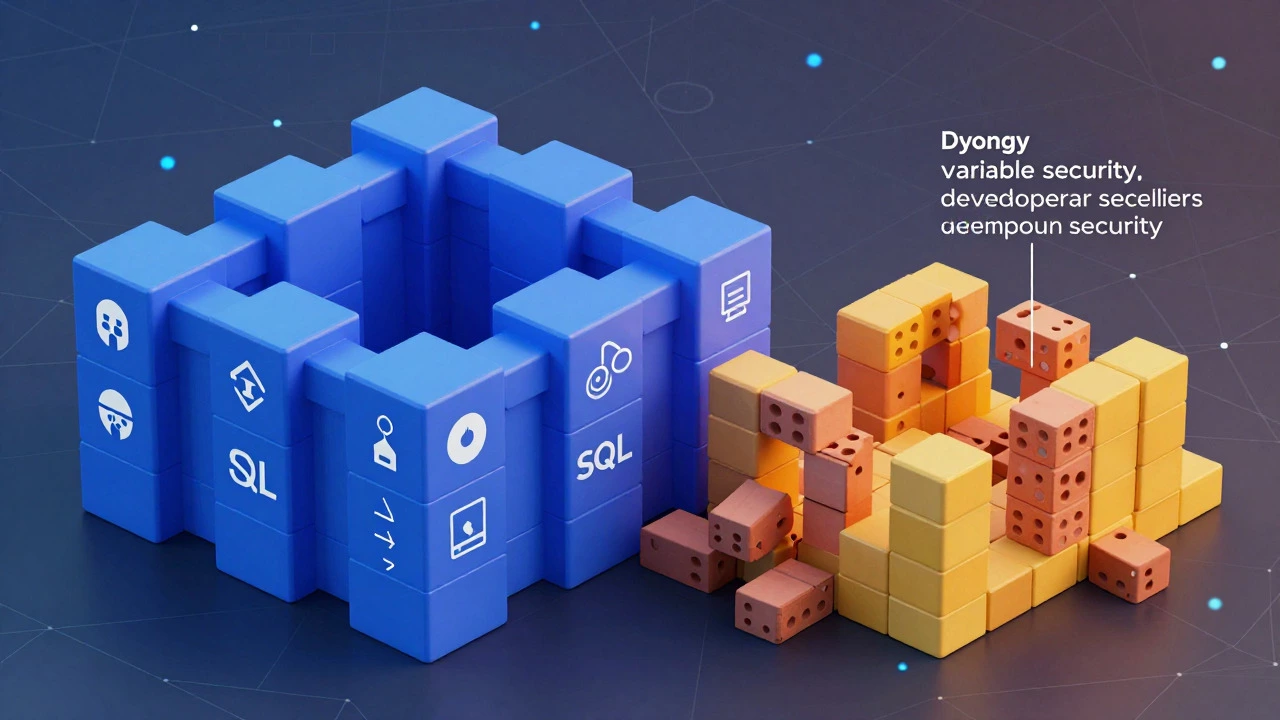
Security isn’t a feature you add later; it’s a foundation you build on. Django was designed with security as a first-class citizen. By default, it protects against Cross-Site Scripting (XSS), Cross-Site Request Forgery (CSRF), SQL Injection, and Clickjacking. You don’t have to remember to escape inputs manually-the framework does it for you. This reduces the human error factor, which is responsible for most web vulnerabilities.
PHP’s security record is mixed. In the early 2000s, PHP was notorious for insecure defaults. While modern PHP versions have improved dramatically, the burden of security often falls on the developer. You must explicitly configure prepared statements to prevent SQL injection. You must implement CSRF tokens manually unless you’re using a framework. For large enterprises handling sensitive financial or health data, Django’s enforced security model provides peace of mind that raw PHP cannot match without significant additional engineering effort.
Performance and Scalability
Let’s talk numbers. PHP, particularly when compiled with OPcache and running on Nginx, can handle thousands of requests per second with minimal memory overhead. It’s stateless by nature, meaning each request is independent. This makes horizontal scaling straightforward-you can add more servers behind a load balancer without worrying about session state synchronization.
Django runs on Python, which suffers from the Global Interpreter Lock (GIL). This means only one thread can execute Python bytecode at a time, limiting true parallelism. However, Django applications typically use asynchronous workers (like Celery) for background tasks and serve static files through CDNs. For I/O-bound applications (like social networks or e-commerce sites), Django performs admirably. For CPU-intensive tasks (like image processing or real-time analytics), you might need to offload work to separate microservices written in Go or Rust. So, while PHP might win in raw request-per-second benchmarks for simple pages, Django scales well enough for most modern web apps when architected correctly.
The Ecosystem and Job Market in 2026
Your choice of technology affects your career trajectory and hiring pool. PHP powers WordPress, WooCommerce, and Drupal. If you’re building custom themes or plugins for these platforms, PHP is non-negotiable. The job market for PHP developers remains strong, especially in agencies that maintain hundreds of client websites. However, many new startups are moving away from pure PHP stacks toward Python-based solutions.
Django is deeply integrated with the broader Python ecosystem. If your web app needs machine learning capabilities, data analysis, or scientific computing, Django connects seamlessly with libraries like TensorFlow, Pandas, and NumPy. This makes Django the preferred choice for tech companies building AI-driven products. Hiring a Django developer often means hiring someone who understands full-stack development, data pipelines, and automation-skills that are increasingly valuable in 2026.
When to Choose Django Over PHP
- Building a SaaS Platform: You need multi-tenancy, robust user permissions, and an admin dashboard. Django’s built-in features accelerate this.
- Data-Heavy Applications: If your app processes large datasets or integrates with AI models, Python’s ecosystem is unmatched.
- Small Teams Without Senior Architects: Django’s conventions prevent junior developers from making catastrophic architectural mistakes.
- Rapid Prototyping: You need to validate an idea in weeks, not months.
When to Stick with PHP
- Content Management Systems: WordPress customization requires PHP expertise.
- Budget-Constrained Projects: Shared hosting for PHP is cheaper and more widely available than Python-compatible hosting.
- Legacy Codebases: Migrating a 10-year-old PHP application to Django is often cost-prohibitive.
- Simple Brochure Sites: If you don’t need a complex backend, PHP’s simplicity keeps things lightweight.
Conclusion: It’s Not About Better, It’s About Fit
Is Django better than PHP? Technically, yes, in terms of structure, security defaults, and modern development practices. But "better" is subjective. If you’re a freelancer managing fifty WordPress clients, switching to Django would hurt your bottom line. If you’re a startup founder building the next big fintech app, sticking with raw PHP might delay your launch by three months due to reinventing the wheel.
In 2026, the gap between these technologies has narrowed thanks to modern PHP frameworks and Django’s maturity. The real decision comes down to your team’s skills, your project’s requirements, and your long-term maintenance strategy. Don’t choose based on hype. Choose based on fit.
Is Django harder to learn than PHP?
Yes, initially. Django requires understanding Python, MVC/MVT architecture, and command-line tools. PHP is easier to pick up for beginners because you can write code directly in HTML files. However, mastering modern PHP with frameworks like Laravel is equally challenging.
Can I use Django for small projects?
Absolutely. While Django is powerful for large apps, its lightweight core makes it suitable for small projects too. The admin panel alone can save hours of development time even for simple CRUD applications.
Which is faster: Django or PHP?
For simple page loads, PHP is generally faster due to lower overhead. For complex applications with database interactions, the difference becomes negligible. Performance depends more on caching strategies and database optimization than the language itself.
Does Django require more server resources?
Yes, Django applications typically consume more RAM and CPU than equivalent PHP scripts because Python processes are heavier. This means you may need slightly more expensive hosting plans, though cloud providers offer optimized instances for both.
Are there many jobs for Django developers in 2026?
Yes, demand for Django developers is growing, especially in fintech, healthcare, and AI-driven startups. PHP jobs remain plentiful in agency settings and enterprise environments maintaining legacy systems.