PHP vs Modern Alternatives Comparison Tool
This tool helps you determine the best technology stack for your new project based on your requirements. Enter your project details to see a comparison between PHP and modern alternatives.
Project Requirements
PHP used to be everywhere. Back in the early 2000s, if you wanted a website, you used PHP. WordPress, Drupal, Joomla - all built on it. Facebook started with PHP. Even today, over 75% of websites using a server-side language still run PHP. But if you walk into a tech meetup in Dublin, Berlin, or San Francisco, you’ll hear far more talk about JavaScript, Python, or Go than PHP. So why does it feel like PHP faded into the background?
It Got Left Behind by Modern Development Trends
PHP wasn’t designed for the kind of apps we build today. Early PHP was a mess of global variables, inconsistent function names, and no real structure. Functions like mysql_query() were standard - and dangerous. Developers had to manually escape inputs to avoid SQL injection. There was no built-in way to handle JSON. You had to write your own session handlers. It felt like coding with duct tape.
By the time PHP 5.3 came out in 2009, the rest of the world had moved on. Languages like Python and Ruby offered clean syntax, clear object models, and tools like Django and Rails that enforced structure. JavaScript, thanks to Node.js, became a full-stack language. Developers didn’t want to juggle two different languages for front and back end anymore. PHP didn’t adapt fast enough.
It Doesn’t Fit the Developer Experience We Expect Now
Modern developers expect tools that just work. You install a framework, run one command, and you’ve got a server, routing, database migrations, and testing setup. PHP doesn’t offer that out of the box. Even Laravel - the most popular PHP framework - requires configuration. You need Composer, you need to set up environment files, you need to manage dependencies manually.
Compare that to Python’s Flask or FastAPI. You write a single file, run uvicorn app:app, and you’re live. Or Node.js with Express: install, write, run. No complex bootstrapping. PHP feels like assembling IKEA furniture with missing screws. You can do it, but why would you choose it when better tools exist?
JavaScript Took Over the Full Stack
Node.js changed everything. Before 2010, JavaScript was just for buttons and form validation. Then came Node.js - and suddenly, you could write your entire app in one language. Front end? JavaScript. Back end? JavaScript. Database queries? JavaScript. Even deployment scripts? JavaScript.
That’s a huge win for teams. No context switching. No need to hire separate front-end and back-end devs. One person can build a full app. PHP can’t compete with that. Even if you use Laravel or Symfony, you still need JavaScript for the front end. You’re juggling two languages, two ecosystems, two sets of tools. Why not just use one?
Young Developers Don’t Learn PHP Anymore
Look at any coding bootcamp or university syllabus today. You’ll see Python, JavaScript, or Go. Maybe Rust. You won’t see PHP. Why? Because instructors know what’s in demand. Companies aren’t hiring PHP devs unless they’re maintaining legacy systems.
When a new developer opens a laptop in 2025, they don’t Google “how to install PHP.” They search “how to build a web app with React and Node.js.” YouTube tutorials, freeCodeCamp, Udemy - almost all the top courses skip PHP entirely. The pipeline is dry. No new talent means fewer people pushing PHP forward. It becomes a ghost town.
PHP Is Still Used - But Only for Legacy
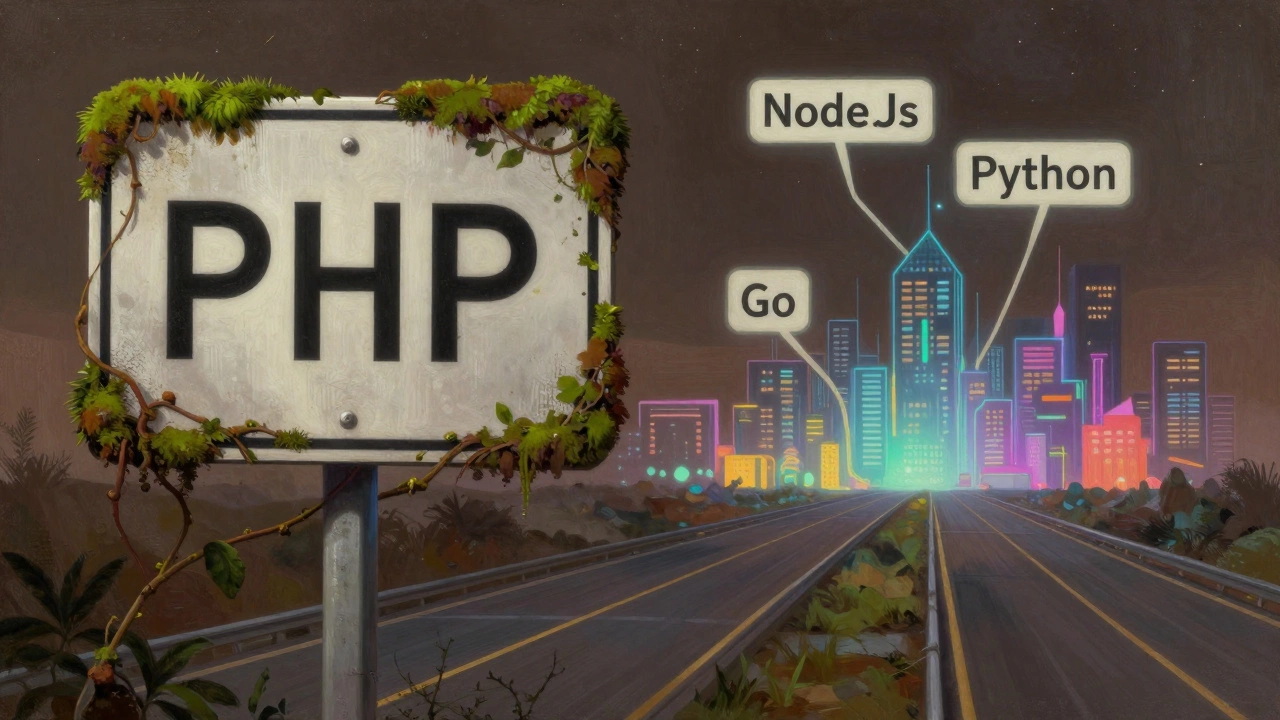
Don’t get me wrong - PHP isn’t dead. WordPress still powers over 43% of all websites. That’s 1.5 billion sites. Many of them run on PHP 7.4 or 8.0. But those sites aren’t being rebuilt. They’re being patched. Companies keep them running because they work - not because they want to.
Think of it like a 1998 Ford Taurus. It still drives. It’s reliable. But if you’re buying a new car today, you don’t pick a Taurus. You pick something with electric power, autopilot, and over-the-air updates. That’s where PHP stands now. It’s the old sedan in the garage. Not the new Tesla in the driveway.
The Language Itself Has Improved - But Too Late
PHP 8.0, released in 2020, was a huge leap. Union types, named arguments, JIT compilation, match expressions - these are modern features. PHP 8.1 added enums. PHP 8.2 added readonly classes. The language is finally catching up.
But here’s the problem: no one cares anymore. The industry moved on. Frameworks like Laravel made PHP usable, but they also made it feel bloated. You don’t write PHP anymore - you write Laravel. And Laravel is a complex beast. It’s not lightweight. It’s not simple. It’s not what new developers are looking for.
Meanwhile, Python’s FastAPI and Deno’s modern runtime offer the same power with cleaner syntax and better tooling. Why stick with PHP when you can get better performance, better security, and better developer happiness elsewhere?
Security and Performance Are No Longer PHP’s Strengths
PHP used to be fast for simple websites. But today, performance is about more than raw speed. It’s about scalability, caching, concurrency, and how well the language handles modern workloads.
Go and Node.js handle thousands of concurrent connections with ease. Python’s async frameworks like FastAPI are built for it. PHP? Even with Swoole or RoadRunner, you’re fighting the language’s design. PHP was built for request-response cycles - one request, one process. That’s fine for a blog. Not for a real-time chat app, a live dashboard, or a microservice architecture.
Security is another issue. PHP’s history is full of vulnerabilities. Even with modern versions, the language still allows dangerous defaults. A developer can accidentally expose a file upload handler or leave a debug endpoint open. It’s not that PHP is insecure - it’s that it makes it too easy to be insecure.

PHP’s Ecosystem Is Fragmented
Want to send an email in PHP? There are 12 libraries. Want to handle authentication? You’ve got Symfony’s Security, Laravel’s Sanctum, custom JWT packages, OAuth2 libraries - and half of them aren’t maintained.
Compare that to Node.js. Express + Passport + JWT is a standard stack. Or Python: FastAPI + OAuth2 + Pydantic. Everyone uses the same tools. The documentation is unified. The community is aligned.
PHP’s ecosystem is a zoo. You spend more time choosing libraries than building features. That’s not a strength. It’s a cost.
It’s Not About the Code - It’s About the Culture
PHP’s biggest problem isn’t syntax or speed. It’s perception. For years, PHP was the language of cheap hosting, cheap developers, and cheap websites. That stigma stuck. Even when a company uses Laravel to build a clean, secure, scalable app, clients still assume it’s “just WordPress.”
Meanwhile, JavaScript and Python are seen as modern, professional, enterprise-ready. That’s not fair - but it’s real. Culture matters. If developers don’t want to work with PHP, companies won’t invest in it. If companies don’t invest in it, PHP won’t grow. It’s a cycle.
When Should You Still Use PHP?
There are still good reasons to use PHP:
- You’re maintaining an existing WordPress, Drupal, or Magento site.
- You’re working for a small business that already has a PHP stack and doesn’t want to rebuild.
- You need to deploy fast on cheap shared hosting.
- You’re working in a region where PHP talent is still abundant and cheap.
But if you’re starting fresh? If you’re building a new app, a SaaS product, or a mobile backend? PHP isn’t the best tool. It’s not the worst - but it’s not the smartest choice either.
What’s Replacing PHP?
Here’s what most new projects use instead:
- Node.js + Express or NestJS - for full-stack JavaScript apps.
- Python + FastAPI or Django - for APIs, data-heavy apps, and AI integrations.
- Go - for high-performance microservices and cloud-native apps.
- Ruby on Rails - for startups that value rapid development.
- Next.js - for server-rendered React apps with built-in API routes.
These tools are faster to learn, easier to scale, and have better tooling. They’re also what hiring managers look for.
Is PHP dead in 2025?
No, PHP isn’t dead. It’s still running on over 75% of websites that use server-side code. WordPress alone keeps it alive. But it’s no longer the go-to choice for new projects. It’s in maintenance mode, not growth mode.
Why do companies still use PHP?
Most companies stick with PHP because they have legacy systems - WordPress sites, old e-commerce platforms, internal tools - that work fine. Rewriting them costs time and money. Unless there’s a major security flaw or performance bottleneck, there’s no reason to switch.
Can PHP still be used for modern web apps?
Yes, but it’s not ideal. Frameworks like Laravel and Symfony let you build modern apps, but you’re fighting the language’s history. You’ll need extra tools for real-time features, better performance, and cleaner architecture. Other languages do the same things with less friction.
Is PHP slower than JavaScript or Python?
On raw speed, PHP 8.2 with JIT is competitive with Python and even beats Node.js in some benchmarks. But speed isn’t everything. PHP’s single-threaded, request-per-process model doesn’t scale well under load. Node.js and Go handle thousands of concurrent connections more efficiently.
Should I learn PHP in 2025?
Only if you need to maintain existing WordPress or legacy systems. If you’re starting your career, focus on JavaScript, Python, or Go. They’ll open more doors, pay better, and give you tools that match how the web is built today.
If you’re working with PHP today, don’t feel bad. It served the web well for decades. But if you’re choosing a language for your next project, look beyond PHP. The tools are better. The community is bigger. And the future? It’s written in something else.