Front-End vs. Backend Career Path Advisor
Based on the article's analysis of stability, learning curves, and job market dynamics, determine which development path aligns best with your personality and career goals.
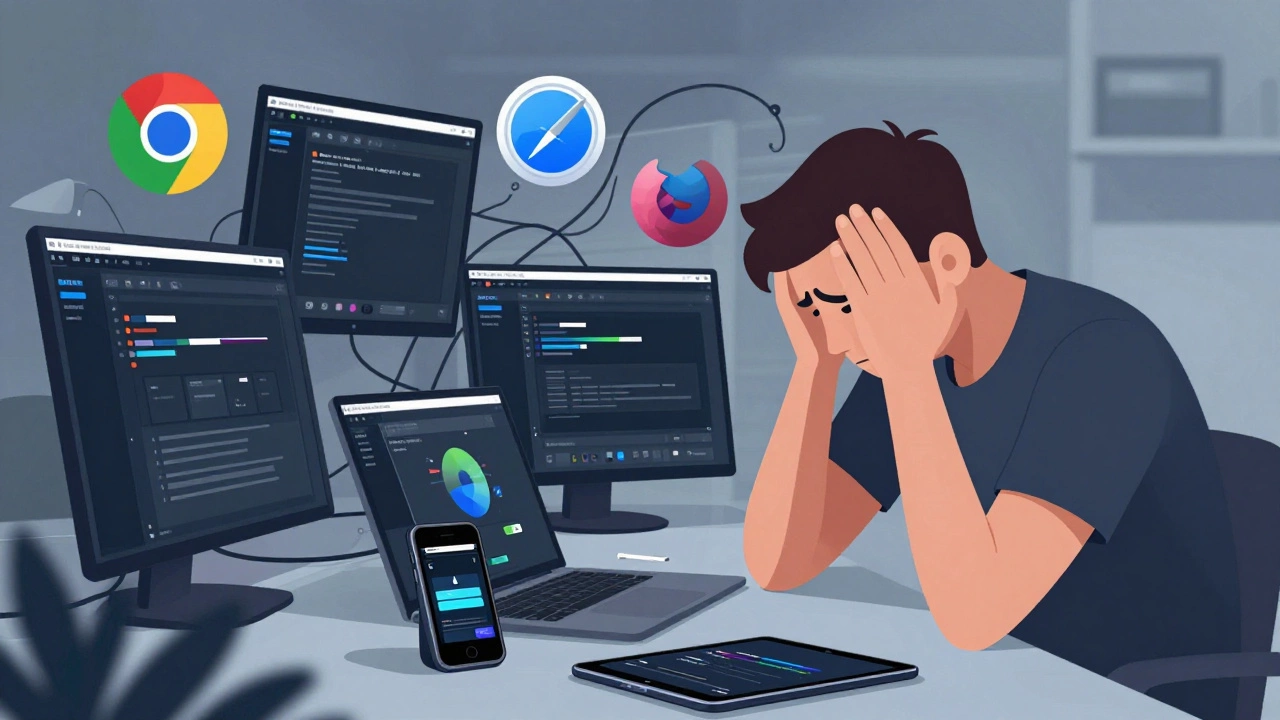
Picture this: You spend three days perfecting a button animation. It’s smooth, it’s snappy, and it looks incredible on your laptop. Then, you open the app on an older Android phone, and the animation stutters. On an iPhone with Dark Mode, the contrast is unreadable. On a tablet, the layout breaks because of a weird screen resolution. Meanwhile, the database query that fetches the user data? It runs in 20 milliseconds every single time, regardless of the device.
This frustration is the daily reality for many Front-End Developers who deal with the client-side code that users interact with directly in their browsers. It’s also why a growing number of engineers are asking: Is backend development actually better?
The short answer is no-"better" is subjective. But if we define "better" as having fewer moving parts, higher job security, less browser fragmentation, and often higher starting salaries, then yes, the backend has distinct advantages. Let’s break down why the server side feels more stable than the client side, without bashing the people who build beautiful interfaces.
The Browser Fragmentation Nightmare
The biggest headache in front-end development isn’t writing code; it’s making sure that code works everywhere. When you write JavaScript for the a programming language primarily used for web development to create interactive effects within web browsers, you aren’t just coding for one environment. You’re coding for Chrome, Firefox, Safari, Edge, and dozens of mobile browsers, each with its own quirks, version updates, and rendering engines.
In contrast, Backend Development focuses on server-side logic, databases, and application programming interfaces (APIs) that power the functionality behind the scenes. When you deploy a backend service using Node.js or a runtime environment that executes JavaScript code outside a web browser, you control the environment. You choose the version. You manage the dependencies. If it works on your server, it works for every user hitting that endpoint. There is no "Safari bug" on the server. This predictability reduces stress and debugging time significantly.
| Feature | Front-End Development | Backend Development |
|---|---|---|
| Environment Control | Low (User's browser/device) | High (Server infrastructure) |
| Primary Focus | User Interface & Experience | Data Logic & Security |
| Tech Churn | Very High (New frameworks yearly) | Moderate (Stable languages like Java/Python) |
| Debugging Complexity | High (Network, CSS, JS conflicts) | Medium (Logs, Database queries) |
| Security Responsibility | Client-side validation only | Core data protection & authentication |
Logic Stability vs. Visual Trends
Front-end development is heavily influenced by design trends. One year, everything is flat design; the next, it’s neumorphism. Frameworks like React, a JavaScript library for building user interfaces maintained by Meta, Vue, and a progressive JavaScript framework for building UIs, Angular compete for dominance, forcing developers to constantly learn new syntaxes and patterns just to stay employable.
Backend logic, however, is timeless. A SQL query to join two tables doesn’t care what the website looks like. An algorithm that calculates tax rates remains valid regardless of whether the frontend uses HTML5 or some future markup language. Languages like Java, a high-level, class-based, object-oriented programming language, C#, and a general-purpose programming language developed by Microsoft, or even Python, a versatile programming language known for readability and wide use in data science and web backends, have been around for decades. Learning these technologies provides a longer shelf life for your skills. You aren’t chasing the latest hype cycle; you’re mastering fundamental computer science principles.

Higher Barrier to Entry Means Less Competition
Because front-end development is visible, it attracts a massive influx of beginners. Bootcamps prioritize teaching HTML, CSS, and basic JavaScript because students can see immediate results. This saturation drives entry-level competition up and salaries down for junior roles.
Backend development requires a deeper understanding of system architecture, databases, networking, and security. You can’t "see" your work in the same way. This higher barrier to entry filters out casual learners. As a result, there is a consistent shortage of skilled backend engineers. Companies pay a premium for talent that can design scalable APIs, optimize database performance, and secure sensitive user data. According to recent industry reports, senior backend roles often command higher salaries than their front-end counterparts because the cost of a backend failure (data breach, downtime) is exponentially higher than a visual glitch.

The Reality Check: Why Front-End Still Matters
If backend is so much "better," why does everyone want to do front-end? Because it offers instant gratification. You change a color, and you see it. You fix a layout, and it snaps into place. For creative minds, this feedback loop is addictive. Additionally, modern front-end development has become increasingly complex. With the rise of Server-Side Rendering (SSR) using tools like Next.js, a React framework that enables server-side rendering and static site generation, the line between front-end and backend is blurring. Modern front-end developers need to understand API integration, state management, and even basic server logic.
Furthermore, user experience (UX) is king. The best backend in the world is useless if the interface is confusing. Front-end developers are the bridge between the machine and the human. They solve problems related to accessibility, performance optimization for low-end devices, and intuitive interaction design. These are critical business drivers that backend code alone cannot address.
Which Path Should You Choose?
Your choice shouldn’t be based on which side is "easier" or "more prestigious." It should be based on how your brain works.
- Choose Backend if: You enjoy puzzles, logic, and structure. You like knowing exactly how data flows from point A to point B. You prefer working with abstract concepts over visual aesthetics. You value stability and deep technical expertise over rapid visual changes.
- Choose Front-End if: You are visually oriented and empathetic to user frustrations. You enjoy seeing the immediate impact of your work. You are comfortable with constant learning and adapting to new tools. You like collaborating closely with designers and product managers.
The most valuable developers in the market today are not strictly front-end or backend-they are Full-Stack Developers who professionals capable of working on both the client-side and server-side of web applications. Understanding both sides allows you to communicate better with your team, anticipate issues before they arise, and build more cohesive products. Start with one, master it, then expand to the other. That is the true path to career resilience.
Is backend development harder than front-end?
It is not necessarily harder, but it is different. Backend requires stronger logical thinking, understanding of algorithms, and knowledge of databases and servers. Front-end requires strong attention to detail, creativity, and ability to handle cross-browser compatibility. Many find backend conceptually challenging due to abstraction, while front-end is frustrating due to environmental inconsistencies.
Which pays more: front-end or backend?
Generally, backend developers tend to earn slightly higher salaries, especially at senior levels. This is because backend roles often involve handling critical infrastructure, security, and data integrity, which carry higher risks and responsibilities for companies. However, top-tier front-end specialists with expertise in performance optimization and complex state management can also command very high salaries.
Do I need to know both to get hired?
Not initially. Most entry-level jobs specialize in either front-end or backend. However, having a basic understanding of both makes you a much stronger candidate. Knowing how APIs work helps front-end devs, and understanding how UI renders helps backend devs. Full-stack proficiency is highly valued for mid-to-senior roles.
Is backend development boring?
Some people find it less exciting because there are no visuals. However, backend developers often describe the satisfaction of optimizing a slow database query or designing a scalable microservice architecture as deeply rewarding. It is about solving complex logical problems rather than aesthetic ones.
What is the future of front-end vs backend?
The lines are blurring. With technologies like Next.js and SvelteKit, front-end developers are writing server-side code. Conversely, headless CMS platforms allow backend-focused teams to deliver content without worrying about presentation. The future belongs to developers who can navigate both worlds seamlessly.