WordPress Career Salary Calculator
Estimate your potential annual salary as a WordPress developer in 2026 based on your experience level, skills, and location. This tool uses current market data from the article.
Your estimated salary will appear here after calculating.
Is WordPress a good career? If you’re asking this in 2026, you’re not alone. Thousands of people every year wonder if learning WordPress is worth the time-especially with all the buzz around AI, React, and custom-built apps. The truth? WordPress isn’t just surviving. It’s thriving. And for developers, designers, and freelancers, it’s still one of the most reliable paths to steady work, decent pay, and real independence.
WordPress powers nearly 40% of all websites
That’s not a guess. That’s a stat from W3Techs, updated every month. In January 2026, WordPress runs on 42.7% of all websites worldwide. That’s over 1.9 billion sites. Think about that: nearly half of every website you visit-from small local bakeries to big news outlets-is built on WordPress. That’s not a niche. That’s a massive, ongoing demand.
Why does this matter for your career? Because businesses don’t just build websites once. They update them. Fix them. Add features. Optimize them for speed. Make them secure. And they need people who know how to do it-fast, affordably, and without rewriting everything from scratch.
Unlike custom-coded apps that need full-stack teams, WordPress sites can be maintained by one person. That’s why companies hire WordPress developers-not because they’re lazy, but because it’s smart. You’re not replacing developers. You’re enabling them to focus on the complex stuff while you handle the scalable, high-demand work.
Real jobs, real pay
Let’s talk money. In Dublin, a junior WordPress developer with 1-2 years of experience earns between €35,000 and €45,000 a year. Mid-level developers with plugin customization, WooCommerce, and performance optimization skills make €50,000-€65,000. Senior developers or agency leads can hit €75,000+, especially if they handle client management or lead teams.
Freelancers? Even better. Hourly rates for WordPress work range from €40 to €120 depending on skill and niche. Need a simple site? €800-€1,500. Need a custom WooCommerce store with membership logic, multi-currency, and API integrations? €5,000-€15,000. I’ve seen freelancers in Ireland land three projects a month without even trying hard.
And it’s not just Ireland. Companies in the UK, Germany, Canada, and the US are all hiring WordPress talent. Remote work is normal. You can work for a startup in Austin while living in Cork. The market doesn’t care where you are-only what you can deliver.
What skills do you actually need?
Don’t get fooled by the myth that WordPress is “just drag-and-drop.” That’s for bloggers. For a career, you need real skills:
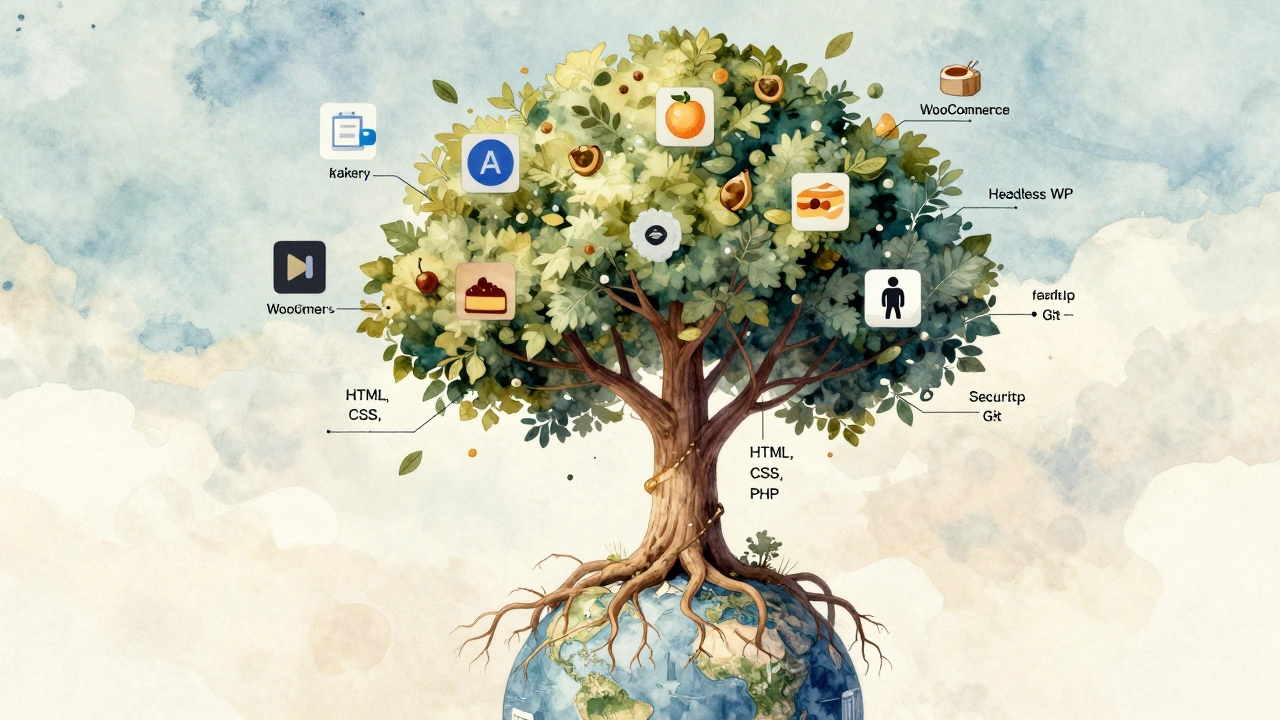
- PHP - WordPress is built on it. You don’t need to be a PHP guru, but you must understand loops, hooks, filters, and how to write safe, clean functions.
- JavaScript (especially React) - Gutenberg blocks, admin interfaces, and dynamic front-ends all use JavaScript. React is now standard for custom block development.
- HTML/CSS - Still the foundation. If you can’t make a layout look good on mobile, you won’t get hired.
- WooCommerce - The #1 e-commerce platform for WordPress. If you can build, customize, or fix a WooCommerce store, you’re in high demand.
- Performance optimization - Speed matters. Knowing how to use caching, lazy load images, optimize databases, and reduce render-blocking resources is a huge differentiator.
- Security - WordPress sites get hacked daily. Knowing how to harden a site, use plugins safely, and respond to breaches is a skill that commands premium rates.
- Version control (Git) - Not optional anymore. Agencies and clients expect it.
These aren’t nice-to-haves. They’re the baseline. The people who make good money aren’t the ones who installed Elementor ten times. They’re the ones who can debug a broken REST API call between WooCommerce and a CRM.
It’s not just about coding
Most WordPress careers aren’t about writing code all day. They’re about solving problems for real people.
You might be helping a dentist in Galway update their booking system. Or fixing a broken checkout flow for a sustainable fashion brand in Berlin. Or training a small business owner to manage their own site without hiring you every month.
That means soft skills matter: communication, patience, clarity. You don’t need to be a salesperson, but you do need to explain why a plugin is slowing their site down-and how to fix it without breaking anything else.
Many WordPress developers start as freelancers. Then they build a small agency. Then they hire others. It’s a common path. One developer I know started by fixing WordPress sites for €20/hour. Five years later, he runs a team of seven and bills clients €150/hour for enterprise-level support.
What’s changing in 2026?
WordPress isn’t stuck in 2010. It’s evolving fast.
- Gutenberg is now the default - Block themes are replacing traditional themes. You need to understand how blocks work under the hood.
- AI is helping, not replacing - Tools like AI-powered content generators and image optimizers are speeding up workflows. But they can’t fix a broken theme or secure a hacked site. Humans still handle the complex stuff.
- Headless WordPress is growing - More companies are using WordPress as a backend (via REST API or GraphQL) and building front-ends with React or Vue. That’s a new skill path: WordPress backend + modern frontend.
- Accessibility is mandatory - EU regulations require websites to meet WCAG 2.1 standards. If you don’t know how to make a site accessible, you’re leaving money on the table.
The people who thrive in 2026 aren’t the ones who stick to old methods. They’re the ones who adapt-learning block development, diving into APIs, and understanding compliance.
Who shouldn’t pursue WordPress?
It’s not for everyone. If you hate dealing with clients, you’ll burn out. If you want to build the next TikTok or AI startup, WordPress won’t get you there. If you think it’s easy because “anyone can use it,” you’re in for a rude awakening.
WordPress is not for people who want to avoid learning. It’s for people who want to solve real problems with tools that millions already use. It’s for those who like variety-every site is different, every client has different needs.
And if you’re looking for a career with low competition and high demand? You won’t find many better.
How to start in 2026
Here’s the fastest path:
- Learn the basics of HTML, CSS, and JavaScript. FreeCodeCamp and Codecademy are solid starting points.
- Install WordPress locally (using Local by Flywheel or XAMPP) and break things on purpose. Then fix them.
- Build three real sites: one for a friend, one for a local business, one for yourself. Document your process.
- Learn WooCommerce. Set up a test store with products, shipping, and taxes.
- Master one theme framework (like GeneratePress or Kadence) and learn how to customize it without child themes.
- Learn how to use Git. Push your work to GitHub-even if it’s just for backup.
- Join WordPress communities. Attend local meetups (Dublin has several) or join online forums like WordPress.org or Reddit’s r/WordPress.
- Start offering small fixes on Upwork or Fiverr. Charge €25/hour. Deliver fast. Get reviews.
It takes 3-6 months of consistent effort to go from beginner to hireable. Not because it’s hard-but because you need to build confidence through doing.
Final answer: Yes, it’s a good career
WordPress isn’t glamorous. It won’t make you a tech billionaire. But it will give you a stable, flexible, and growing career. You’ll work with real people. You’ll solve real problems. You’ll get paid well. And you’ll never run out of work.
The web isn’t going away. And as long as businesses need websites, WordPress will be at the center of it. If you’re willing to learn, adapt, and show up, it’s one of the safest bets in tech right now.
Is WordPress still relevant in 2026?
Yes. WordPress powers over 42% of all websites globally, and that number is still growing. It’s not going away-it’s evolving. Businesses rely on it because it’s flexible, affordable, and easy to maintain. The demand for skilled WordPress developers is higher than ever.
Can you make a living as a WordPress freelancer?
Absolutely. Many freelancers earn €40-€120/hour, with top specialists charging even more. A single custom WooCommerce project can bring in €5,000-€15,000. With consistent clients, it’s easy to hit €60,000-€80,000 a year working part-time or full-time remotely.
Do you need a degree to work with WordPress?
No. Most successful WordPress developers are self-taught. Employers and clients care more about your portfolio, problem-solving skills, and reliability than your diploma. Build real projects, get testimonials, and show results-that’s what matters.
Is WordPress development boring or repetitive?
Only if you treat every site the same. Each client has different goals, audiences, and challenges. One day you’re fixing a security vulnerability, the next you’re building a custom booking system with API integrations. The variety keeps it engaging-if you’re willing to learn new things.
What’s the biggest mistake beginners make?
Relying too much on plugins. Beginners install 30+ plugins to do simple tasks, which slows down the site and creates security risks. The best developers write custom code when needed and use plugins only when they’re truly necessary and well-maintained.
Should I learn WordPress or focus on React or Vue?
Learn both. WordPress is the most widely used CMS, and it’s not going anywhere. But headless WordPress (using WordPress as a backend with React or Vue on the front end) is growing fast. Knowing both gives you more options and higher earning potential.
Is WordPress safe from AI taking over jobs?
AI can generate basic content or suggest code snippets, but it can’t handle client communication, troubleshoot complex conflicts, or ensure legal compliance. AI can’t replace a developer who understands business needs and technical constraints. It’s a tool-not a replacement.
If you’re thinking about a career in WordPress, the time to start is now. The market is wide open, the tools are mature, and the demand is real. You don’t need to be the smartest person in the room. You just need to be the one who shows up, learns, and delivers.