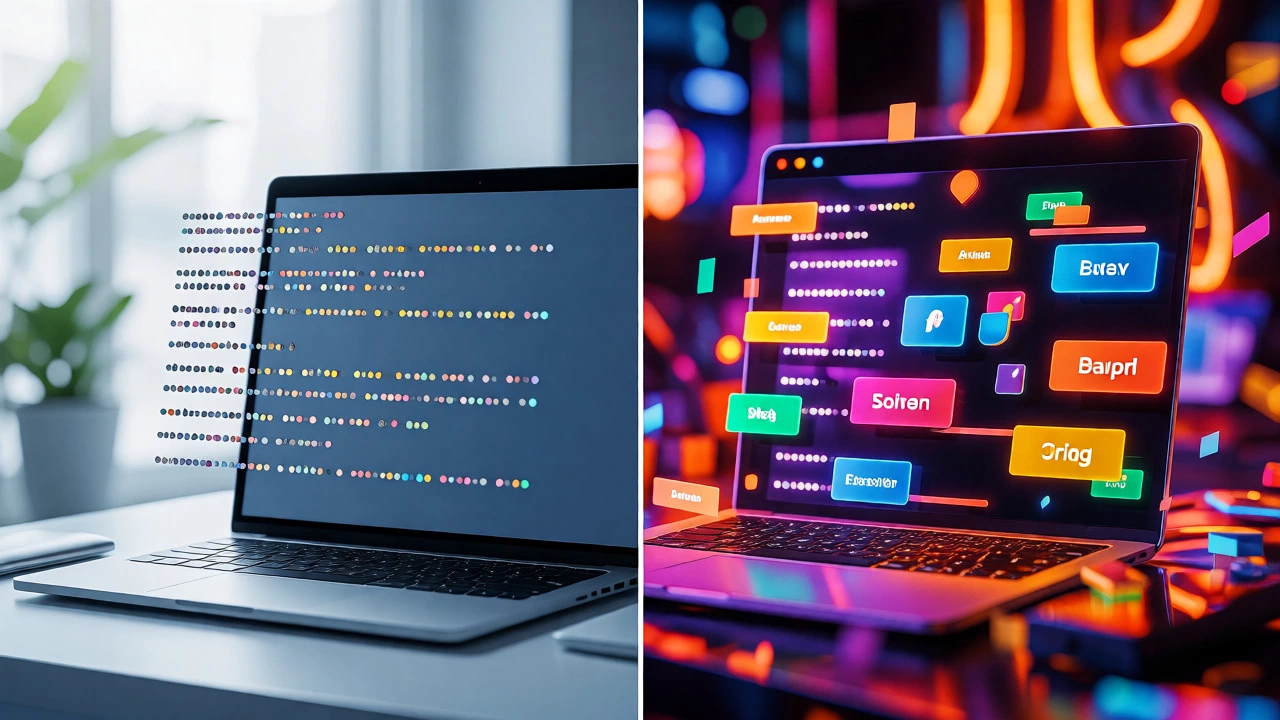
Python vs. JavaScript: Which Should You Learn First?
Not sure where to start? Answer these quick questions to find out which language aligns best with your immediate goals.
1. What is your primary goal right now?
2. How do you prefer to set up your environment?
3. What kind of feedback keeps you motivated?
4. How do you feel about strict rules vs. flexibility?
🚀 Start with JavaScript
Why? Your answers suggest you value immediate visual feedback and low barrier to entry. JavaScript runs everywhere (in your browser) and lets you build interactive interfaces instantly. This tight feedback loop is crucial for keeping motivation high when starting out.
Next Steps:
- ✅ Open Chrome/Firefox and press F12 to try the Console.
- ✅ Learn basic HTML/CSS first, then add JS interactivity.
- ✅ Build a simple To-Do List app.
🐍 Start with Python
Why? Your answers indicate an interest in data, automation, or structured problem-solving. Python’s readable syntax reduces cognitive load, allowing you to focus on logic rather than syntax quirks. It’s the industry standard for Data Science and AI.
Next Steps:
- ✅ Install Python and VS Code.
- ✅ Learn basic variables, loops, and functions.
- ✅ Try automating a simple file renaming task or analyzing a CSV.
⚖️ It's a Tie!
Why? You have mixed interests. You might enjoy building web apps but also care about data structure. Since concepts transfer well between languages, pick the one that has the most interesting project waiting for you *right now*.
Recommendation:
If you are undecided, JavaScript is often recommended for absolute beginners because you need no installation. However, if you hate debugging weird behavior, Python's stricter nature might save you headaches later.
You’ve probably heard the debate a thousand times. Someone says Python is the easiest language to learn because it reads like English. Then another person argues that JavaScript is simpler because you can run it in your browser without installing anything.
Who’s right? The honest answer is: it depends on what you want to build and how your brain works. If you’re trying to decide which one to pick up first, or if you’re already learning one and wondering if the other will be harder, this breakdown cuts through the noise.
The "Easy" Myth Needs Busting
Let’s clear up a common misconception. Neither language is objectively "easier." They just have different friction points. Think of it like choosing between driving an automatic car (Python) and a manual transmission (JavaScript). One hides complexity; the other forces you to understand the mechanics immediately.
Python is a high-level, interpreted programming language known for its clear syntax and readability. It was created by Guido van Rossum in 1991 with a specific goal: code should be read as much as it is written. This philosophy makes it incredibly forgiving for beginners. You don’t need semicolons at the end of every line. You don’t need curly braces to define blocks of code. Indentation does the work for you.
On the flip side, JavaScript is a multi-paradigm scripting language primarily used for client-side web development. It was created by Brendan Eich in just ten days in 1995. That rushed origin story explains a lot about its quirks. It’s flexible, sometimes too flexible, but it runs everywhere. If you want to see results instantly-like making a button change color when clicked-JavaScript gives you immediate visual feedback. Python usually requires a terminal window, which feels less magical to some learners.
Syntax Showdown: Reading Code Like Human Language
When you look at code for the first time, syntax is your biggest hurdle. Let’s compare two simple tasks: printing "Hello World" and looping through a list.
| Task | Python Syntax | JavaScript Syntax | Winner for Beginners |
|---|---|---|---|
| Print Statement | print("Hello") |
console.log("Hello") |
Tie (Both are short) |
| Variable Declaration | x = 5 |
let x = 5; |
Python (Less clutter) |
| For Loop | for i in range(5): |
for (let i = 0; i < 5; i++) { |
Python (Much cleaner) |
| Error Handling | try: / except: |
try {} / catch {} |
Python (More intuitive keywords) |
Notice the loop example. In Python, for i in range(5) tells you exactly what’s happening: iterate over numbers from 0 to 4. In JavaScript, you have to manage the initialization (let i = 0), the condition (i < 5), and the increment (i++) all in one line. For a new coder, that’s three things to remember instead of one concept. This is why many bootcamps start with Python-it reduces cognitive load.
However, JavaScript has its own advantage: consistency within the browser. Once you learn how to select an element using document.querySelector(), you can manipulate almost any part of a webpage. Python doesn’t have a built-in equivalent for DOM manipulation because it wasn’t designed for the browser. If your goal is visual creativity, JavaScript’s syntax becomes second nature faster because you’re interacting with things you already see on screen.
Environment Setup: The Hidden Barrier
Here’s where the "ease" argument shifts. Installing Python on Windows or macOS is straightforward, but configuring virtual environments (using tools like venv or Conda) confuses beginners. You might spend your first week fighting path variables instead of writing code.
JavaScript wins here decisively. You already have a JavaScript engine installed. It’s called Chrome, Firefox, or Safari. Open the developer tools (usually F12), click the Console tab, and type alert('Hi'). Boom. You’re coding. No downloads, no installations, no configuration files. For absolute beginners who get frustrated by technical setup, JavaScript removes that initial wall entirely.
But wait-modern JavaScript development isn’t just about the console. If you want to build serious apps, you’ll eventually need Node.js to run JavaScript outside the browser, plus package managers like npm or Yarn. Suddenly, the simplicity fades. You’re dealing with dependency hell, version conflicts, and build steps. Python has similar issues with pip, but its ecosystem tends to be more standardized for data science tasks.
Where Each Language Shines (And Where It Hurts)
To judge difficulty fairly, we have to look at use cases. Learning a language in a vacuum is pointless. You learn best when solving real problems.
Choose JavaScript If...
- You want instant visual gratification. Making websites interactive is rewarding. Seeing a menu slide out or a form validate in real-time keeps motivation high.
- You’re interested in front-end web development. There is no alternative. Every modern website uses JavaScript. Frameworks like React, Vue, and Angular dominate the market.
- You like flexibility. JavaScript lets you write code in multiple styles (functional, object-oriented, procedural). This freedom is great for creative types but confusing for those who prefer strict rules.
Choose Python If...
- You’re into data science, AI, or automation. Libraries like Pandas, NumPy, and TensorFlow are industry standards. Writing a script to analyze a CSV file takes five lines in Python versus fifty in JavaScript.
- You prefer structure. Python enforces indentation. You can’t make messy-looking code easily. This helps beginners develop good habits early.
- You want backend versatility. While Node.js handles backends well, Python frameworks like Django and Flask are renowned for their robustness and security features out of the box.
The Conceptual Hurdle: Async and Types
Once you move past basic loops and variables, both languages present unique challenges.
In JavaScript, the biggest mental shift is understanding asynchronous programming. Because browsers can’t freeze while waiting for data from a server, JavaScript uses callbacks, promises, and async/await. Imagine ordering coffee: you place your order (async request), then continue talking to friends (other code execution) until the barista calls your name (callback/promise resolution). Grasping this non-blocking behavior trips up many learners. Python, traditionally synchronous, added async support later, so it feels less central to the core experience.
Then there’s typing. Both are dynamically typed, meaning you don’t declare variable types upfront. But JavaScript’s loose typing leads to famous bugs. Remember when "5" + 3 equals "53" but "5" - 3 equals 2? These implicit conversions confuse beginners. Python is stricter; trying to add a string and an integer throws an error immediately. This strictness saves you from subtle logic errors later, making debugging easier in Python.

Career Path and Job Market Reality
Does ease of learning translate to job prospects? Yes, but differently.
JavaScript developers are in high demand for front-end roles. The barrier to entry is low, so competition is fierce at the junior level. However, mastering complex frameworks like React or Next.js opens doors quickly. Salaries vary widely based on location, but full-stack JavaScript developers often command competitive rates due to their ability to handle both client and server sides.
Python developers often target data engineering, machine learning, or backend roles. The learning curve for specialized libraries is steeper, but the specialization pays off. According to recent Stack Overflow Developer Surveys, Python consistently ranks among the most popular languages globally, largely driven by its dominance in AI research and educational sectors.
If you live in tech hubs like Dublin, London, or New York, you’ll find plenty of openings for both. But note: many companies now expect JavaScript knowledge even for backend roles, thanks to Node.js. Conversely, Python skills are increasingly valued in general software engineering, not just data roles.
Which Should You Learn First?
Stop asking which is easier. Ask which is more useful for your next project.
If you want to build a portfolio website, a personal blog, or an interactive dashboard, start with JavaScript. You’ll see tangible results in hours. The feedback loop is tight, which keeps dopamine flowing and motivation high.
If you want to automate boring spreadsheet tasks, analyze financial data, or prototype a machine learning model, start with Python. The syntax won’t fight you, and you’ll spend less time wrestling with environment setups and more time solving actual problems.
Ultimately, the "easiest" language is the one you’ll actually finish learning. Many successful developers learn both. Start with one, get comfortable, then pick up the other. The concepts transfer surprisingly well. Understanding loops in Python makes them obvious in JavaScript, and vice versa. Don’t let analysis paralysis stop you. Pick one today and write your first line of code.
Can I learn JavaScript and Python at the same time?
It’s possible, but generally not recommended for absolute beginners. Learning two languages simultaneously can cause confusion regarding syntax differences (like indentation vs. braces). It’s better to master the fundamental concepts (variables, loops, functions) in one language first, then switch to the other. Once you know one, picking up the second takes weeks rather than months.
Is Python better for AI than JavaScript?
Yes, currently. Python dominates the AI and Machine Learning landscape due to mature libraries like TensorFlow, PyTorch, and Scikit-Learn. While JavaScript has libraries like TensorFlow.js for running models in the browser, Python remains the standard for training and heavy computational tasks.
Why do people say JavaScript is hard?
People cite its quirky behaviors (like hoisting and coercion), the complexity of asynchronous operations, and the rapidly changing ecosystem of frameworks. However, modern tooling and TypeScript (a superset of JavaScript) have made it much more predictable and manageable for large projects.
Do I need to know HTML/CSS before learning JavaScript?
If you’re learning JavaScript for web development, yes. Basic knowledge of HTML (structure) and CSS (style) is essential because JavaScript interacts directly with these elements. You don’t need to be an expert, but understanding the DOM (Document Object Model) is crucial.
Which language pays more, Python or JavaScript?
Salaries depend more on specialization than language. Senior Data Scientists (often Python-based) and Senior Full-Stack Developers (often JavaScript-based) earn comparable high salaries. Entry-level positions may vary by region and company size, but neither language guarantees higher pay on its own.