
Front-End vs. Back-End Role Classifier
Select a technology from the list below to see where it fits in the modern web architecture. This tool helps clarify common misconceptions, such as the difference between Java and JavaScript.
Technologies
Analysis
Key Takeaway
Remember: Java is primarily a server-side (Back-End) language running on the JVM. JavaScript is the primary client-side (Front-End) language running in the browser. They are unrelated despite similar names.
You’re staring at a job description that asks for "Java skills," but the role is listed under Front-End Development. Your brain does a little flip. Is Java actually back-end? Can you use it on the client side? If you’ve ever felt confused by where Java fits in the modern web stack, you’re not alone. The short answer is yes, Java is overwhelmingly a back-end language. But the longer answer involves why people get confused and how the lines between front-end and back-end are blurrier than they used to be.
The Short Answer: Yes, Java is Back-End
Let’s cut through the noise immediately. In 95% of professional web scenarios, when someone says "Java," they mean the server-side engine powering your application. It handles database queries, user authentication, business logic, and API responses. It runs on servers (like Tomcat or Jetson) or cloud instances, not in your browser.
Why the confusion? Because JavaScript-the king of the front-end-has "Java" in its name. This naming accident from the 1990s still trips people up today. They are two completely different languages with no shared codebase, syntax rules, or execution environments. Think of them like "car" and "carpet." Just because they share letters doesn’t mean they do the same thing.
Java is a high-level, class-based, object-oriented programming language designed for running on the Java Virtual Machine (JVM). It is primarily used for building scalable server-side applications, enterprise systems, and Android apps. Unlike scripting languages that run directly in the browser, Java requires compilation into bytecode before execution.
What Actually Happens on the Front-End?
If Java isn’t there, what is? The front-end is everything your user sees and interacts with. It lives in the browser. The core trio here is HTML (structure), CSS (style), and JavaScript (behavior). These three run natively in Chrome, Firefox, Safari, and Edge without any extra plugins.
Modern front-end frameworks like React, Vue, or Angular take this further. They manage complex state, component rendering, and routing entirely within the browser environment. When you click a button and see a modal pop up instantly, that’s JavaScript doing its job. No server round-trip needed for simple interactions.
| Feature | Front-End (Client-Side) | Back-End (Server-Side - Java) |
|---|---|---|
| Primary Language | JavaScript, TypeScript | Java, Kotlin, Scala |
| Execution Environment | Web Browser | Server / JVM |
| Main Responsibility | User Interface & Experience | Data Logic & Security |
| Visible to User? | Yes (via DevTools) | No (Hidden behind APIs) |
| Common Frameworks | React, Angular, Vue | Spring Boot, Jakarta EE |
So Why Do Some Jobs Mention Java for Front-End?
Here is where it gets tricky. You might see a "Full Stack Developer" role requiring Java and React. Or perhaps a legacy system uses Java Applets. Let’s break down the edge cases that cause this confusion.
- Full Stack Confusion: Many companies hire one person to do both jobs. They need you to write Java APIs (back-end) and connect them to a React interface (front-end). The job title might say "Front-End focused," but the requirement list includes Java because you’ll touch the server code too.
- JavaFX and Swing: These are desktop GUI libraries written in Java. They create windowed applications, not web pages. If you’re building a banking terminal app for a teller, you might use Java. That’s not web front-end; it’s desktop software.
- GWT (Google Web Toolkit): A few years ago, Google created a tool that let developers write Java code and compile it into JavaScript. This allowed Java devs to build front-end apps without learning JS. While GWT still exists, it has largely fallen out of favor compared to native JavaScript frameworks.
- Blazor WebAssembly: Microsoft now allows C# (and theoretically other .NET languages) to run in the browser via WebAssembly. Java has similar experimental paths (like TeaVM), but they are niche. Most teams don’t use Java for browser logic today.

The Role of the JVM in Modern Architecture
Even if Java isn’t drawing pixels on the screen, it powers the machinery behind the scenes. The JVM (Java Virtual Machine) is a robust runtime environment that allows Java code to run anywhere. This "write once, run anywhere" promise made Java the default choice for large enterprises.
When you log into Amazon.com, your browser sends a request. The front-end (JavaScript) displays the loading spinner. Meanwhile, Java services on AWS servers query databases, check inventory, calculate shipping costs, and return JSON data. The front-end then paints the results. You never see the Java code, but it did all the heavy lifting.
Frameworks like Spring Boot have made Java back-end development faster and less verbose. Spring Boot auto-configures servers, handles security, and connects to databases with minimal boilerplate. It’s why Java remains dominant in fintech, healthcare, and e-commerce sectors where reliability trumps rapid prototyping.
Can You Use Java in the Browser Today?
Technically, yes. Thanks to WebAssembly (Wasm), you can compile Java code to Wasm and run it in the browser. Projects like CheerpJ or TeaVM enable this. However, just because you *can* doesn’t mean you *should*.
JavaScript engines (V8 in Chrome, SpiderMonkey in Firefox) are hyper-optimized for DOM manipulation. Compiling Java to Wasm adds overhead. For most UI tasks, native JavaScript is faster and easier to debug. Developers typically stick to Java for back-end performance and stability, leaving the browser to JavaScript specialists.
There is a growing trend called "Kotlin Multiplatform Mobile" (KMM), which shares logic between iOS and Android. While not web-focused, it shows how JVM languages are expanding their reach. Still, for pure web development, Java stays on the server.
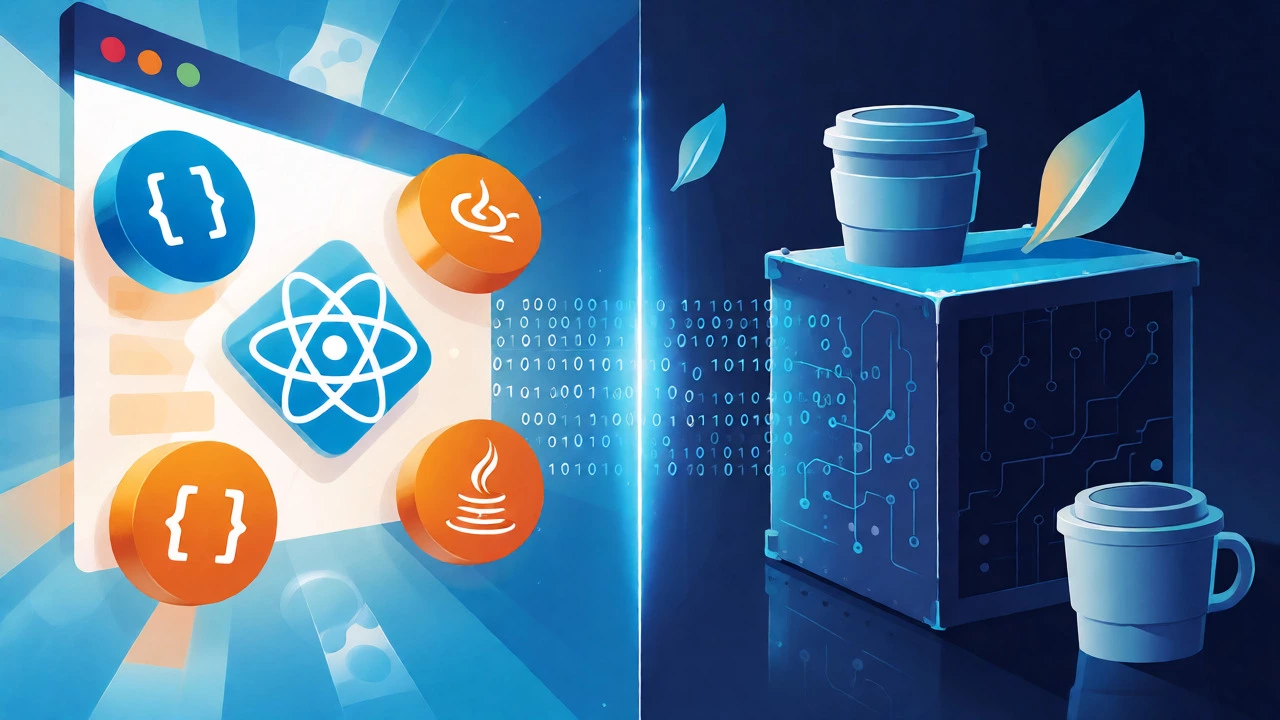
How to Structure Your Learning Path
If you’re trying to decide whether to learn Java or JavaScript first, consider your goals. Do you want to build interfaces? Start with JavaScript. Do you want to architect scalable systems? Start with Java.
- Learn the Basics of HTTP: Understand how requests and responses work. This bridges the gap between front and back.
- Pick One Side First: Don’t try to learn Spring Boot and React simultaneously. Master one layer.
- Understand APIs: Learn how to consume a REST API with JavaScript. Then, build a simple API with Java/Spring.
- Connect Them: Build a small project where a React frontend fetches data from a Java backend. This solidifies the separation of concerns.
Remember, being a "full-stack" developer doesn’t mean knowing every technology. It means understanding how the pieces fit together. Knowing that Java is back-end helps you ask better questions during interviews and technical planning.
Frequently Asked Questions
Is Java used for front-end development?
Generally, no. Java is primarily a back-end language. While tools like GWT or WebAssembly allow Java to run in browsers, standard web front-end development relies on HTML, CSS, and JavaScript.
Why is Java considered back-end?
Java runs on the Java Virtual Machine (JVM) on servers. It excels at handling complex business logic, database interactions, and high-volume traffic, which are typical server-side responsibilities. Browsers do not natively execute Java bytecode.
What is the difference between Java and JavaScript?
They are unrelated languages. Java is statically typed and compiled, mostly used for back-end systems and Android apps. JavaScript is dynamically typed and interpreted, used exclusively for client-side web interactivity. The name similarity is historical marketing.
Can I become a front-end developer without knowing Java?
Absolutely. Most front-end roles require expertise in JavaScript, React/Vue/Angular, HTML, and CSS. Java knowledge is only necessary if you aim for a full-stack role involving Java-based back-ends.
Which is harder to learn, Java or JavaScript?
Opinions vary. Java has stricter syntax and static typing, which can feel rigid initially but catches errors early. JavaScript is more flexible but can lead to unexpected bugs due to loose typing. Beginners often find JavaScript’s immediate visual feedback rewarding, while Java appeals to those who prefer structured architecture.