Web Development Technology Selector
Choose a Development Task
Select what you want to build and we'll tell you which technologies you need
Required Technologies
How It Works
Each technology has a specific role in web development:
People often ask if HTML is "good" with Python, like they’re two people trying to date. The truth? HTML and Python don’t date. They don’t even live in the same house. But they work together - and that’s the whole point.
HTML Doesn’t Run Python
HTML is a markup language. It’s the skeleton of a webpage. It tells the browser: "Here’s a heading. Here’s a paragraph. Here’s a button." That’s it. HTML can’t do math. It can’t check if a user is logged in. It can’t talk to a database. It doesn’t understand variables or loops. It’s static. Simple. Literal.
Python, on the other hand, is a full programming language. It can calculate taxes, process payments, manage user accounts, and even control robots. But Python doesn’t run in your browser. Not directly. You can’t drop a Python script into an HTML file and expect it to work.
So no, HTML isn’t "good" with Python - because HTML isn’t meant to be. It’s not a tool for logic. It’s a tool for structure.
Where Python Actually Comes In
Python’s job in web development isn’t to replace HTML. It’s to generate it.
Think of it like a chef and a recipe book. The recipe book (HTML) shows you how to arrange ingredients. The chef (Python) decides what ingredients to use, how much to cook, and when to serve it.
When you visit a website like Instagram or Reddit, you’re seeing HTML. But that HTML wasn’t typed by hand. It was created on the fly by Python code running on a server. Python pulls data from a database, figures out what content belongs to you, and then packages it into HTML before sending it to your browser.
That’s where frameworks like Django a high-level Python web framework that encourages rapid development and clean design. Also known as Django Framework, it was first released in 2005 and has since powered millions of websites. and Flask a lightweight Python web framework that gives developers flexibility to build web applications with minimal boilerplate. Also known as Flask Framework, it was released in 2010 and is widely used for small to medium-sized web apps. come in. They let you write Python code that outputs HTML. You write:
<h1>Welcome, {{ user.name }}!</h1>
<p>You have {{ unread_messages }} new messages.</p>
And Python fills in the blanks. That’s called templating. It’s not Python running in the browser. It’s Python building the HTML before the browser even sees it.
What About Front-End? Can Python Talk to HTML in the Browser?
Here’s where things get tricky. Some people think Python should be used to build buttons, animations, or form validation - stuff that happens in the browser. That’s not how it works.
The browser speaks JavaScript. Not Python. If you want a button to change color when clicked, you need JavaScript. Not Python.
There are tools like Pyodide a port of Python to WebAssembly that allows running Python code directly in the browser. Also known as Pyodide, it was developed by the Pyodide Project and enables scientific computing in browsers. that let you run Python in the browser. It’s real. It works. But it’s like using a tractor to mow your lawn. Possible? Yes. Practical? Almost never.
Pyodide is great for educational tools, data visualization demos, or legacy scientific apps. But if you’re building a website for customers, you’ll still need JavaScript. And you’ll still need HTML. Python won’t replace either.

How Real Websites Use Both
Let’s take a real example: a blog.
- HTML defines the structure: title, author, date, paragraphs, comments section.
- JavaScript handles the interactive bits: letting users like posts, load more comments without refreshing, or toggle dark mode.
- Python runs on the server: it stores the blog posts in a database, checks if the user is logged in, sends the right HTML to each visitor, and handles form submissions when someone leaves a comment.
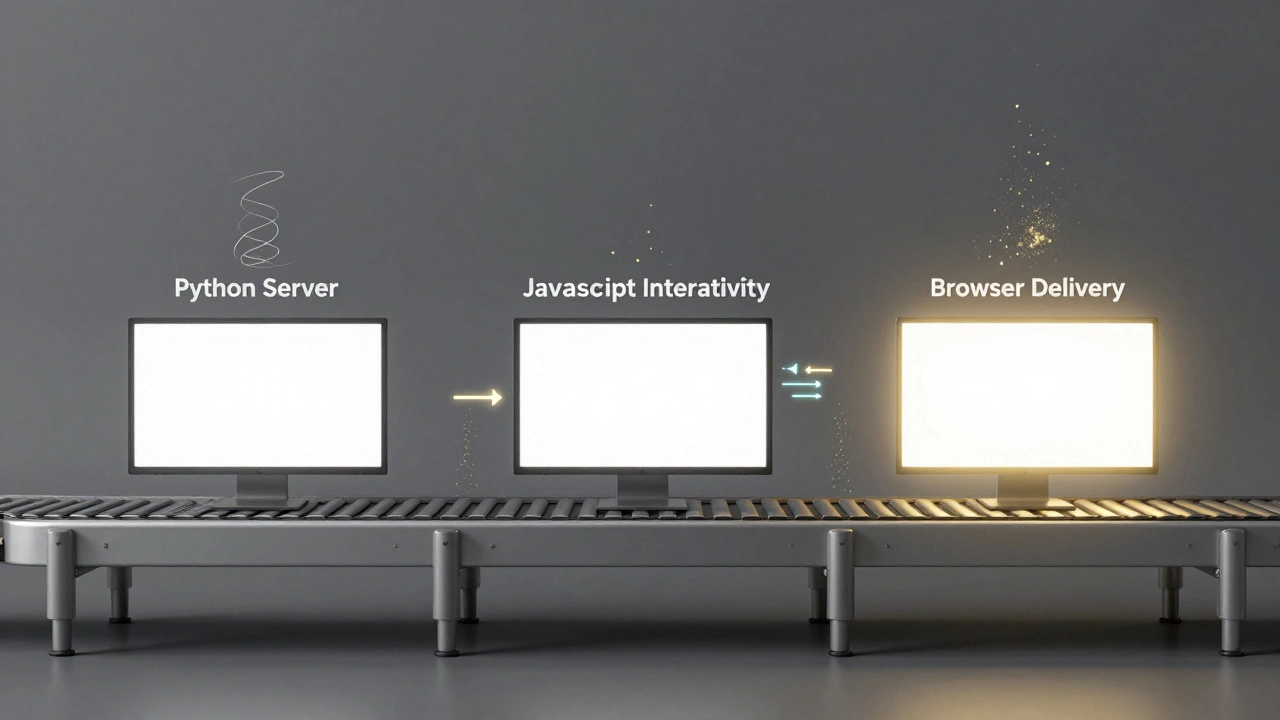
So Python doesn’t touch the HTML you see. It creates it. The HTML you see is the final product. Python is the factory that made it.
That’s why full-stack developers exist. They know HTML for structure, JavaScript for interaction, and Python (or another backend language) for logic and data.
Common Misconceptions
Here are three things people get wrong:
- "I can write Python in my HTML file." - No. If you try, the browser will treat it as plain text. It won’t run.
- "Python is better than JavaScript for front-end." - No. JavaScript is the only language browsers understand natively. Python needs heavy workarounds.
- "If I learn Python, I don’t need to learn HTML." - Absolutely false. You can’t build a website without HTML. Not even close.
HTML is the foundation. You can’t skip it. Python is the engine. You need it for dynamic sites. But they serve completely different roles.
When Should You Use Python for Web Development?
You should use Python when:
- You’re building a backend API to serve data to a front-end app.
- You need to process forms, upload files, or handle payments.
- You’re managing a database of users, products, or content.
- You want to automate tasks like sending emails or generating reports.
You should not use Python when:
- You’re adding a hover effect to a button.
- You’re validating an email address in real-time as someone types.
- You’re building a single-page app with smooth transitions.
Those are JavaScript jobs. Don’t force Python into them.
What Should You Learn First?
If you’re starting out:
- Learn HTML. Build static pages. Get comfortable with tags, attributes, and layout.
- Learn CSS. Make them look good.
- Learn JavaScript. Add interactivity.
- Then, learn Python. Use it to build the backend that serves your HTML and JavaScript.
This order isn’t arbitrary. It’s how the web actually works. Skip HTML and you’ll be building castles in the air.
Final Answer: Is HTML Good with Python?
HTML and Python aren’t a team. They’re a supply chain.
Python makes the HTML. HTML gets delivered to the browser. JavaScript makes it move. That’s the stack.
So yes - they’re "good" together. Not because they’re alike. But because they’re different. And that’s exactly how the web was designed to work.
Can I use Python instead of HTML to build websites?
No. HTML is the standard language browsers use to display content. Python can generate HTML, but it can’t replace it. Browsers don’t understand Python code. You need HTML for structure, CSS for styling, and JavaScript for interaction. Python handles the server-side logic behind the scenes.
Does Python work with front-end frameworks like React or Vue?
Not directly. React and Vue run in the browser using JavaScript. But Python can power the backend that feeds them data. For example, you can use Django or Flask to build a REST API that sends JSON data to a React app. The React app then turns that data into a live interface. So Python supports front-end frameworks - it doesn’t replace them.
Is Pyodide a replacement for JavaScript in the browser?
No. Pyodide lets you run Python code in the browser using WebAssembly, but it’s slow, adds large file sizes, and lacks browser API access compared to JavaScript. It’s useful for niche cases like data science demos or educational tools, but not for real-world websites. JavaScript remains the only practical choice for browser-side interactivity.
Why do so many tutorials say "Learn Python to build websites"?
Because Python is excellent for the backend. Tutorials focus on Python because it’s easier to learn than languages like Java or C#. But those tutorials usually assume you already know HTML and CSS. If a tutorial skips HTML, it’s either incomplete or misleading. Building websites requires all three: HTML, CSS, and JavaScript for the front-end; Python (or another language) for the back-end.
Can I build a full website using only Python?
Technically, yes - using frameworks like Django or Flask to generate HTML. But you still need to write HTML templates. You still need CSS for styling. You still need JavaScript for dynamic behavior. Python handles the logic, but it doesn’t eliminate the need for front-end technologies. A website built with only Python code and no HTML/CSS/JS would be invisible to users.