
Freelance Web Developer Earnings Calculator
Estimate Your 2025 Freelance Income
Based on industry data from the article "How Much Can a Beginner Web Developer Make Freelancing in 2025?"
Pricing Model
Your Skill Level
Hours Worked
Your Estimated Earnings
💡 Pro Tip: Switching to project pricing can increase your effective hourly rate by 2-3x!
Key Insights
Starting at $15-$25/hour is common for beginners.
Project pricing often yields higher earnings than hourly rates.
Your skill level directly impacts your rate - React/Vue developers earn 20-30% more.
When you’re just starting out as a web developer, one of the first questions you ask isn’t about JavaScript frameworks or responsive grids-it’s how much can you actually make? The answer isn’t a single number. It’s a range shaped by where you live, what skills you have, who you work for, and how you pitch yourself. For beginners freelancing in 2025, the truth is simple: you can make anywhere from $15 to $60 an hour, and that’s before you even start building a reputation.
What You’ll Actually Earn in Your First 6 Months
Most new freelancers start by taking small jobs: fixing a broken contact form, building a simple WordPress site for a local bakery, or updating an old HTML page. These gigs pay $15-$25 an hour if you’re in the U.S., Canada, or Western Europe. In countries like Ireland, where the cost of living is high but competition is fierce, beginners often charge $20-$35/hour to stay competitive.
Let’s say you land three small projects in your first month. One is a $300 website for a plumber. Another is a $200 landing page for a yoga instructor. The third is a $150 fix for a Shopify store. That’s $650 in 30 days. If you worked 40 hours total, that’s $16.25/hour. It looks low-but you’re not being paid for your time. You’re being paid for solving a problem someone can’t fix themselves.
By month three, you’ll start getting repeat clients. One of those bakery owners might need a blog added. The yoga instructor wants a booking system. These are higher-value tasks. You can raise your rate to $30/hour. Suddenly, you’re making $800-$1,200 a month. That’s not life-changing, but it’s more than most entry-level office jobs pay-especially if you’re working part-time.
Skills That Pay More (Even as a Beginner)
Not all beginner web developers earn the same. Your income depends heavily on what you can do. Here’s what actually moves the needle in 2025:
- HTML, CSS, JavaScript - The baseline. You need these. But alone, they won’t get you above $25/hour.
- WordPress - Still the most in-demand platform for small businesses. If you can build a custom theme, install plugins, and optimize speed, you can charge $35-$50/hour.
- React or Vue - If you can build a simple interactive component (like a product filter or modal popup), you jump into the $40-$60/hour range, even as a beginner.
- Basic SEO setup - Adding meta tags, optimizing images, fixing broken links. Clients don’t know how to do this. You do? You just added $500 to a $2,000 project.
- Responsive design - If your site looks bad on mobile, it doesn’t matter how pretty it is on desktop. Clients notice. You fix it? You’re no longer a coder-you’re a problem solver.
One freelancer in Dublin started with just WordPress and basic HTML. After learning how to optimize site speed (using tools like PageSpeed Insights), she raised her rate from $20 to $45/hour in two months. Her clients didn’t care that she was new. They cared that their site loaded faster and ranked higher on Google.
Where the Real Money Is: Project-Based Pricing
Hourly rates are fine when you’re starting. But the real leap comes when you switch to project pricing. Instead of charging $25/hour for a 10-hour site, you charge $500 flat. It sounds risky-but here’s why it works:
- You control the scope. No more working 12 hours for $25/hour because the client kept changing their mind.
- You look more professional. Clients trust someone who gives a clear price.
- You earn more per hour. If you build the site in 6 hours instead of 10, you made $83/hour.
Beginners who use project pricing typically earn 2-3x more than those who stick to hourly. A simple 5-page website? $600-$1,200. A basic e-commerce store with 10 products? $1,500-$2,500. These are realistic numbers for 2025. You don’t need to be an expert. You just need to deliver what’s promised.

Where to Find Your First Clients (Without Paying for Ads)
You don’t need a fancy portfolio or a LinkedIn profile with 500 connections. You need three things: a few sample sites, a clear message, and a way to reach people who need help.
Start local. Walk into small businesses-coffee shops, hair salons, fitness studios-and ask if their website works on phones. Most won’t know. But if you point out the broken button or the tiny text, you’ve already opened the door. Offer to fix it for $200. Most say yes.
Join Facebook groups for local entrepreneurs. Search for “small business website help [your city]”. People are asking for exactly what you offer. Reply with: “I help local businesses fix their websites so they get more calls. I’ve done 15+ sites in the last 3 months. Can I take a look at yours for free?”
Don’t wait for perfection. Build three sites for friends or family. Make them real. Put them on a free domain (like yourname.site). That’s your portfolio. Clients don’t care if you went to college. They care if your site works.
What to Avoid (The Common Beginner Mistakes)
Here’s what kills income for new freelancers:
- Undercharging to “get experience” - You’re not a student. You’re a service provider. Charging $10/hour teaches clients you’re cheap, not skilled.
- Working for free for “exposure” - No one pays for exposure. They pay for results. If you build a site for a big brand and they never thank you? You lost time and money.
- Trying to learn everything at once - Don’t jump into Node.js, Python, and Docker while still struggling with CSS. Master WordPress or React first. Then add one new skill every 2-3 months.
- Not setting boundaries - “Can you just make this one change?” becomes five changes, then a full redesign. Always define scope. Get it in writing-even if it’s just a text message.
One beginner in Cork spent six months building free sites for nonprofits. He didn’t earn a cent. He didn’t get referrals. He didn’t get a portfolio he could show paying clients. He was exhausted. He started charging $400 per site three months ago. Now he has six paying clients and a waiting list.
How Fast Can You Scale to $3,000/Month?
It’s possible. Not easy, but possible. Here’s how:
- Month 1-2: Do 3-4 small projects at $300-$500 each. Total: $1,200-$2,000.
- Month 3: Start charging $600-$1,000 per site. Land 2 clients. Total: $1,800-$2,000.
- Month 4: Add SEO and speed optimization as a $200 add-on. Now you’re making $800-$1,200 per project.
- Month 5-6: Get referrals. Ask happy clients: “Do you know anyone else who needs a website?”
By month six, you’re doing 3-4 projects a month at $800-$1,000 each. That’s $2,400-$4,000. You’re not rich-but you’re earning more than most 22-year-olds with degrees.
And here’s the best part: you’re not limited by a boss, a 9-to-5, or a company policy. You can take a week off. You can work from a café. You can raise your rates when you’re ready.
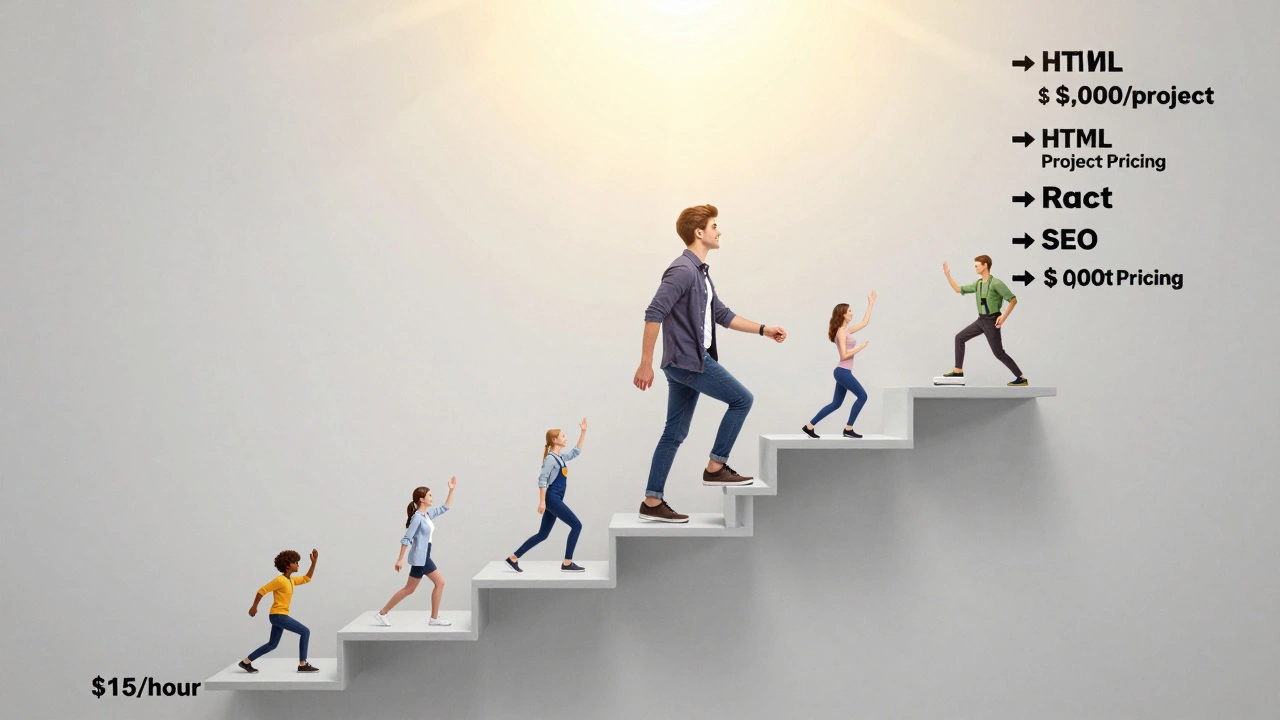
What’s Next After the First ,000?
Once you’re making consistent income, your goal shifts from “how do I earn?” to “how do I grow?”
- Start offering monthly maintenance plans. Charge $50-$100/month to update plugins, backup the site, fix bugs. It’s passive income.
- Specialize. Become “the guy who fixes WooCommerce sites” or “the developer who helps dentists get more online bookings.”
- Record short videos of your work. Post them on TikTok or Instagram. “How I fixed this bakery’s website in 1 hour.” People love seeing results.
- Learn basic copywriting. A good headline and clear call-to-action can double conversion rates. That’s worth charging extra for.
You don’t need to become a full-stack engineer to make good money. You just need to solve real problems for real people. And that’s something anyone can learn.
Frequently Asked Questions
Can a beginner web developer make a full-time income?
Yes, but it takes focus. Most beginners make part-time income first-$1,000 to $2,500 a month-while holding another job. By month six, many switch to full-time freelancing if they’re consistent. You don’t need 100 clients. You need 5-8 paying clients who trust you.
Do I need a degree to earn more as a freelance web developer?
No. Employers might ask for degrees. Freelance clients don’t. They care about your portfolio, your communication, and whether your sites load fast and work on phones. I’ve seen people with no formal training earning $70/hour because they fixed a client’s broken checkout page and saved them $12,000 in lost sales.
What’s the fastest way to get my first client?
Go to a local business you like-maybe a bookstore, a gym, or a florist. Ask if their website works on mobile. If it doesn’t, say: “I help businesses fix their websites so they get more customers. I can fix this for you in two days for $300.” Most will say yes. That’s your first client.
Is it better to charge hourly or by project?
Start hourly to learn how long things take. But switch to project pricing as soon as you can. It’s more professional, it protects you from scope creep, and it lets you earn more per hour. A $600 website that takes you 8 hours is $75/hour. If you charged $25/hour hourly, you’d make $200.
How long does it take to go from beginner to earning $5,000/month?
With consistent effort-working 15-20 hours a week-it usually takes 6 to 9 months. The key isn’t learning more code. It’s getting better at communicating, setting boundaries, and delivering results faster than your competition. Most people quit before month four. Those who stick with it hit $5,000 by month eight.
Next Steps for Beginners
If you’re reading this and thinking, “I can do this,” here’s what to do tomorrow:
- Build one simple website-any site. Use WordPress or a free template. Put it online.
- Find one local business with a bad website. Send them a short, friendly message: “I noticed your site doesn’t work well on phones. I help businesses fix this. Can I take a look?”
- Set your first rate: $30/hour or $500/project. Don’t lowball.
- Track every hour you work. You’ll learn where your time goes.
You don’t need to be perfect. You just need to start. The money follows the action-not the other way around.