
Full Stack Learning Path Simulator
Configure Your Study Plan
Your Estimated Timeline
With consistent effort, you'll build a portfolio-ready skillset capable of securing junior roles.
Interactive Roadmap Progress
Click on each step as you complete it to track your journey:
1 Master HTML, CSS & Vanilla JS
2-3 monthsBuild static websites and understand the DOM. Foundation for everything else.
2 Learn React Framework
2-3 monthsBuild dynamic UIs and fetch data from APIs. The most popular frontend library.
3 Add Backend with Node.js
2-3 monthsServer-side JavaScript. Unified language experience across your entire stack.
4 Database Management (PostgreSQL)
1-2 monthsLearn SQL queries, tables, rows, and relationships for data persistence.
5 Build Full CRUD Applications
OngoingConnect front end, back end, and database. Build real projects like todo lists or blogs.
Does the term full stack developer make you feel like you need a PhD in computer science before you can write your first line of code? You are not alone. The job title sounds intimidating because it implies you need to know everything about how the internet works. From the pixels on a screen to the databases storing user data, the scope feels massive.
The short answer is: yes, it is hard. But no, it is not impossible. In fact, millions of people have learned these skills without a formal degree. The difficulty comes from the sheer volume of tools and technologies, not necessarily the complexity of the logic itself. If you break it down into manageable pieces, learning to build complete web applications becomes a series of small, achievable wins rather than one giant mountain.
What Does "Full Stack" Actually Mean?
To understand the difficulty, you first need to define what you are trying to achieve. A Full Stack Developer is a software engineer who can work on both the front-end (client-side) and back-end (server-side) of a web application. Think of a restaurant. The front end is the dining room where customers sit, look at the menu, and order food. The back end is the kitchen where chefs prepare the meals, manage inventory, and handle payments. A full stack developer knows how to design the dining room *and* run the kitchen.
In technical terms, this means you need to master two distinct worlds:
- Frontend Development involves creating the visual interface users interact with using HTML, CSS, and JavaScript frameworks like React or Vue.
- Backend Development involves building the server logic, database management, and API integrations using languages like Python, Node.js, or PHP.
The challenge isn't just learning one language; it's understanding how they talk to each other. When you click a button on the front end, how does that request reach the database? How does the data come back? Connecting these dots is where the real learning curve sits.
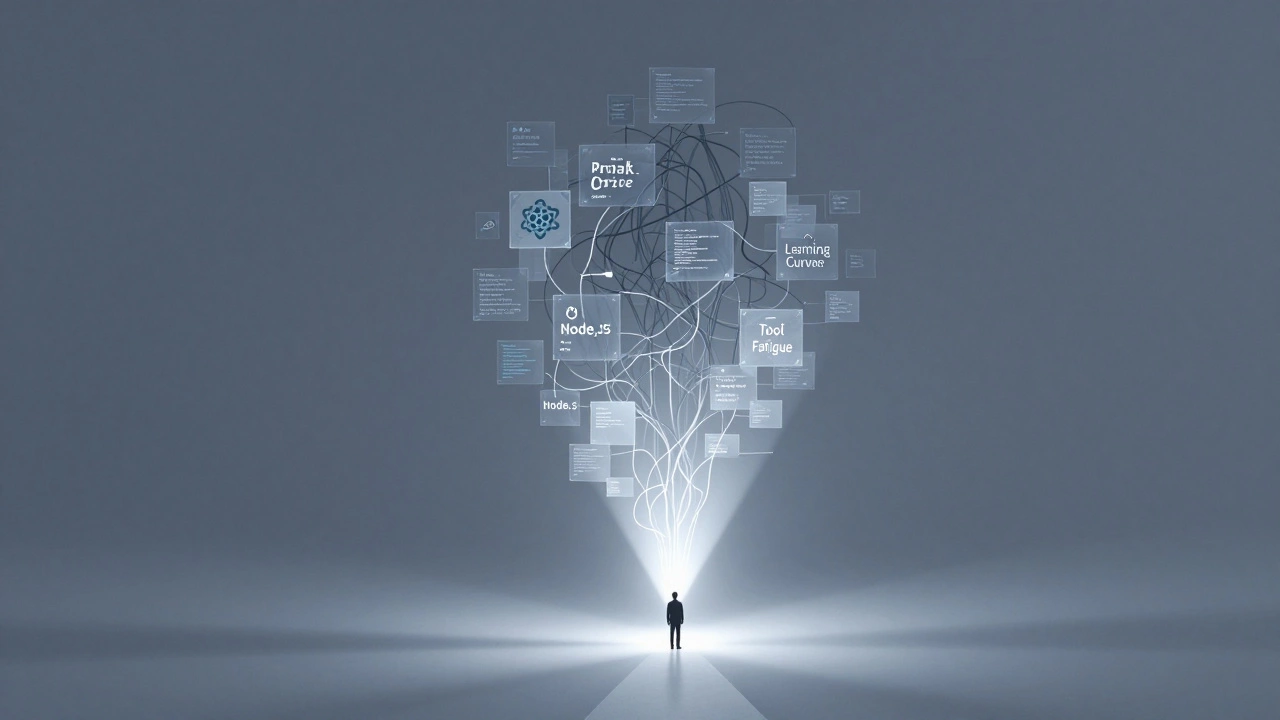
The Learning Curve: Where Do Most People Struggle?
If you ask ten developers why it was hard to start, you'll get ten different answers. However, there are three common bottlenecks that trip up almost everyone.
1. Tool Fatigue
Every year, new frameworks emerge. In 2026, you might hear about Next.js, SvelteKit, or Nuxt. Ten years ago, it was AngularJS and jQuery. This constant churn creates anxiety. Beginners often think they need to learn every single tool before starting. You don't. The core concepts-how variables work, how loops function, how HTTP requests are made-remain the same regardless of the framework. The struggle here is psychological: feeling overwhelmed by choice paralysis.
2. Abstract Concepts
Frontend development is visual. You change a color, and you see it immediately. Backend development is abstract. You write code to store a user's password, but you don't "see" anything happen on the screen. Understanding asynchronous programming, APIs, and database relationships requires a shift in thinking. You have to visualize data moving through invisible pipes.
3. Debugging Complexity
When something breaks in a full stack app, it could be a CSS error, a JavaScript bug, a server configuration issue, or a database query failure. Isolating the problem requires systematic troubleshooting. For beginners, this can feel like looking for a needle in a haystack. Experienced developers spend more time debugging than writing new code, so this skill takes months to refine.
A Realistic Roadmap to Reduce Difficulty
You can flatten the learning curve by following a structured path. Don't try to learn everything at once. Focus on depth before breadth.
- Master the Basics First: Spend the first 2-3 months strictly on HTML, CSS, and vanilla JavaScript. Build static websites. Understand how the Document Object Model (DOM) works. If you skip this, frameworks will confuse you later.
- Pick One Frontend Framework: Once you are comfortable with JavaScript, choose one major framework. React is currently the most popular JavaScript library for building user interfaces, backed by Meta and widely used in enterprise applications. Stick with it until you can build a dynamic app that fetches data from an external API.
- Add a Backend Language: Since you already know JavaScript, the easiest transition is to Node.js, which allows you to run JavaScript on the server side, creating a unified language experience across your entire stack. Alternatively, Python with Django or Flask is excellent for beginners due to its readable syntax.
- Learn Database Management: Start with a relational database like PostgreSQL. Learn SQL queries. Understand tables, rows, and relationships. Later, explore NoSQL options like MongoDB if your project requires flexible data structures.
- Connect the Dots: Build a simple CRUD (Create, Read, Update, Delete) application. A todo list is cliché for a reason-it teaches all the fundamental interactions between front end, back end, and database.
Time Commitment: How Long Does It Take?
This is the question everyone wants answered with a specific number. The truth is, it depends on your daily commitment. Here is a realistic breakdown based on consistent study habits:
| Study Intensity | Hours Per Week | Time to Job-Ready | Outcome Expectation |
|---|---|---|---|
| Casual Learner | 5-10 hours | 18-24 months | Strong foundational knowledge, suitable for freelance gigs |
| Part-Time Professional | 15-20 hours | 9-12 months | Portfolio-ready, capable of junior roles |
| Full-Time Immersion | 40+ hours | 4-6 months | Intensive bootcamp pace, high stress, rapid progress |
Note that "job-ready" doesn't mean you know everything. It means you can solve problems independently, read documentation effectively, and build functional applications. Companies hire juniors for their potential and ability to learn, not because they are experts on day one.
Common Pitfalls That Make It Harder Than Necessary
Many learners sabotage their own progress by falling into these traps. Avoiding them will save you months of frustration.
- Tutorial Hell: Watching video after video without typing code yourself. You feel productive, but you aren't retaining information. You must build projects, even if they are ugly or broken.
- Switching Stacks Too Often: Starting with React, then hearing Vue is easier, so switching to Vue, then hearing Python is better for AI, so switching to Python. Depth beats breadth. Master one stack before exploring others.
- Igoring Version Control: Not learning Git early on. Git is the industry-standard version control system that tracks changes in source code during software development. Without it, you cannot collaborate or safely experiment with your code. It adds initial complexity but pays off exponentially.
- Comparing Yourself to Seniors: Looking at a senior developer's clean code and feeling inadequate. Remember, they have five years of practice. Your code will be messy at first. That is normal.

Resources That Actually Help
The internet is flooded with free and paid resources. Curating them is half the battle. Here is a lean selection for 2026:
- Interactive Learning: Platforms like freeCodeCamp or The Odin Project provide structured, curriculum-based paths. They force you to write code, which is crucial.
- Documentation: MDN Web Docs remains the gold standard for web technologies. Learn to read official docs early; it is a superpower.
- Community Support: Join Discord servers or Reddit communities like r/learnprogramming. Asking questions and helping others solidifies your own understanding.
- Project-Based Courses: Udemy or Coursera courses that focus on building a complete app (e.g., "Build a Social Media App with MERN Stack") are better than theoretical lectures.
Is It Worth the Effort?
Learning full stack development is difficult, but the payoff is significant. You gain the autonomy to bring ideas to life without waiting for other specialists. You become valuable to employers because you can bridge gaps between teams. The salary prospects for full stack developers remain strong in 2026, especially for those who can demonstrate practical problem-solving skills.
The difficulty is not a barrier; it is a filter. It filters out those who want quick fixes and rewards those who are patient, curious, and persistent. If you enjoy solving puzzles and creating things from scratch, the journey will feel less like a chore and more like a game.
Do I need a computer science degree to become a full stack developer?
No, a degree is not required. Many successful full stack developers are self-taught or graduated from coding bootcamps. Employers care more about your portfolio, your ability to solve problems, and your understanding of core concepts than your academic background. However, a degree can help with visa sponsorships or roles at large traditional enterprises.
Which is easier to learn: frontend or backend?
Frontend is generally considered easier to start because the feedback loop is immediate-you see changes on the screen instantly. Backend requires more abstract thinking regarding server logic, security, and database architecture. However, modern frontend frameworks like React introduce complex state management, so the gap narrows as you advance.
Can I learn full stack development in 3 months?
You can learn the basics in 3 months if you study full-time (40+ hours per week). You will be able to build simple applications and understand core concepts. However, becoming "job-ready" usually takes 6-9 months of consistent practice to build a robust portfolio and gain confidence in debugging and deployment.
What is the best programming language for beginners in 2026?
JavaScript is the best choice because it is the only language that runs natively in web browsers, making it essential for frontend development. With Node.js, you can also use it for backend development, allowing you to learn one language for the entire stack initially. This reduces context switching and accelerates learning.
How do I stay motivated when learning gets difficult?
Focus on building projects that interest you personally rather than generic tutorials. Set small, achievable goals (e.g., "add a login feature this week"). Join a community for accountability. Remember that confusion is part of the learning process; if you aren't stuck sometimes, you aren't learning enough. Celebrate small wins to maintain momentum.