WordPress Developer Earnings Estimator
Based on US market averages adjusted for specialization.
Why this rate?
You see the stats: WordPress powers over 43% of the entire web. It’s everywhere. But here is the question keeping many developers up at night: does working with this specific CMS actually pay well, or are you stuck in a race to the bottom against $50 website builders?
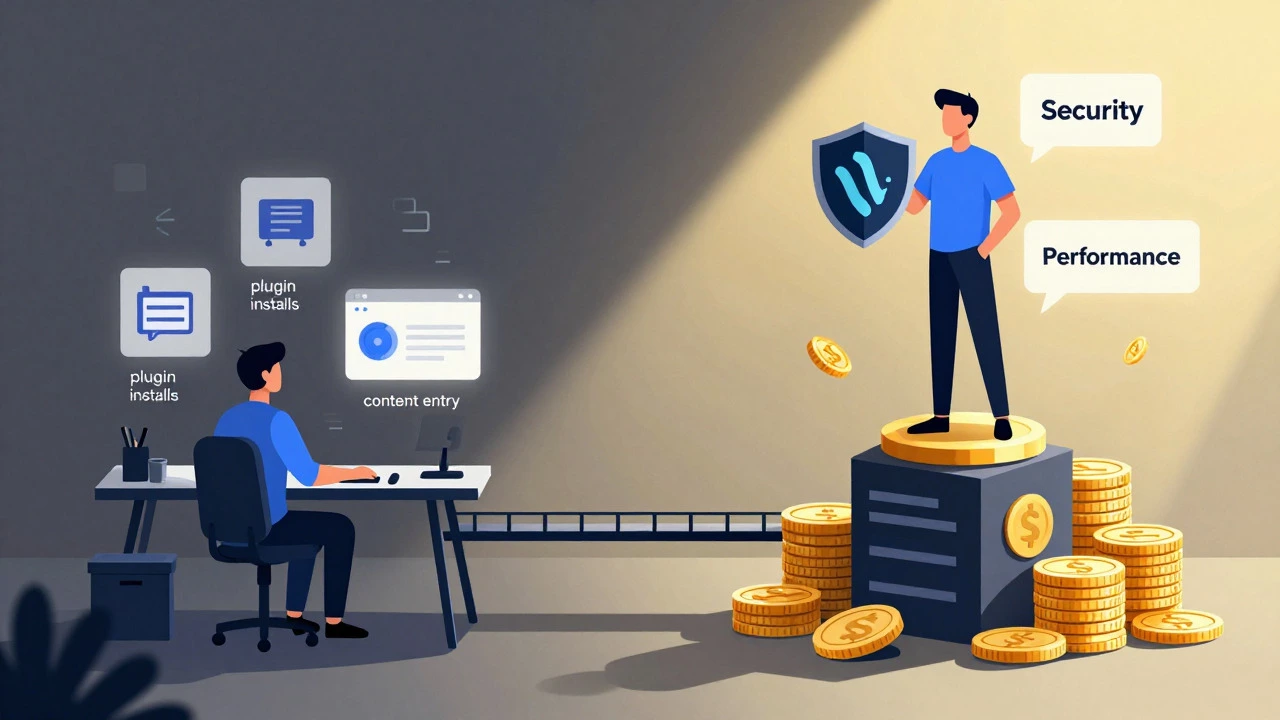
The short answer is yes, but it depends entirely on how you position yourself. If you treat WordPress as just "installing plugins," you will struggle to make a living wage. If you treat it as a robust application framework requiring deep PHP and JavaScript knowledge, the ceiling for your income is surprisingly high. Let’s break down the real numbers, not the marketing fluff.
The Reality of Entry-Level vs. Senior Roles
When you start out, the market can feel saturated. You might find gigs on platforms like Upwork where clients want a full site for $100. That is a trap. Those projects usually involve poor planning and endless revisions that eat your hourly rate alive.
However, once you move past basic theme customization, the money changes quickly. Junior developers typically earn between $40,000 and $60,000 annually in the US, though this varies wildly by location. In Dublin, where I live, entry-level roles often start around €30,000-€35,000, which sounds low until you realize the cost of living adjustments and rapid promotion paths available.
Senior WordPress engineers, especially those who understand server architecture and security, command significantly more. We are talking about salaries ranging from $80,000 to $120,000+ for specialized roles. Why the jump? Because senior devs don’t just build sites; they solve business problems involving scale, speed, and integration with other systems like CRMs or payment gateways.
Freelance Rates: The Hourly Breakdown
Freelancing is where the variance in "pay" gets most extreme. Your rate isn’t determined by what WordPress costs; it’s determined by the value you deliver and your niche expertise.
| Experience Level | Hourly Rate | Typical Tasks | Client Expectation |
|---|---|---|---|
| Beginner | $15 - $35 | Theme installation, content entry, minor CSS tweaks | Fast turnaround, low budget, high volume of small tasks |
| Intermediate | $40 - $75 | Custom theme development, plugin configuration, SEO setup | Reliable delivery, basic troubleshooting, decent design sense |
| Expert/Specialist | $80 - $150+ | Headless WP, custom plugin dev, performance optimization, migration | Strategic advice, complex problem solving, long-term partnership |
Notice the gap between intermediate and expert. Crossing that bridge requires moving beyond using page builders like Elementor or Divi. Experts write custom code. They optimize database queries. They handle security patches personally rather than relying on automated services alone. This technical depth allows them to charge premium rates because they reduce risk for the client.
Niche Specializations That Boost Income
Generalists get paid average wages. Specialists get paid premium wages. Here are three areas within the WordPress ecosystem where developers consistently report higher earnings:
- E-commerce (WooCommerce): Building online stores involves complex logic-inventory management, shipping calculations, tax rules, and payment gateway integrations. A bug here costs the client real money immediately. Because the stakes are higher, clients pay more. Experienced WooCommerce developers often charge 20-30% more than standard blog/site developers.
- Headless WordPress: This involves using WordPress solely as a backend content repository while serving the front end via React, Vue, or Next.js. It requires strong JavaScript skills alongside PHP. Since fewer developers master this stack, supply is lower, driving rates up. Projects here often range from $10,000 to $50,000 per build.
- Enterprise Migration: Moving large, legacy sites (often from Drupal or proprietary systems) to WordPress requires meticulous planning, data mapping, and zero-downtime strategies. These projects are high-stress but high-reward, often billed as fixed-price contracts worth tens of thousands.
Don’t underestimate the power of maintenance retainers. Instead of chasing new projects every month, secure ongoing contracts for updates, backups, and security monitoring. Charging $100-$300 per month per site creates predictable cash flow. Ten such clients equal a modest passive income stream that covers your bills while you work on bigger builds.
Agency Work vs. Freelancing
Should you work for an agency or go solo? Agencies offer stability and benefits, which matters if you have a family or mortgage. However, agencies take a cut of your labor. A client might pay the agency $150/hour for your time, but you receive $50/hour in salary equivalent. You trade upside potential for reduced sales pressure and administrative overhead.
Freelancing gives you control over your rates. You keep 100% of the billable amount (minus taxes and platform fees). But you also spend unpaid hours on marketing, invoicing, and scoping. Successful freelancers learn to bundle these admin tasks into their project quotes. If you hate selling, stay at an agency. If you love autonomy and can sell your expertise, freelancing pays better in the long run.
The Impact of Location and Remote Work
Your geographic location influences your baseline rate, but remote work has blurred these lines. A developer in Eastern Europe might charge $40/hour, while one in San Francisco charges $120/hour. Yet, both might be delivering identical quality code.
Clients increasingly hire based on portfolio proof and communication skills rather than zip code. If you build a reputation for reliability and clear English communication, you can tap into global markets. Many Irish and UK developers now serve US clients, leveraging the timezone overlap for synchronous meetings during US afternoons. This arbitrage-earning USD rates while living in a lower-cost currency zone-can significantly boost your effective purchasing power.

How to Increase Your WordPress Pay
If you feel underpaid, it’s likely due to positioning, not skill deficiency. Here is how to shift the needle:
- Stop selling features, start selling outcomes. Don’t say "I’ll install Yoast SEO." Say "I’ll improve your organic traffic visibility through technical SEO implementation." Clients pay for results, not checkboxes.
- Learn adjacent technologies. Knowing Git, Docker, and CI/CD pipelines makes you valuable to larger teams. Understanding basic DevOps concepts separates hobbyists from professionals.
- Build a niche portfolio. Do you specialize in healthcare websites? Non-profits? Local restaurants? Show case studies relevant to your target client. Specificity builds trust faster than general competence.
- Automate your workflow. Use tools like LocalWP for development, Advanced Custom Fields (ACF) for structured data, and WP-CLI for batch operations. Speed equals profit. If you finish a $2,000 project in 10 hours instead of 20, your hourly rate doubles without raising prices.
Remember, WordPress isn’t going anywhere. Its open-source nature ensures longevity, meaning skills learned today remain valuable for years. Unlike trendy frameworks that fade, WordPress adapts. Block Editor (Gutenberg), Full Site Editing, and headless capabilities prove it evolves with user needs.
Frequently Asked Questions
Is WordPress development dying?
No. While newer static site generators and headless architectures exist, WordPress remains dominant due to its ease of use for non-technical users and massive plugin ecosystem. Demand for skilled developers continues to grow, particularly for custom solutions and enterprise implementations.
Can I make six figures as a WordPress freelancer?
Yes, but it requires treating your business professionally. You need efficient workflows, high-value niches (like e-commerce or SaaS integrations), and strong sales skills. Relying solely on low-budget marketplace gigs rarely leads to six-figure incomes unless you scale by hiring subcontractors.
Do I need to know PHP to make good money with WordPress?
Not strictly for all roles, but yes for higher pay. Page builders allow non-coders to build sites, but custom functionality, plugin development, and performance optimization require PHP. Developers who write custom code generally command higher rates than those who only configure existing tools.
What is the difference between a WordPress developer and a designer?
Designers focus on visual aesthetics, UX/UI principles, and layout using tools like Figma or Adobe XD. Developers translate those designs into functional code, handling databases, server-side logic, and interactivity. Often, hybrid roles exist, but pure developers tend to earn more due to the technical complexity involved.
Are WordPress maintenance contracts profitable?
Very. Maintenance contracts provide recurring revenue with minimal ongoing effort once initial setup is complete. Using automation tools for backups and updates reduces manual labor. Over time, a portfolio of 20-30 maintenance clients can generate substantial passive income, stabilizing cash flow during slower project periods.