
Career Path Matcher: Full Stack vs. AI/ML
You’ve probably seen the headlines. "AI replaces coders." "Machine Learning engineers earn $300k." It’s easy to feel like you’re standing at a crossroads where one path leads to glory and the other to obsolescence. But here’s the truth: neither AI ML nor full stack development is inherently "better." They are completely different trades with different daily realities, skill requirements, and career trajectories.
If you love building visible products that users interact with every day, full stack is your lane. If you thrive on abstract math, data patterns, and probabilistic models, AI/ML is where you belong. Let’s cut through the hype and look at what these roles actually entail in 2026.
The Core Difference: Building vs. Predicting
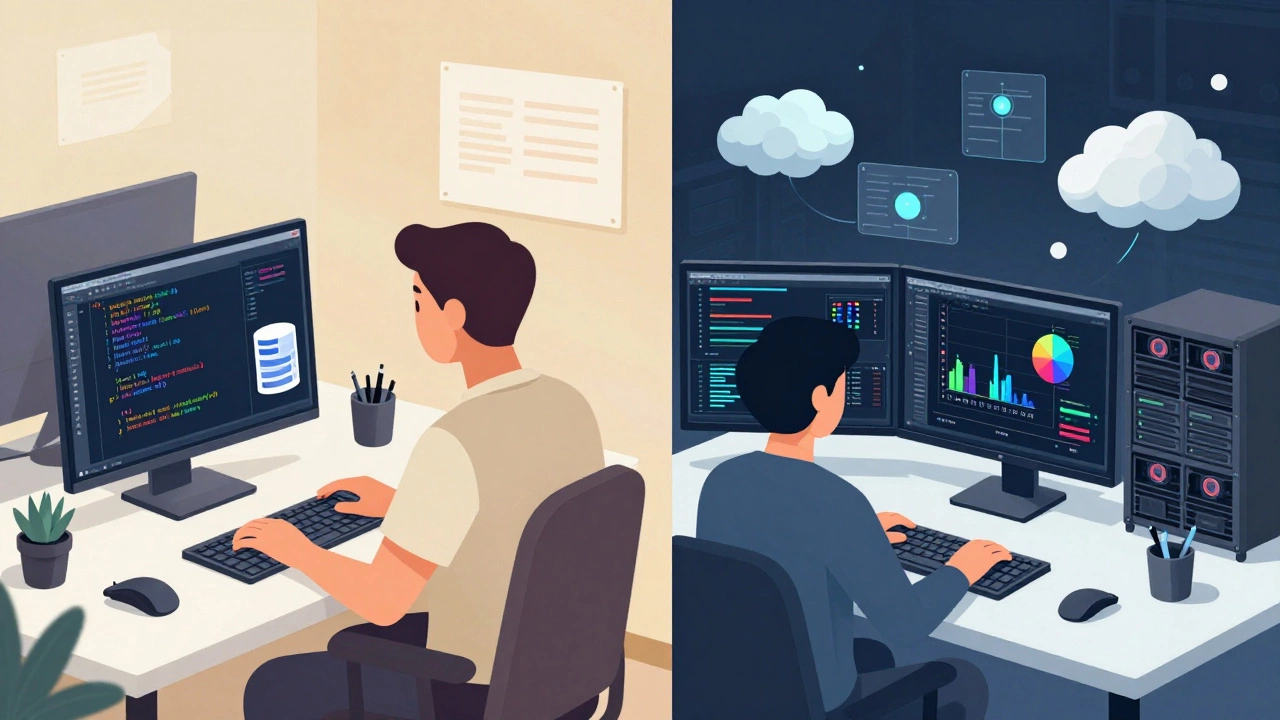
To understand which is better for you, you first need to understand what you’re actually doing. A Full Stack Developer is a software engineer who handles both the front-end (what users see) and back-end (server-side logic) of an application. You take a feature request-say, a "checkout button"-and you build it from start to finish. You write the HTML/CSS, handle the API calls, manage the database entry, and ensure the payment gateway connects correctly. The outcome is deterministic: if the code runs, the button works.
An AI/ML Engineer is a specialist who designs algorithms that learn from data to make predictions or decisions without explicit programming. You don’t build a "checkout button." You might build a model that predicts whether a user will abandon their cart based on their browsing history. The outcome is probabilistic: the model isn’t "right" or "wrong" in a binary sense; it has accuracy, precision, and recall metrics. You spend less time writing traditional logic and more time cleaning data, tuning hyperparameters, and evaluating statistical significance.
This fundamental difference dictates your daily life. Full stack developers solve immediate problems with concrete tools. AI/ML engineers explore uncertain spaces with mathematical frameworks.
Skill Set Comparison: What Do You Actually Need?
The barrier to entry differs significantly between these two paths. Here is a breakdown of the core competencies required for each role in the current market.
| Category | Full Stack Developer | AI/ML Engineer |
|---|---|---|
| Primary Languages | JavaScript, TypeScript, Python, Go, Rust | Python, R, SQL, C++ (for optimization) |
| Key Frameworks | React, Vue, Node.js, Django, Spring Boot | TensorFlow, PyTorch, Scikit-learn, Hugging Face |
| Data Handling | SQL databases (PostgreSQL), NoSQL (MongoDB) | Data lakes, Spark, Pandas, Data pipelines |
| Math Requirement | Basic algebra and logic | Linear algebra, calculus, probability, statistics |
| Infrastructure | Docker, Kubernetes, AWS/Azure services | GPU clusters, MLOps tools (MLflow, Kubeflow) |
Notice the math requirement? This is the biggest filter for AI/ML roles. You don’t need to be a mathematician, but you must be comfortable with vectors, matrices, and statistical distributions. If those terms make your head spin, full stack development is likely a much smoother ride. In full stack, you can build complex systems using existing libraries without ever touching a derivative. In AI/ML, understanding the underlying math helps you debug why a model isn’t converging.
Salary Expectations and Job Market Reality
Let’s talk money, because that’s often the deciding factor. Historically, AI/ML roles commanded higher salaries due to scarcity. In 2026, that gap has narrowed slightly but remains significant for senior roles.
A mid-level Full Stack Developer in major tech hubs typically earns between $110,000 and $150,000 annually. Senior engineers at top-tier companies can push $200,000+ with equity. The job market is robust because every company needs websites, apps, and internal tools. There is constant demand for people who can ship features reliably.
A mid-level AI/ML Engineer often starts higher, ranging from $140,000 to $180,000. Senior specialists working on large language models or computer vision can exceed $250,000. However, the job pool is smaller. Not every company has the data infrastructure or use cases to justify hiring dedicated ML engineers. Many startups now rely on pre-built APIs (like OpenAI or Anthropic) rather than building custom models from scratch, which has reduced the number of pure ML engineering roles compared to the 2021-2023 boom.
Here’s the catch: AI/ML roles are more volatile. When the hype cycle dips, layoffs hit this sector harder. Full stack roles are more recession-resilient because maintaining existing software is always cheaper than rewriting it.
Day-to-Day Life: Debugging Code vs. Tuning Models
Your daily routine will shape your job satisfaction more than your salary. As a full stack developer, your day might look like this:
- Morning stand-up to discuss sprint priorities.
- Spending three hours debugging a race condition in a React component.
- Writing unit tests for a new API endpoint.
- Deploying a hotfix to production and monitoring logs.
The feedback loop is fast. You change code, you refresh the page, you see the result. If it breaks, you know exactly why. The satisfaction comes from seeing tangible progress. You built something that didn’t exist yesterday.
As an AI/ML engineer, your day might look like this:
- Cleaning a messy dataset that contains missing values and outliers.
- Running a training job on a GPU cluster that takes six hours.
- Analyzing confusion matrices to understand why the model misclassifies certain inputs.
- Collaborating with data scientists to refine feature engineering strategies.
The feedback loop is slow. You might run an experiment for days only to find it performed worse than the baseline. The satisfaction comes from intellectual discovery-finding a pattern in chaos that others missed. But it can also lead to frustration when results are ambiguous.
The Impact of Generative AI on Both Roles
You can’t discuss this topic in 2026 without addressing generative AI. Tools like GitHub Copilot, Cursor, and specialized LLMs have changed how we work. Does this make either role obsolete? No. It makes them more efficient.
For Full Stack Developers, AI acts as a super-powered autocomplete. You can generate boilerplate code, write tests, and even refactor entire modules in seconds. This doesn’t replace the developer; it elevates them. You spend less time typing syntax and more time designing architecture and solving business logic problems. The bar for entry has risen slightly-you need to know how to review AI-generated code critically-but the overall productivity boost is massive.
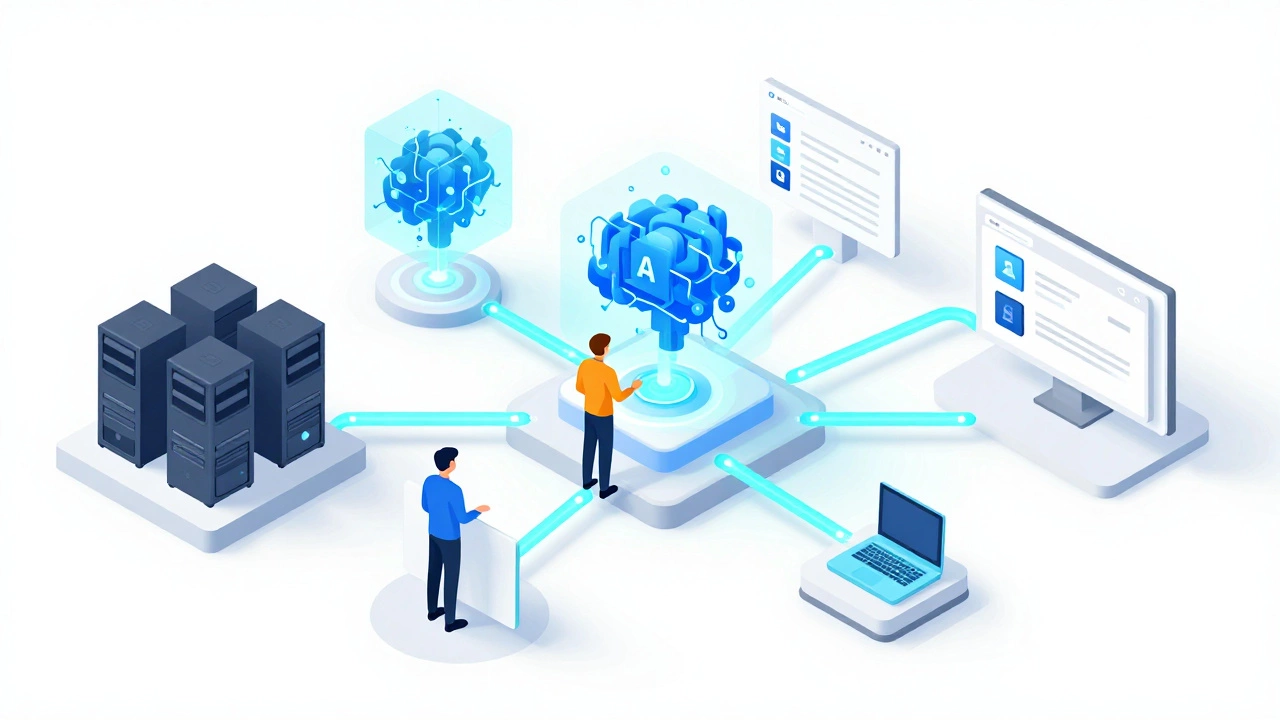
For AI/ML Engineers, the impact is deeper. Pre-trained models have commoditized many traditional ML tasks. You no longer need to train a basic image classifier from scratch; you fine-tune an existing model. This shifts the role from "model builder" to "AI integrator." The value is no longer just in creating the algorithm, but in deploying it safely, ensuring it doesn’t hallucinate, and integrating it into a larger system. This actually blurs the line between the two roles. Many full stack developers are now adding AI features to their apps, while AI engineers need to understand deployment pipelines.
Which Path Should You Choose?
So, which is better? It depends on your personality and long-term goals. Ask yourself these questions:
Do you prefer certainty or exploration? If you like clear requirements and definite outcomes, choose full stack. If you enjoy experimentation and dealing with uncertainty, choose AI/ML.
How do you handle math? If linear algebra and statistics excite you, AI/ML is a great fit. If you’d rather avoid calculus, stick to full stack.
What kind of impact do you want? Full stack developers build the digital world’s infrastructure. AI/ML engineers build the intelligence layer on top of it. Both are critical. However, full stack offers more job security and broader opportunities across industries. AI/ML offers higher ceiling salaries but narrower opportunities.
A pragmatic approach? Start with full stack. Build a strong foundation in software engineering principles, databases, and system design. Then, specialize in AI/ML later. It’s much easier for a skilled full stack developer to learn machine learning than for a pure data scientist to learn how to deploy scalable web applications. The hybrid "AI Engineer" who can both build models and deploy them as production-ready APIs is the most valuable profile in the market right now.
Is it hard to switch from full stack to AI/ML?
It is challenging but achievable. The main hurdle is the math and statistics background. Most full stack developers lack formal training in linear algebra and probability. However, since you already know Python and how to structure code, you can bridge the gap by taking online courses in machine learning fundamentals and focusing on practical applications like NLP or computer vision. Many successful transitions happen over 12-18 months of dedicated study.
Will AI replace full stack developers?
No, AI will not replace full stack developers entirely. While AI can generate code snippets and boilerplate, it struggles with complex architectural decisions, understanding nuanced business requirements, and debugging intricate system interactions. Full stack developers will shift from writing code manually to curating and integrating AI-generated solutions, making them more productive rather than redundant.
Do I need a Master's degree for AI/ML roles?
Not necessarily. While a Master’s or PhD was common in earlier years, the industry now values practical experience and portfolio projects. Many companies hire self-taught engineers who have demonstrated proficiency with frameworks like PyTorch or TensorFlow through open-source contributions or personal projects. That said, advanced research roles still require academic credentials.
Which role has better job security in 2026?
Full stack development generally offers better job security. Every business needs maintainable software, and there is a consistent demand for engineers who can build and support web applications. AI/ML roles are more cyclical and tied to specific technological trends. When a particular AI hype fades, demand for those specific skills can drop sharply, whereas full stack skills remain perpetually relevant.
Can I work as both a full stack developer and an AI engineer?
Yes, this hybrid role is increasingly common and highly valued. Companies need engineers who can not only build machine learning models but also integrate them into user-facing applications with proper APIs, security, and scalability. This "MLOps" or "AI Engineering